Expert Note: Reviewed by Hobbite’s PhD optical engineering team (ISO 14001:2015 / ISO 9001:2015 certified). With over 20 years in precision optical design and custom solutions, we bridge theory with high-precision practice.
- Technical Review: Optical Technology Department
- Last Updated: 2026-3-10
Summary: This update provides a more in-depth analysis of the principles of collimating lenses and incorporates optical path demonstrations of Gradient-Index (GRIN) lenses and the Chinese C-lens to make the collimation feature more concrete.
In any real-world optical system, light rays rarely propagate in a perfectly parallel manner. Whether the light originates from a laser diode, an LED, or the end face of an optical fiber, as long as the light source has a finite size and a nonzero divergence angle, the beam will inevitably spread out as it travels. For instance, a typical laser diode may exhibit a fast-axis divergence of 20°–40° and a slow-axis divergence of 5°–10°, while an LED often has a much larger divergence of 30°–120°. Even light emerging from a single-mode fiber exhibits a residual divergence depending on the fiber mode field diameter.
The core purpose of a collimating lens is to control this divergence and shape the beam for predictable propagation. Essentially, the lens redirects the originally diverging rays into a near-parallel beam, minimizing the residual divergence angle and producing a more uniform beam profile. This transformation is crucial: a poorly collimated beam not only increases spot size and reduces power density over distance, but also decreases coupling efficiency in fiber-optic systems, reduces measurement accuracy in laser-based sensors, and leads to uneven illumination in machine vision or inspection applications. Next, we will take you through a more comprehensive understanding of collimating lenses
Why Does Optical Collimation Matter?
In practical applications, beam divergence is often a major cause of performance instability. Once a beam diverges, the spot size rapidly increases with distance, the power density decreases, and the beam direction becomes much harder to control.
- Spot: The spot refers to the bright area formed when a beam hits a surface. It can also be understood as the distribution range of light energy on that surface. The more concentrated the beam, the smaller and clearer the spot usually is.
- Power Density / Energy Density: This refers to the amount of light energy or optical power per unit area. Simply put, it’s about “how much area the same light energy is concentrated into.” The smaller the spot, the higher the power density typically is.
In an optical lab, this might just mean difficulty aligning the beam. But in real-world applications, a diverging beam often leads to more serious problems, such as reduced optical efficiency, a lower signal-to-noise ratio, or even causing the end device to malfunction.
For example, in the optical communication industry, if the beam emitted from an optical fiber end face cannot be effectively collimated, it’s very difficult to stably couple it into the next optical component. For laser measurement or scanning products, an excessive divergence angle directly limits the measurement distance and accuracy. In seemingly simple applications like pointing or illumination, if beam divergence isn’t controlled, the resulting spot is often blurry, and energy is wasted.
Therefore, collimation is about making the beam’s propagation more stable, predictable, and usable for a well-designed system.

What is a Collimating Lens?
Functionally, a collimating lens is an optical element used to convert a diverging beam into an approximately parallel beam. It is typically placed at a specific position near the light source so that the rays emitted from the source propagate in as uniform a direction as possible after passing through the lens.
It’s crucial to emphasize that “collimation” in the optical sense doesn’t mean achieving theoretically perfect parallel light. Due to factors like the size of the light source, lens aberrations, and diffraction effects, real-world beams will always have a certain residual divergence angle.
Therefore, in practical optical design, the goal of collimation isn’t absolute parallelism, but rather to make the beam divergence angle sufficiently small and the spot shape sufficiently stable over the required working distance.
How Does a Collimating Lens Work?
Understanding how a collimating lens works comes down to understanding the light’s origin and path. According to geometric optics principles, when a point light source is placed at the focal point of a lens, the rays refracted by the lens will propagate in approximately parallel directions. This is the most typical operating state of a collimating lens.
Optically speaking, when light travels from air into a specific lens material, it refracts because the material has a different refractive index. The curvature of the lens surface (the “convexness”) changes the refraction angle for rays hitting different positions, gradually steering the originally diverging rays toward a common direction after they leave the lens.

If a point source is placed exactly at the lens’s focal point, rays from the source at different angles are refracted after passing through the lens, forming an approximately parallel beam. This is the most common type in collimation applications. Other types, such as Gradient-Index (GRIN) lenses, work on similar principles and achieve ray bending through a gradual change in refractive index.
However, in real applications, the light source is rarely an ideal point source. It usually has a certain size and divergence angle. Therefore, even with a collimating lens, the output beam will still have some residual divergence. The goal of optical design isn’t necessarily to achieve 100% parallelism, but to get a sufficiently stable beam within the working distance range.
The Impact of Light Source Characteristics on Collimation
In any optical system, the characteristics of the light source itself have a direct impact on collimation quality. Different sources possess unique divergence angles and physical dimensions, which ultimately determine the residual divergence of the beam after it passes through a collimating lens.
Laser Diodes (LDs) typically exhibit asymmetric divergence: a “fast axis” (usually 20°–40°) and a “slow axis” (roughly 5°–10°). Without proper control, the output beam becomes elliptical rather than circular, leading to uneven intensity in downstream optical components. LEDs, on the other hand, generally have much wider divergence angles (30°–120°). Their multi-point emission nature makes it significantly harder to achieve a narrow, highly collimated beam. For fiber-coupled outputs, mode field matching is the critical factor. Poor matching can lead to a 5%–20% drop in coupling efficiency, which severely compromises system stability.
Consequently, light source characteristics must be the primary consideration when designing or selecting a collimating lens. A thorough analysis of divergence, source size, and beam shape is essential to ensure maximum stability and uniformity. In technical manuals or articles, it is highly recommended to include diagrams illustrating the transition from divergent light to a collimated beam for better visual clarity.
The Impact of Lens Parameters on Collimation Quality
The focal length, Numerical Aperture (NA), and surface curvature of a collimating lens are the primary factors that dictate beam performance. Generally, a longer focal length results in lower residual divergence, though it also increases the overall system length. For instance, within the typical focal length range of 5–50 mm, the residual divergence angle can generally be controlled between 0.5° and 5°, depending on the characteristics of the light source.
Numerical Aperture (NA) determines the lens’s ability to capture divergent light. A higher NA allows for more efficient collection of wide-angle light—making it ideal for high-divergence sources like laser diodes—and helps produce a more uniform beam spot. However, a high NA also places stricter demands on aberration control.
Regarding lens types:
Spherical Lenses: These offer excellent cost-efficiency for low-to-mid NA applications. However, in high-precision or high-NA scenarios, they tend to introduce spherical aberrations, which can degrade beam parallelism.
Aspherical Lenses: These are the preferred choice for laser collimation and fiber coupling, as they effectively minimize aberrations and deliver superior beam quality.
GRIN (Gradient-Index) Lenses: These control light through variations in the refractive index, offering significant advantages in compact system designs.
Furthermore, manufacturing precision and surface quality are vital for far-field beam stability. Any surface errors, decentration (center deviation), or non-uniform coatings can lead to spot distortion or increased divergence. In high-performance systems, even if the focal length and NA are correctly specified, poor manufacturing quality will prevent the system from reaching its ideal collimation potential.
In conclusion, selecting lens parameters is not about optimizing a single variable, but rather a comprehensive trade-off between source characteristics, system constraints, and application requirements. In fields such as optical communications, laser metrology, and precision sensing, the key to high-quality collimation lies in the precise matching of focal length, NA, and lens geometry.
Collimation Errors and System Stability
Collimation quality does not rely solely on the lens itself; it is also heavily influenced by system installation and the precise positioning of the light source. Any minute displacement of the light source relative to the lens’s focal point—even as small as 0.05–0.1 mm—can cause the beam to shift direction, distort the spot shape, and increase residual divergence.
In multi-lens systems, minor lens tilts or mechanical assembly errors can compound, significantly degrading beam parallelism and compromising the overall stability and performance of the optical system.
To ensure high-precision collimation, an integrated design approach is required—one that considers the lens, light source, and mechanical housing as a single unit. Effective engineering measures for error control include:
- Fine-adjustment mounts: Allowing for sub-millimeter alignment of optical components.
- Precision fixtures: Ensuring consistent positioning during assembly.
- Defined system tolerances: Setting realistic mechanical limits to balance performance and manufacturing costs.
During the design and alignment phases, it is highly recommended to utilize optical path diagrams or beam schematics to analyze error propagation paths. These tools provide a clear, visual understanding of how each individual factor influences the final beam parallelism and spot quality.
How the C-Lens (China Lens) Works
In China, another popular collimating lens is the C-lens, which can stand for Collimating Lens or China Lens. This homegrown product is essentially a classic spherical lens that has been highly optimized.
Its optical mechanism is based on the classic principle of refraction: the lens material is optically uniform (N-SF11 is very common), meaning its refractive index is constant throughout. The beam transformation relies entirely on the precisely machined spherical curvature of the lens surface. As light passes through this curved interface, it bends according to Snell’s Law, achieving functions like focusing or collimation.
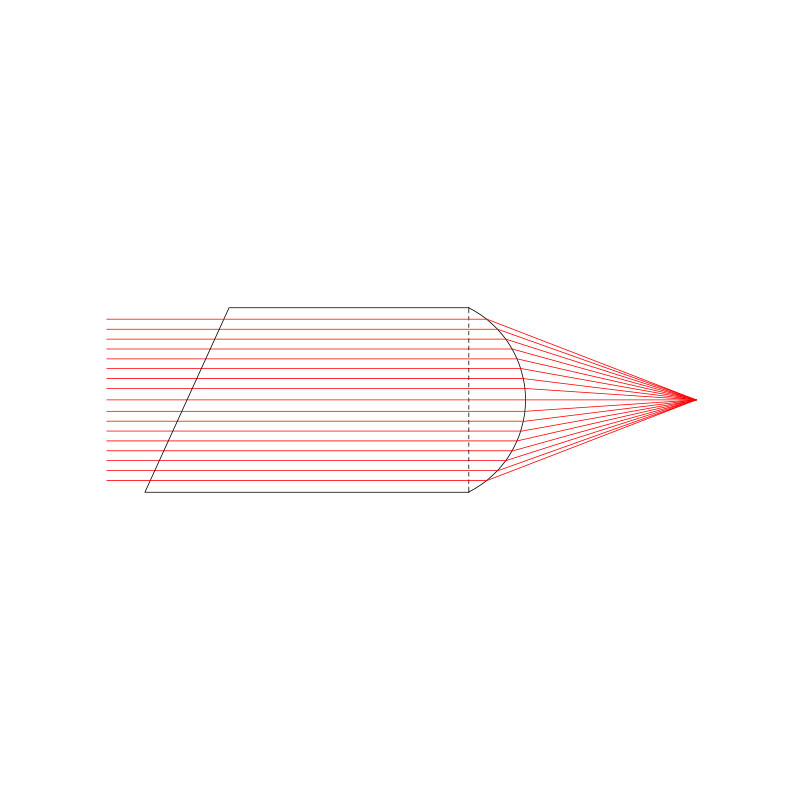
Its performance is determined by the surface accuracy, surface quality, centering error, and coating quality of the spherical surface. This lens represents a high-performance breakthrough in fundamental Chinese manufacturing processes. As a cost-effective alternative to GRIN lenses, it is frequently used in China’s optical communication and laser industries.
Is a Collimating Lens Just a Convex Lens?
In many basic textbooks, a collimating lens is often simply described as a convex or spherical lens. This statement isn’t entirely wrong at a conceptual level, but from an engineering design perspective, it’s oversimplified and ignores crucial details.
Most collimation systems indeed use positive focal length lenses, but not every convex lens is suitable for collimation. What truly determines collimation performance is the lens’s ability to control aberrations under specific conditions of numerical aperture (NA), operating wavelength, and beam size.
In high-NA or miniaturized applications, traditional spherical lenses often produce significant spherical aberration, preventing rays at different heights from meeting the required parallelism. Therefore, in applications like laser diode collimation or fiber coupling, aspheric collimating lenses have perhaps become one of the most common solutions.
What Factors Determine Collimation Quality?
Collimation quality isn’t something guaranteed just by installing a lens. First and foremost is the divergence characteristic of the light source itself. For instance, a laser diode typically has different divergence angles in its fast axis and slow axis, which directly affects the shape of the collimated beam. Next are the lens’s focal length and numerical aperture – these parameters determine the range of divergence angles the system can accept.
Furthermore, the lens surface shape, manufacturing precision, and assembly errors all impact the final beam quality. In high-performance systems, collimation design often isn’t just about a single lens; it requires an integrated design approach combining the source, optics, and mechanical structure.
The Specific Roles of Collimating Lenses in Various Applications
Collimating lenses play a critical role across diverse optical systems, directly determining the stability and controllability of the light beam in downstream modules.
In laser ranging and scanning systems, the beam’s residual divergence impacts both measurement accuracy and scanning resolution; even a minor increase in divergence can lead to significantly higher measurement errors. In fiber optic communication, collimating lenses serve as the essential interface between the optical fiber and free-space optical paths. Their performance directly affects coupling efficiency and signal stability. For instance, when a light source is precisely aligned with the lens’s focal point, fiber coupling efficiency can improve by 5%–15%, ensuring reliable data transmission.
For machine vision, industrial inspection, and structured light illumination, a collimated beam provides a stable and uniform spot. This ensures consistent intensity distribution, which is essential for enhancing measurement and imaging precision. By optimizing lens type, focal length, and numerical aperture (NA) while accounting for specific light source characteristics, collimating lenses ensure predictable beam propagation across various scenarios, establishing a stable foundation for the entire optical system.
Typical Applications of Collimating Lenses
In many optical systems, the collimating lens serves as the primary critical element in the optical path, establishing the foundational beam quality for all subsequent modules. Analyzing its function in real-world applications underscores its pivotal role in overall system performance.
In laser systems, collimating lenses transform divergent beams from laser diodes into stable, near-parallel light. Depending on the configuration, residual divergence can be minimized to under 1°, yielding a high-precision source for expansion, shaping, or scanning modules.
In fiber-optic communications, the lens acts as a vital interface between the fiber’s mode field and free-space optics. Precise alignment facilitates superior coupling—potentially boosting efficiency by 5–15% while ensuring signal integrity across the system.
In machine vision and industrial inspection, collimated beams are essential for structured light or uniform illumination. By delivering parallel light, these systems achieve consistent intensity, mitigating measurement or detection errors. For instance, enhanced uniformity of 10–20% significantly improves the accuracy and repeatability of visual inspections.
Characteristics of the Chinese C-Lens (CLens)
In the laser and optical communication fields, the C-Lens (referring to a cylindrical lens or a collimating lens assembly) has become a common optical component. In recent years, Chinese-made C-Lenses have gained significant importance in the global optical supply chain.
Chinese C-Lenses typically have several notable characteristics. First, in terms of manufacturing processes, many factories have achieved high-precision molded glass or precision grinding, ensuring the accuracy and stability of the lens surface shape. Second, in terms of cost and mass production, China’s optical manufacturing ecosystem has strong industrial support, allowing CLenses to offer high performance at a competitive price.
Furthermore, the design of Chinese CLens products is also advancing towards higher performance, and they are widely used in LiDAR, optical communication modules, laser rangefinders, and industrial sensing systems. As laser applications continue to expand, the CLens has become an indispensable key component in many optical modules.
Conclusion
The collimating lens transforms an unpredictable, diverging beam into a beam state that can be designed, calculated, and adjusted, thereby providing a stable input condition for the entire optical system. It is this capability that makes collimating lenses ubiquitous, yet often overlooked, in modern optical equipment. Understanding the collimating lens is a key step in understanding how an optical system transitions from a simple light source to a functional module.
Common Pitfalls and Engineering Tips
In practical optical engineering, several misconceptions persist regarding collimating lenses.
Parallelism vs. Divergence: Collimation does not imply that a beam must be perfectly parallel. The engineering goal is to ensure the beam maintains a sufficiently low residual divergence within its intended operating range.
Lens Selection: Aspheric lenses are not a universal requirement for every system. However, they are often the superior choice for applications demanding high Numerical Aperture (NA), compact footprints, or stringent beam quality.
The Criticality of Alignment
Precise positioning of the light source is vital to system stability. Even a minor displacement of 0.05–0.1 mm can significantly distort the output spot shape or increase the residual divergence angle, which negatively impacts the performance of downstream optical components.
To achieve high-precision collimation and meet engineering requirements, it is recommended to:
- Analyze Error Propagation: Use optical path diagrams during the design phase to evaluate how installation errors from the source and lens affect the final beam.
- Implement Engineering Measures: Utilize fine-adjustment mounts, precision fixtures, and robust tolerance designs to ensure beam parallelism.
FAQ
Can a collimating lens produce perfectly parallel light?
No. Collimation in engineering means achieving a sufficiently small divergence angle over the target working distance, rather than perfectly parallel light.
Does a collimating lens have to be an aspheric lens?
Not necessarily. However, in systems requiring high numerical aperture, compact design, or high beam quality, aspheric lenses typically offer better performance.
Is the position of the light source important for collimation?
Yes, very important. A positional deviation of the light source relative to the lens’s focal point will significantly change the divergence angle of the output beam.
Can a collimating lens and a focusing lens be used interchangeably?
Optically, their function is reversible. However, whether they are suitable for interchange depends on the specific system design and aberration requirements.
When can a collimating lens be omitted?
A collimating lens can be omitted when the optical path distance is very short, the system is constrained, cost is a major factor, and beam divergence does not significantly affect performance.