In the field of optical communications, active devices are components that can actively generate or amplify optical signals, such as laser diodes (LDs) or photodetectors (PDs). They are responsible for converting electrical energy into optical energy or modulating optical signals. In contrast, passive devices do not generate light; they are only used to transmit, distribute, or filter optical signals, such as optical fibers, splitters, and filters. Optical components play a critical role between these two types of devices, using structures like lenses, prisms, or filters to control the path and shape of light, ensuring that optical signals can be transmitted efficiently and stably between active and passive devices.
In practical use, active devices provide the source of light and signal changes, passive devices are responsible for light transmission and distribution, and optical components ensure that beams can be collimated, focused, or shaped, thereby guaranteeing the performance of the entire system. Without optical components, even with a high-power laser source or a high-performance receiver, the optical signal may not be effectively utilized due to divergence, poor coupling, or distortion. This article will guide you through the principles of active and passive devices and their relationship with optical components.
What Are Active Optical Devices?
The Role of Energy Conversion
The core characteristic of active devices is that they can actively change the state of an optical signal, which requires an external energy input as a driver. The most common form is converting electrical energy into optical energy. For example, a laser diode (LD) injects current into a semiconductor PN junction to produce stimulated emission, thereby generating a highly coherent, directionally controllable beam. Another type is the photodiode (PD), which converts an incoming optical signal back into an electrical signal, completing the closed loop of optoelectronic conversion. In some applications, active devices can also amplify or modulate optical signals, such as an erbium-doped fiber amplifier (EDFA) providing gain compensation to weak optical signals, or directly modulating the intensity, phase, or frequency of light to transmit information.
These types of devices are not only the starting point of an optical signal or the core of signal processing but also determine the basic performance indicators of the system, including output power, signal bandwidth, modulation rate, and noise characteristics. For example, in an optical communication module, the power and modulation response of the laser diode directly affect the transmission distance and data rate. In a laser processing system, the power stability and pulse characteristics of the laser source determine processing precision and efficiency.

Functional Characteristics
Although active devices can generate or amplify optical signals, they have clear limitations. First, even though light is generated, its spatial distribution and directionality do not automatically meet system requirements. An unshaped beam may diverge severely, leading to reduced coupling efficiency and increased signal transmission loss. Second, active devices cannot directly control the path or wavefront shape of light. This means that even if the output power is sufficient, the optical signal may not be effectively utilized because it has not been collimated, focused, or filtered.
Therefore, optical components are needed to address light-path problems such as collimation and focusing. An efficient optical system typically relies on active devices to provide power and modulation, combined with optical components for fine control, thereby ensuring that optical signals can be transmitted and processed stably and efficiently.
What Are Passive Optical Devices?
The Role of Light Transmission
Unlike active devices, passive devices do not require electrical power and do not actively generate or amplify optical signals. Their main function is to transmit, distribute, or filter optical signals, ensuring that light can flow stably and efficiently within the system. An optical fiber is the most typical passive device, capable of transmitting a beam over very long distances while maintaining low loss and good signal integrity. In optical communication systems, a splitter can evenly distribute a single optical signal to multiple channels for information distribution. A wavelength filter can select signals for specific bands, enabling the functionality of wavelength division multiplexing (WDM) systems.
The role of passive devices is not limited to signal transmission; they are also key components of system stability. In high-precision applications, such as optical sensors or laser ranging systems, the low-loss characteristics of optical fibers and filters maximize the maintenance of signal strength and waveform stability, avoiding performance degradation caused by signal attenuation or frequency aliasing.

Functional Characteristics
The advantages of passive devices are high stability and low loss, allowing them to reliably maintain the transmission of optical signals along complex paths. However, they also have clear limitations. First, passive devices cannot change the distribution or divergence angle of light. This means that even if the optical signal can reach its destination, its beam shape may not meet the requirements. For example, an uncollimated beam will have significantly reduced coupling efficiency at fiber interfaces or between optical devices, thereby lowering overall system efficiency. Second, passive devices cannot actively adjust the power or frequency of an optical signal, so they must rely on active devices to generate the required optical signal and on optical components to precisely control the beam.
Therefore, the combination of passive devices and optical components ensures that light is usable and controllable. In any high-performance optical system, passive devices and optical components typically work together to collectively convert the light generated by active devices into a truly usable signal, thereby meeting the precision requirements for information transmission, measurement, or processing.
Where Do Optical Components Fit In?
The Hidden Layer Inside the System
Optical components are typically not classified solely as either active or passive devices, yet they exist within both and play a critical role in the system. By nature, optical components act on the propagation of light, using refraction, reflection, or diffraction to precisely control the path, shape, and characteristics of a beam. Unlike active devices, which are responsible for generating or modulating light, or passive devices, which are responsible for transmitting light, the core duty of optical components is to ensure that optical signals are usable and controllable. They hold an irreplaceable role in optical systems.
Optical Components Inside Active Devices
Inside active devices, optical components determine whether the device can achieve high performance. For example, the light emitted by a laser diode typically has a large divergence angle. Without lenses or collimating optical structures to shape the beam, this light cannot efficiently enter subsequent optical or precision transmission systems. Similarly, on the receiving end, a photodetector must use optical components to focus light onto its effective receiving area; otherwise, signal loss or even failure to detect will occur.
It can be said that even with the most advanced active devices, without the cooperation of high-precision optical components, their optical performance is difficult to fully realize. Optical components play a key transitional role here, enabling the optical signals generated by active devices to smoothly move to the next stage of the system.
Optical Components Inside Passive Systems
Optical components are equally indispensable in passive devices. During fiber coupling, the coupling efficiency directly depends on the precision of beam alignment. This precision is not achieved by the fiber itself but relies on micro-lenses, collimators, or other optical structures. In a wavelength division multiplexing (WDM) system, the performance of filters or gratings also determines the effectiveness of signal separation, which is actually the optical components at work, not a function of the passive devices themselves.
Therefore, behind the stability and efficiency of a passive system, the fine control of optical components is always relied upon. It can be said that optical components are a core part of enabling passive devices to achieve efficient transmission and precise distribution.
How the Three Work Together in Real Systems
A System-Level View
From a system-level perspective, the collaboration of the three can be understood as a continuous yet interdependent process:
- The optical signal is first generated by an active device, but the initial beam is often divergent and cannot be used directly.
- Optical components collimate, shape, or focus the light so that it can meet optical technical requirements.
- The optimized light then enters a passive device for stable transmission or path distribution.
- During transmission, optical components continue to participate, such as in coupling, filtering, or wavelength control.
- Finally, the optical signal reaches the receiving end, where an active device completes detection and conversion, forming a closed loop.
Functional Interdependence
From a functional division perspective, a clear but inseparable relationship exists among the three:
- Active devices: Responsible for generating and modulating optical signals; they are the energy entry point of the system.
- Passive devices: Provide low-loss transmission and distribution paths, ensuring stable signal propagation.
- Optical components: Control the beam shape, making the light regular and usable.
This process is interlocking, with multiple components working together. Any deviation in one part will be amplified and affect the overall performance.
Common Optical Components and Their Roles
Among passive and active components, commonly used optical components are not only diverse in form but also have varied functions.
Lenses
Lenses are used for collimation, focusing, beam expansion, or imaging. They are the most basic and most common optical components. Spherical lenses are suitable for simple focusing and imaging tasks but are prone to aberrations under large apertures or high-precision requirements. Aspheric lenses can effectively reduce spherical aberration, allowing the beam to focus more precisely. Cylindrical lenses are used for line beam shaping, such as in laser scanning or line light projection. Lenses are critical at both the output end of active devices and the coupling end of passive devices, directly affecting coupling efficiency and system precision.

Prisms
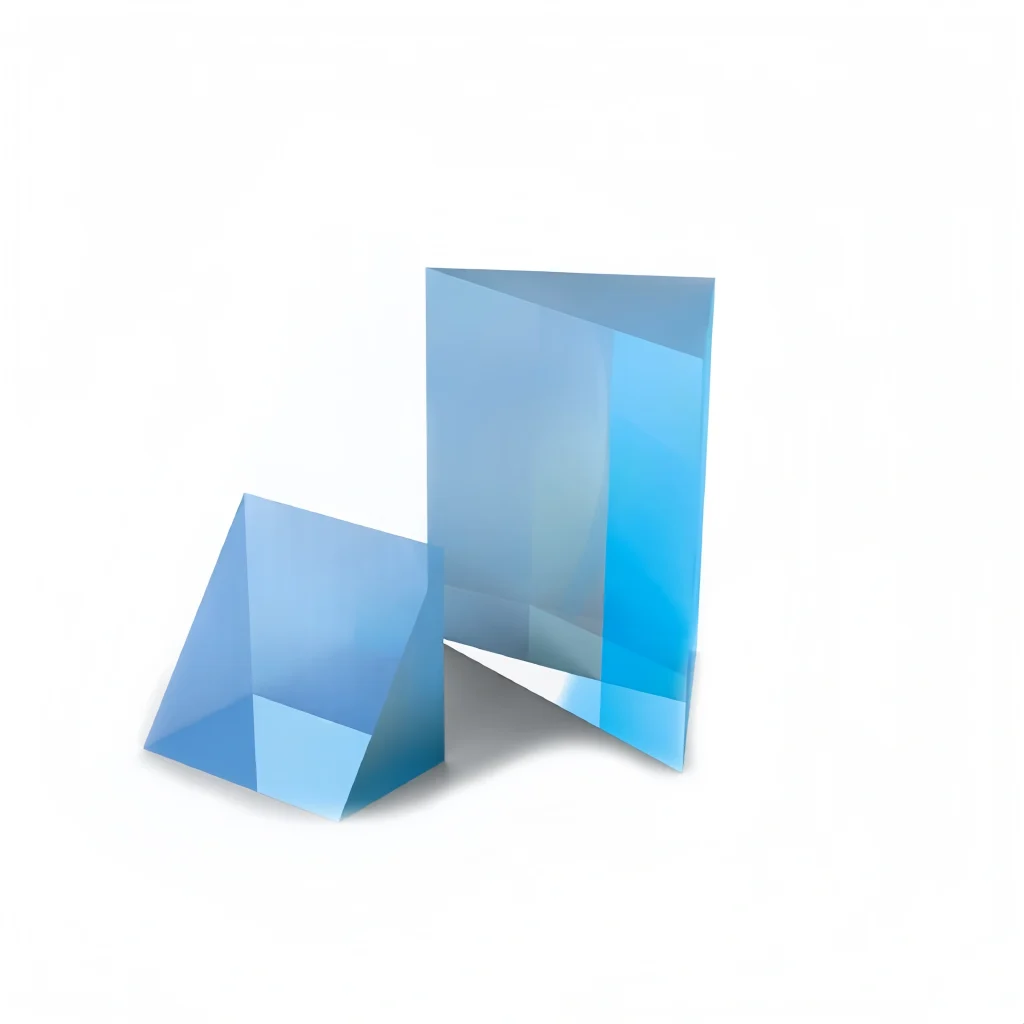
Prisms change the direction of light propagation through refraction or total internal reflection, enabling optical path deflection, beam splitting, or a combination. In optical communications, prisms can separate light of different wavelengths for wavelength division multiplexing (WDM). In laser scanning systems, prisms can achieve precise deflection, allowing the beam to scan a target at specific angles.
Optical Filters
Filters are used to select light of a specific wavelength, suppress background stray light, and improve signal purity. In optical communication systems, they are used for signal selection in WDM channels. In spectral analysis or laser ranging, filters ensure that the detector receives only the target wavelength, improving measurement accuracy.

Optical Windows
Optical windows are used to protect the internal optical path of a device while ensuring beam transmission without loss or interference. High-quality windows can reduce reflection loss and prevent dust and environmental contamination from affecting the optical signal. They are indispensable components in high-power laser systems and precision optical instruments.

Mirrors
Optical mirrors reflect light to change the direction of the optical path, used for folding the optical path or extending the optical distance. Metal mirrors and dielectric mirrors are selected based on application requirements. Metal mirrors are suitable for a wide band of light, while dielectric mirrors can achieve high reflectivity and low loss. Mirrors are very common in optical alignment, laser cavity design, and complex optical path layouts.

Fiber Couplers / Collimators
These devices are used to efficiently couple a beam into an optical fiber or device, ensuring the efficiency and stability of signal transmission. A collimator can shape a divergent beam into a parallel beam, while a coupler optimizes the match of the beam entering the fiber core, thereby maximizing transmission power and reducing loss.

Adjustable Optical Components
These include adjustable lenses, rotatable prisms, or tunable filters. They are used for precise optical path correction or system performance optimization. They are widely used in research instruments, laser interferometry, and optical measurements, achieving precise control of system performance by fine-tuning the direction and shape of the beam.
These optical components enable optical signals to be collimated, shaped, distributed, and efficiently utilized between active and passive devices. Their design precision, material selection, and processing quality are very important. Choosing the right optical component supplier is a critical step in the procurement process. Hobbite has a 10-year production history, collaborates with customers globally, serves diverse industries, and provides one-on-one customization capabilities based on industry needs.
Conclusion
In summary, active devices generate light, passive devices transmit light, and optical components make light usable. Typically, in a high-performance optical system, all three work together to achieve better performance.