Laser Protective Optical Window Selection Guide: Fused Silica, Sapphire & N-BK7/K9
In high-power laser applications—whether for industrial cutting, precision welding, or optical sensing—the protective optical window is far more than a simple optical barrier. Choosing an incorrect substrate or sub-par coating can lead to severe thermal lensing, beam deviation, or catastrophic surface destruction under high laser-induced damage threshold (LIDT) operational conditions.
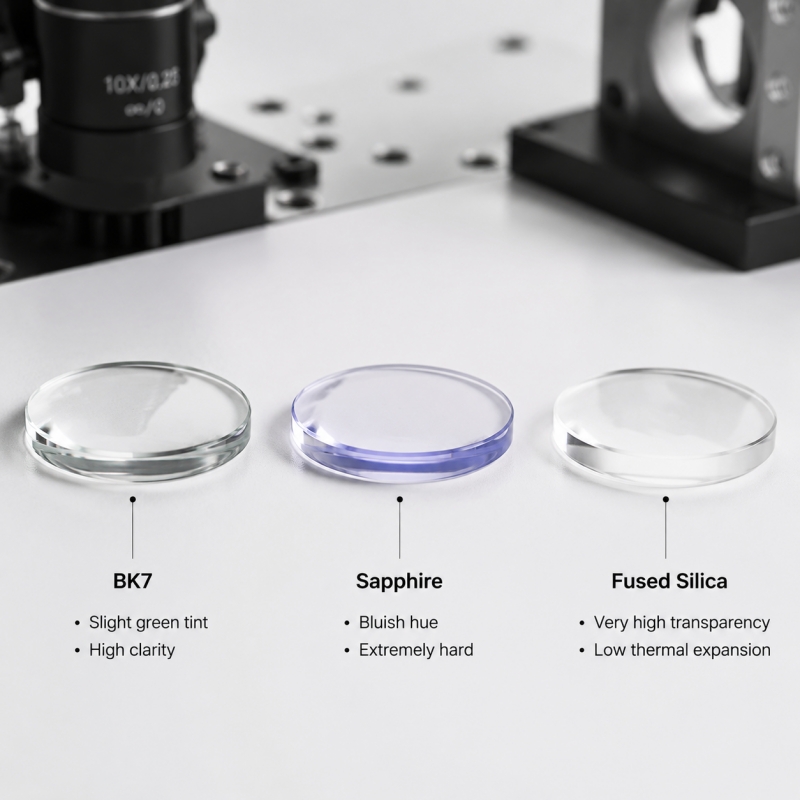
When designing or replacing protective windows for precision laser optics, engineering teams typically evaluate three primary optical substrates: Fused Silica (JGS1/JGS2), Sapphire, and Optical Glass (N-BK7/K9). Each substrate presents specific trade-offs in thermal stability, mechanical durability, and overall unit cost. Here is a practical field breakdown to help you select the right material for your custom optical window requirements.
Quick Comparison: Laser Window Substrates

The table below summarizes the key optical and physical properties of common laser window substrates:
| Feature / Parameter | Optical Glass (N-BK7 / K9) | Fused Silica (JGS1 / JGS2) | Sapphire (Al₂O₃) |
|---|---|---|---|
| Transmission Range | 350 nm – 2,000 nm | 185 nm – 2,100 nm (UV-NIR) | 170 nm – 5,500 nm (UV-IR) |
| Laser Damage Threshold (LIDT) | Moderate | High (Essential for High Power) | Very High |
| Thermal Expansion Coeff. | 7.1 × 10⁻⁶ / K | Very Low (0.5 × 10⁻⁶ / K) | 5.0 × 10⁻⁶ / K |
| Mohs Hardness | ~5.5 | ~6.5 | 9 (Extreme Scratch Resistance) |
| Relative Cost | Economy | Moderate | Higher |
Fused Silica (JGS1/JGS2): The Gold Standard

For industrial Fiber, YAG, or UV lasers, synthetic Fused Silica remains the most trusted substrate for protective optical windows.
Key Advantages
Minimal Thermal Lensing: Fused silica features an ultra-low coefficient of thermal expansion and exceptional thermal shock resistance. This minimizes thermal lensing—a severe phenomenon where localized heat absorption changes the refractive index of the glass, shifting the focal spot during continuous laser operation.
Substrate Grade Selection:
JGS1 (UV Grade): High purity, bubble-free, optimized for deep ultraviolet (DUV) and high-power precision optics.
JGS2 (Standard Grade): Excellent for near-infrared (NIR) applications such as 1064 nm industrial fiber lasers.
Typical Applications
Laser cutting & welding heads
High-power laser beam delivery systems
UV laser optics and precision optical sensors
Sapphire: Extreme Hardness & Broad IR Spectrum
When your laser optical train operates in severe mechanical conditions or requires broad spectral coverage, Sapphire provides unmatched physical ruggedness.
Key Advantages
Extreme Mechanical Durability: With a Mohs hardness of 9, sapphire is virtually scratch-proof under normal industrial operation.
Harsh Environment Tolerance: It withstands extreme mechanical pressure, abrasive debris, and harsh chemical environments while remaining transparent from deep UV through mid-wave infrared (MWIR).
Typical Applications
High-pressure industrial sight glasses
Debris-prone laser processing heads
Defense, aerospace, and IR sensor windows
Optical Glass (N-BK7 / K9): Cost-Effective Choice
For low-power alignment systems, laboratory setups, or cost-sensitive equipment, high-quality N-BK7 or K9 Optical Glass offers an economical balance of optical clarity and structural stability.
Key Advantages
Cost Efficiency: Delivers exceptional optical homogeneity and high transmission across the visible and NIR spectrums at a fraction of the raw material cost of sapphire or synthetic fused silica.
Typical Applications
Low-power laser diode windows
Industrial inspection optics
Non-critical protective covers
Key Manufacturing & Coating Tolerances
Selecting the raw substrate is only half the engineering equation. To prevent optical throughput losses or focal drift in precision setups:
1、Anti-Reflection (AR) Coatings: Uncoated glass reflects approximately 4% per surface. Applying custom V-coatings or Broadband AR (BBAR) coatings can boost total transmission to >99.5% at your operational laser wavelength (e.g., 532 nm, 1064 nm, or 10.6 µm).
2、Surface Quality (Scratch-Dig): High-power optics require 20-10 or 10-5 Scratch-Dig surface quality standards to eliminate localized energy hot-spots that could compromise the thin-film coating.
3、Parallelism & Flatness: Tight wedge and parallelism control (< 10 arcsec) prevents beam steering and optical deviation across long optical paths.
Hobbite Custom Optical Window Capabilities
At Hobbite, we provide comprehensive end-to-end support from prototype customization to high-volume production for custom optical windows and related precision optical components:
Substrate Inventory: We maintain immediate raw material stock across BK7/K9, JGS1/JGS2 Fused Silica, Sapphire, and IR materials to support rapid prototyping turnarounds.
Precision Machining & Coating: Complete customization on dimensions, steps, bevels, wedge angles, and high-LIDT AR coatings tailored to your specific operational wavelengths.
100% Quality Verification: Every production batch is verified using Zygo 3D interferometers for surface flatness/parallelism and spectrophotometers for spectral transmission before dispatch.
💡 Need a Custom Optical Window Quote or Technical Evaluation?
Whether you need replacement protective windows for an existing laser line or a custom substrate specification for a new design, Hobbite’s engineering team is ready to review your CAD or Zemax drawings.
👉 Contact Hobbite Engineers Today for a Fast Technical Evaluation & RFQ
Frequently Asked Questions (FAQ)
What is the main cause of thermal lensing in laser windows?
Thermal lensing occurs when an optical window absorbs a portion of the laser energy. The resulting temperature gradient alters the refractive index of the substrate and causes thermal expansion, creating an unintended lens effect that shifts the laser focal point.
How do I choose between JGS1 and JGS2 Fused Silica?
Choose JGS1 if your optical system operates in the deep ultraviolet (UV) spectrum or requires ultra-high optical purity with zero bubbles. Choose JGS2 for standard near-infrared (NIR) applications, such as 1064 nm industrial fiber lasers, where cost-efficiency and high thermal stability are balanced.
Why are Anti-Reflection (AR) coatings necessary for optical windows?
Uncoated optical substrates suffer from Fresnel reflection losses (~4% per surface). AR coatings reduce reflection losses, increasing total optical transmission to >99.5%, while preventing dangerous back-reflections into the laser cavity.
How do I know if my optical system requires Fused Silica instead of N-BK7 glass?
If your optical setup involves continuous high-power lasers (e.g., > 500W fiber lasers), UV wavelengths (< 350 nm), or tight focal stability requirements, Fused Silica (JGS1/JGS2) is mandatory. N-BK7 glass absorbs more laser energy at high power, leading to thermal expansion and thermal lensing that shifts your system’s focal point. For low-power alignment lasers, optical sensors, or visible spectrum inspection, N-BK7 / K9 remains a reliable, cost-effective choice.
What is “Thermal Lensing” in laser windows, and how can I prevent it?
Thermal lensing occurs when an optical window absorbs a portion of the high-power laser beam. This localized heat creates a refractive index gradient across the center of the glass, effectively turning the flat window into an unintended weak lens that shifts your focal point and degrades beam quality. You can prevent thermal lensing by:
Selecting substrates with extremely low thermal expansion coefficients, such as Synthetic Fused Silica (0.5 × 10⁻⁶ /K).
Applying high-efficiency Anti-Reflection (AR) coatings with high Laser-Induced Damage Threshold (LIDT) to minimize absorption.
When should I choose Sapphire over Fused Silica for an optical window?
Choose Sapphire when your laser window is exposed to severe mechanical abrasion, extreme pressure differentials, harsh chemical environments, or requires broad transparency extending into the Mid-Wave Infrared (MWIR up to 5.5 µm). While Fused Silica excels in high-power thermal stability, Sapphire’s Mohs hardness of 9 makes it virtually scratch-proof for severe field or debris-heavy industrial conditions.
What is the difference between JGS1 and JGS2 Fused Silica substrates?
JGS1 (Synthetic UV-Grade Fused Silica):Synthetic glass produced with high-purity precursors. It offers superior optical transmission in the Deep Ultraviolet (DUV) range down to 185 nm, is free of micro-bubbles, and is ideal for UV lasers and ultra-precision laser optics.
JGS2 (Infrared-Grade Fused Silica):Typically produced from natural quartz. It offers high transmission across the Visible and Near-Infrared (NIR) spectrums (up to 2,100 nm), making it the standard, cost-effective substrate for 1064 nm industrial fiber laser windows.
What surface quality (Scratch-Dig) spec is necessary for high-power laser optical windows?
For high-power laser application (such as industrial laser cutting or welding), a surface quality of 20-10 or 10-5 Scratch-Dig is highly recommended. Standard commercial optics (60-40 Scratch-Dig) contain microscopic surface defects that absorb laser energy, creating localized thermal hot spots that can cause AR coating breakdown and premature window destruction.
Why is Parallelism (Wedge Angle) critical for custom optical protective windows?
If an optical window’s front and back surfaces are not perfectly parallel (high wedge angle), the light passing through will refract slightly off-axis. In high-power laser processing or precision alignment systems, even a small wedge angle can displace the beam path over longer distances. Specifying a parallelism tolerance of < 10 arcseconds ensures zero unwanted beam steering.
Conclusion
Selecting the right optical window requires balancing laser power density, operating wavelength, environmental hazards, and total component budget. While BK7/K9 glass provides an economical choice for general optics, Fused Silica (JGS1/JGS2) remains the ultimate choice for high-power laser stability, and Sapphire provides unmatched ruggedness for harsh environments.
By partnering with an experienced optics manufacturer like Hobbite, you ensure that every custom window is precision-machined, correctly coated, and fully tested to meet your exact system requirements.