In the information world built upon optical fibers and lasers, the journey of light is not a straightforward path. Light emitted from an optical fiber is highly divergent and disordered, requiring a specialized component for effective control—the key element here being the collimating lens (C-Lens).
Within China’s high-end optical communication industry, the story of G-Lenses and C-Lenses is a familiar yet significant one. They represent not just two distinct technological paths, but also encapsulate the complete journey of China’s optical industry—from a position of catching up, to breaking barriers, and ultimately to innovation. In this article, Hobbite will guide you through understanding the C-Lens.
A Common Misconception
In technical literature and industry discourse, the term “C-Lens” is often confused with the “C-Mount” lens interface standard used in industrial vision. While both share the letter “C,” they are fundamentally different.
C-Mount is a widely adopted mechanical interface standard for industrial cameras and lenses. It defines physical connection specifications such as flange focal distance and thread specifications, ensuring compatibility between lenses and cameras from different manufacturers. Its concern is mechanical adaptation. The C-Lens we are discussing is a discrete optical component. Its core value lies in its spherical optical design and manufacturing precision. It can be integrated into various housings, such as C-Mount, SMA, Collimator, or even more complex custom packages, via adapters.
Their relationship can be likened to the following: C-Mount is a standardized socket system, whereas C-Lens is a specific optical element within the industry. The confusion stems from the similar abbreviation, but the former is a mechanical interconnection standard, and the latter is a core functional optical component, belonging to different layers of an opto-mechanical system.
The Fundamental Difference Between G-Lens and C-Lens
To appreciate the value of the C-Lens, one must first understand its essential distinction from the G-Lens. This is not a simple product iteration, but a divergence rooted in principles and materials.
What is a G-Lens?
Technical Name: A Gradient Index Lens (GRIN Lens), also known as a Selfoc Lens.


Principle:
Its core technology lies in the lens material possessing a precise, radially graded refractive index distribution: the refractive index changes continuously from the central axis to the edge according to a specific mathematical function. As light propagates through this medium, its path is not straight but naturally bends due to this continuous index change, tracing a periodic sinusoidal curve.
This characteristic allows the beam to periodically converge and diverge within the lens itself without relying on curved surfaces for refraction, enabling self-focusing or collimating functions.
Status & Challenge:
Due to its excellent collimation performance, G-LENS technology was long monopolized by Japanese and German firms, creating high technical barriers and commanding premium prices. It once represented a formidable gap for the domestic industry.
What is a C-Lens?
Brief Description: It is, in essence, a classically designed spherical lens pushed to its performance limits through optimization.
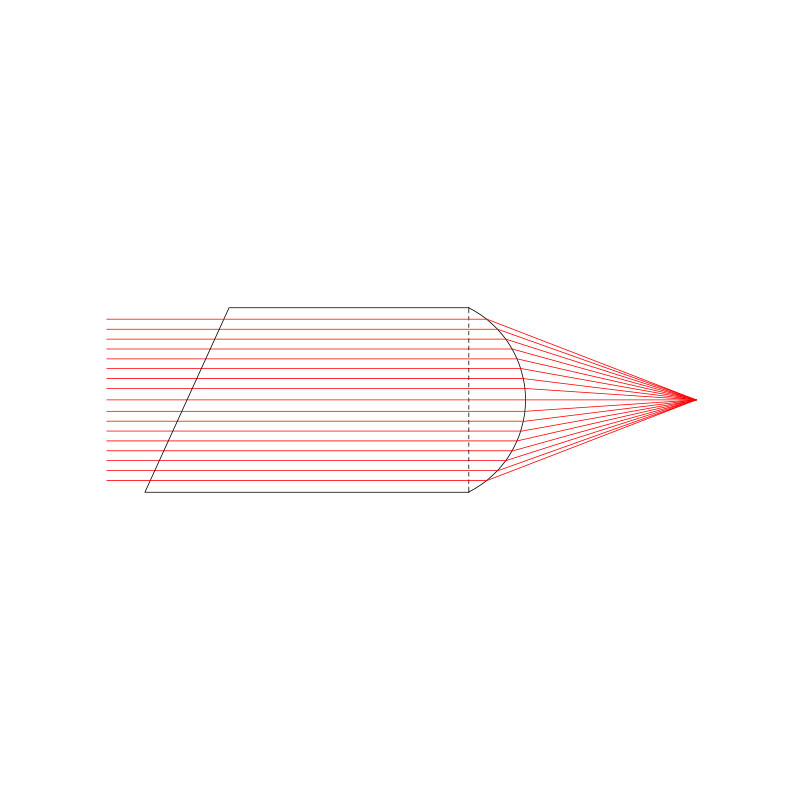

Principle:
Its optical mechanism is based on classic refraction principles. The lens material is an optically homogeneous medium with a constant refractive index throughout. Beam transformation relies entirely on the precisely fabricated spherical curvature of the lens surfaces.
When light passes through this curved interface, it bends strictly according to Snell’s Law of refraction, achieving functions like focusing or collimation. Its performance ceiling is determined by the surface form accuracy, surface finish, eccentricity accuracy, and coating quality of the spheres, embodying the pursuit of high performance by perfecting fundamental, mature technological pathways.
Significance of the Name:
The “C” in its name is widely recognized to carry a triple meaning:
- It represents the first letter of Casix (Fujian Casix Optronics Inc.), the company foundational to its industrialization
- It stands distinctly for China, bearing the mission of import substitution from its inception
- Fundamentally, it denotes its core function of Collimation
Why the C-Lens?
Confronted with the G-LENS monopoly, Chinese optical experts did not choose a head-on collision on the challenging turf of gradient material fabrication. Instead, innovators, led by figures like Professor Luo Yong, made a pivotal strategic decision: pragmatic innovation to break the deadlock by redefining the approach.
Precise Strategic Insight
They circumvented decades of accumulated material science expertise held by competitors. Instead, they focused efforts on the domains of precision optical design, ultra-precision machining, and coating—areas where domestic capability already had a foundation—pushing the performance of classic spherical lenses to meet or even exceed high standards.
Advantages of Targeting Market Needs
- Exceptional Cost-Effectiveness:
With more controllable manufacturing costs, C-Lenses achieved significant price reduction while meeting commercial-grade performance requirements. - Supply Chain Autonomy:
It eliminated dependence on imported products, ensuring supply security and enabling agile, customized responses for core components in the domestic optical communication, fiber optic sensing, and laser equipment industries. - Performance Niche:
Particularly in collimation applications requiring long working distances, C-Lenses demonstrated unique advantages like low insertion loss.
The success of the C-Lens acted like a precise wedge, prying open a crack in the monopolized market. It first satisfied the vast domestic demand for mid-to-high-end applications and forced down the prices of international monopoly products. More profoundly, it bought invaluable R&D time, market capitalization, and technical confidence for China’s optical industry.
From Substitute to Standard-Setter
The story of the C-Lens did not end at “substitution.” Its success triggered a series of positive industrial chain reactions, elevating its role from “breaking the game” to “defining the game.”
Reverse Breakthrough:
In a highly symbolic turn, Chinese companies (for example, Coherent, Hobbite, Casix, etc.) that accumulated capital and technology through C-Lens did not stop there. Building on this foundation, they subsequently invested in R&D to gradually master the manufacturing technology of the more challenging G-LENS.
Consequently, China can now offer not only the cost-effective C-Lens solution but also top-tier G-Lens solutions, achieving comprehensive supply chain autonomy.
High-End Applications:
The value of the C-Lens lies not only in commercial success but also in its reliability being validated under the most stringent conditions. It was employed in the laser ranging and velocimetry sensor of the Chang’e-5 lunar probe.
During this Earth-Moon journey, it withstood extreme environments while performing the critical task of precise optical path collimation. Its inclusion as a high-precision component in aerospace applications perfectly embodies its meaning as the “China Lens.”
Technical Details
8-Degree Angled Face:
The lens end face is often polished at an 8-degree angle. This is not for novelty or aesthetics but serves a critical function: to deflect the vast majority of reflected light away from the main optical path, significantly reducing back reflection and ensuring the stable operation of systems using laser sources.
Working Distance:
Based on the properties of spherical lenses, the distance from the fiber end face to the C-Lens is a key adjustment parameter. The “collimated” light it outputs is actually a Gaussian beam.
Its ideal collimation effect is concentrated within the Rayleigh range, which defines its optimal working zone—a result of meticulous engineering design.
Eccentricity/Surface Shape Indicators:
These represent a contest of craftsmanship and skill among artisans, and are also a standard for evaluating the precision of core indicators in downstream products.
Material/Coating Indicators:
These reflect the application scenario and, more importantly, the artisan’s skill.
Conclusion
From G-LENS to C-Lens—the change of a single letter signifies an innovative technological pathway and the rise of an industry. This story extends far beyond optics. It narrates how not every challenge requires a frontal assault; sometimes, a clever detour leveraging one’s own strengths can better carve out a new path.
It reveals a pattern of innovation: from “usable” to “excellent,” and from “excellent” to “leading.” Each step requires solid groundwork, and each step builds momentum for the next. It reaffirms a fundamental truth: mastering core technology is key to mastering one’s own destiny.
Today, the C-Lens and the Chinese precision optical capability it represents shine forward, as steady and focused as the beam it collimates, toward a more distant future—from deep-sea fiber optic cables to space laser communication, from medical devices to quantum sensing. A new journey has already begun.
Founded in 2015, Hobbite has shipped over 150 million units in the past 10 years and has made groundbreaking innovations with aspherical C-Lens products. Inquiries and customization are welcome. Contact: [email protected]