Quick answer
Choose a spherical lens by how far away the object and the image are. To focus a collimated beam or collimate a point source, use a plano-convex lens with the curved side facing the distant side. For imaging at about 1:1 (object and image at similar distances), use a bi-convex lens. When both colors and sharpness matter, use a cemented achromatic doublet. Spherical singlets work well for slower systems, roughly f/5 and slower, and below that an aspheric lens or a doublet usually performs better.
Key takeaways
- A spherical lenshas surfaces that are parts of spheres. It is the easiest and lowest-cost lens to make, which is why it is the workhorse of laser, imaging and illumination systems.
- Focal length of a thin plano-convex lens is f = R / (n − 1).For N-BK7 at 587.6 nm, a radius of 51.7 mm gives f ≈ 100 mm.
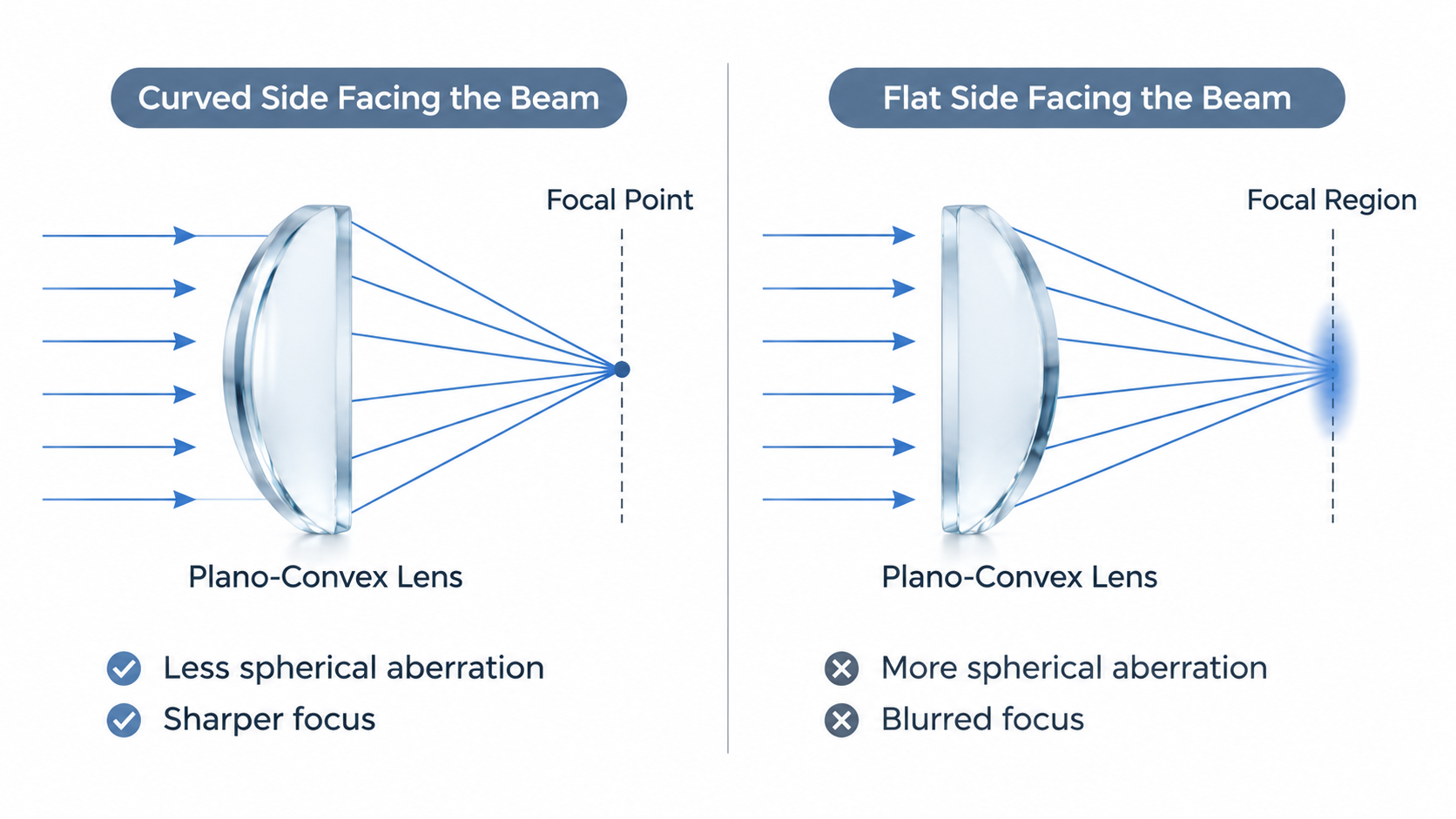
- Orientation matters.A plano-convex lens used with the flat side toward a collimated beam produces noticeably more spherical aberration than one used with the curved side first.
- Rule of thumb for conjugate ratio:beyond about 5:1 or 1:5, use plano-convex. Between those limits, bi-convex is the better single lens.
- Higher-index glass reduces aberrationfor the same focal length, because it needs weaker curvature.
- Always specifyfocal length, diameter, material, centering, surface quality, surface form, wavelength and coating.
What is a spherical lens?
A spherical lens is a lens with one or two surfaces that are parts of a sphere, each defined by a single radius of curvature. The other surface can be flat (plano) or spherical too. Because a rotating tool naturally grinds and polishes a sphere, spherical lenses are easy to produce accurately and economically, in sizes from sub-millimeter to tens of millimeters and beyond.
Spherical lenses are not perfect. A single spherical surface focuses rays at different heights to slightly different points, which is called spherical aberration. When that matters, designers use an aspheric lens, a doublet or a slower f-number. For a closer look at when each is the better choice, see our aspheric guide.
Types of spherical lenses at a glance

Lens type | Shape | What it does | Typical use |
Plano-convex | One flat, one convex surface | Focuses (positive lens) | Focusing or collimating a laser, condenser lenses |
Bi-convex (double convex) | Two convex surfaces | Focuses (positive lens) | 1:1 imaging, relay and coupling lenses |
Plano-concave | One flat, one concave surface | Diverges (negative lens) | Beam expanders, divergence control |
Bi-concave (double concave) | Two concave surfaces | Diverges (negative lens) | Beam expanders, optical designs needing negative power |
Positive meniscus | Convex and concave surface, net positive | Focuses with low aberration at short conjugates | Shortening focal length, laser focusing |
Negative meniscus | Convex and concave surface, net negative | Diverges | Aberration balancing, field correction |
Cemented doublet (achromat) | Two glasses cemented together | Focuses with reduced chromatic and spherical aberration | Imaging, broadband and visible systems |
Rod lens | Cylinder with polished ends | Guides or focuses light | Light delivery, illumination |
Which spherical lens should you use? A decision guide
Your situation | Best choice | Why |
Focusing a collimated laser beam to a spot | Plano-convex, curved side toward the beam | Near-minimum spherical aberration at infinite conjugate |
Collimating light from a point source or fiber | Plano-convex, curved side toward the collimated side | Same principle, reversed direction |
1:1 imaging or relaying an image | Bi-convex (or two matched plano-convex lenses back to back) | Symmetry cancels coma and some distortion |
Conjugate ratio between about 5:1 and 1:5 | Bi-convex | Lower aberration than plano-convex over that range |
Broadband or visible imaging | Cemented achromatic doublet | Corrects chromatic aberration |
Very fast system (below about f/5) | Aspheric lens or doublet | A singlet’s spherical aberration becomes the limit |
Expanding or diverging a beam | Plano-concave or bi-concave | Negative power |
Cost-driven, slow system | Plano-convex or bi-convex singlet | Lowest cost, adequate performance |
Orientation: which side should face the beam?
For a plano-convex lens focusing a collimated beam, put the curved surface toward the collimated beam and the flat surface toward the focus. The refraction is then shared more evenly between the two surfaces and the spherical aberration is near its minimum for a single lens of that shape. Reversing the lens roughly puts all of the bending on one surface and noticeably increases spherical aberration. For collimating a point source, the curved side faces the collimated side, which is the same rule seen from the other end.
Why index matters
For the same focal length, a higher-index glass allows a flatter surface curve, and flatter curves produce less spherical aberration. That is why high-index glasses such as N-SF11 (refractive index about 1.78 at the d-line) are used for compact, fast lenses, while N-BK7 (about 1.517) remains the standard for general use. For background on why BK7 is so widely used, see BK7 glass: not the best on paper, yet the industry standard.
Key formulas for spherical lenses
Thin-lens focal length: 1/f = (n − 1) × (1/R₁ − 1/R₂)
For a plano-convex lens, one radius is infinite, so f = R / (n − 1).
Worked example: an N-BK7 plano-convex lens with R = 51.7 mm and n = 1.5168 (at 587.6 nm) has f = 51.7 / 0.5168 ≈ 100 mm. At longer wavelengths the index is lower, so the focal length is slightly longer, for example at 1550 nm (n ≈ 1.501).
Imaging equation: 1/s + 1/s′ = 1/f, where s is the object distance and s′ is the image distance. Magnification is m = −s′ / s.
F-number: f/# = f / D. A 25 mm diameter lens with a 100 mm focal length is f/4.
Centering and focus shift: if a lens has a centering error (beam deviation) of δ, the focus shifts sideways by about f × δ. For a 100 mm lens with 10 arcminutes of deviation (about 2.9 mrad), the shift is about 0.29 mm.
The thin-lens formulas are good for estimates. A thick lens has principal planes, so the back focal length differs from the effective focal length, and real designs should be checked in optical design software.
Spherical lens materials
Material | Approximate transmission | Strengths | Limits |
N-BK7 (optical glass) | 350 nm to 2.0 µm | Low cost, easy to polish, standard for visible and near-IR | Weak UV transmission |
Fused silica (Corning 7980, JGS1) | About 185 nm to 2.1 µm | UV transmission, low thermal expansion, high laser damage threshold | Higher cost, lower refractive index (about 1.46) |
High-index glass (for example N-SF11) | Visible to near-IR | Strong focusing with flatter curves, compact lenses | Higher cost, more dispersion |
Silicon | About 1.2 to 7 µm | Infrared lenses and sensors | Opaque in the visible |
For more on UV and infrared substrates, see our guide to optical window materials.
Key specifications to define
Specification | Typical values | Why it matters |
Focal length and tolerance | Commonly ±1% to ±2% for standard parts, tighter for precision | Sets spot size, magnification and working distance |
Diameter and tolerance | Often ±0.05 mm standard, tighter for precision mounts | Fit in the mount |
Center thickness and tolerance | Often ±0.05 mm or better | Affects focal length and weight |
Centering (eccentricity or beam deviation) | From several arcminutes down to about 1 arcminute for precision | Lateral focus shift and image quality |
Surface quality (scratch-dig) | 60-40 commercial, 40-20 and 20-10 precision, 10-5 laser grade | Scatter and laser damage resistance |
Surface form (irregularity) | λ/4 standard, λ/10 or better for precision, at 633 nm | Wavefront quality |
Clear aperture | Typically 90% of diameter | The usable area that meets specification |
Coating | AR for the operating band | Transmission and ghost control |
Values are typical for orientation. Tolerances tighter than the system needs raise cost and lead time without improving real performance.
How are spherical lenses made?
 Spherical lens structure and four manufacturing steps: rough shaping, grinding, polishing and coating
- Cutting and blank preparation.Glass is cut into blanks close to the final size.
- Rough grinding (generating).A diamond tool forms the approximate spherical shape.
- Fine grinding.Finer abrasives bring the radius and thickness close to specification.
- The surface is polished to the required form and scratch-dig quality.
- Centering and edging.The lens edge is ground so the optical axis lines up with the mechanical axis, which sets the centering error.
- Cleaning and coating.AR or other coatings are applied. See our optical coating
- Radius, thickness, diameter, centering, surface form, scratch-dig and focal length are checked against the drawing.
Typical checks are test plates or an interferometer for surface form, a spherometer or profilometer for radius, a centering instrument for eccentricity, a microscope for scratch-dig, and a bench setup for focal length.
What are spherical lenses used for?
Application | Typical lens choice | What matters most |
Laser focusing and collimation | Plano-convex, meniscus | Orientation, surface quality, damage threshold. See optical laser applications |
Laser projection and illumination | Plano-convex, bi-convex, achromat | Surface quality, coating, uniformity |
Laser sights and illumination | Plano-convex, bi-convex | Focal length accuracy, centering |
Medical laser systems | Plano-convex, plano-concave, meniscus, cemented | Cleanliness, coating, reliability. See Life Sciences |
Imaging and machine vision | Achromatic doublets, bi-convex | Aberration control, centering |
Beam expanders | Plano-concave plus plano-convex | Matched focal lengths, wavefront quality |
LiDAR optics | Spherical singlets, doublets, aspheric combinations | Coating at 905 or 1550 nm, centering. See LiDAR |
Common mistakes when specifying a spherical lens
- Using the lens backwards.A plano-convex lens with the flat side toward a collimated beam gives noticeably worse focus.
- Using bi-convex for infinite conjugate focusing.Plano-convex is generally the better single lens there.
- Ignoring principal planes.Thick lenses have a back focal length different from the effective focal length.
- Using a fast singlet where an aspheric or doublet is needed.Below about f/5, spherical aberration usually dominates.
- Wrong coating band.An AR coating for 400 to 700 nm will not perform at 1064 nm.
- Ignoring centering.A centering error moves the focus sideways by roughly f × δ, which matters in precise alignment.
- Over-tightening tolerancesthat the system does not need.
What to specify when you request a spherical lens
- Lens type(plano-convex, bi-convex, meniscus, cemented and so on) and orientation requirement.
- Focal length or radius, with tolerance, and the wavelength it is specified at.
- Diameter, center thickness and tolerances.
- Material, or the wavelength range so one can be suggested.
- Centering requirement(eccentricity or beam deviation).
- Surface quality (scratch-dig) and surface form.
- Clear apertureand edge treatment.
- Coating: band, reflectance target, and laser power if relevant.
- Inspection and acceptance criteria.
- Quantity, prototype or production.
A drawing, a draft specification or a sample part is the fastest way for a manufacturer to spot problems early.
Example: Hobbite spherical lenses

Hobbite manufactures spherical lenses in-house, with grinding, polishing, cutting, coating and precision inspection under one roof. The company was founded in 2015 and has a 5,000 m² production facility, more than 500 cooperating customers, and 95% on-time delivery, with ISO 9000 and ISO 14001 certification and RoHS and REACH compliance. The lens processing range is:
Lens profile | Diameter range (Φ) |
Plano-convex | 0.5 to 60 mm |
Plano-concave | 1.0 to 60 mm |
Double convex (bi-convex) | 0.5 to 60 mm |
Double concave | 1.2 to 60 mm |
Meniscus | 1.5 to 60 mm |
Cemented | 0.6 to 50 mm |
Rod | 0.6 to 10 mm |
Glued rod | 1.0 to 10 mm |
Specification | Hobbite capability |
Diameter tolerance | ±0.003 to ±0.05 mm |
Thickness tolerance | ±0.02 to ±0.05 mm |
Surface quality (scratch-dig) | 20/10 standard, 10/5 high precision, 5/0 higher precision |
Eccentricity error | Under 10 arcminutes |
Materials | N-BK7, Corning 7980 and JGS1 fused quartz, or to customer requirement |
Coating | 400 to 2000 nm, covering visible and optical communication bands, or custom |

Hobbite spherical lenses are used in laser projection, laser illumination and sighting, medical laser systems, laser sensing and optical communication devices, and the same factory also makes aspheric lenses, prisms and mirrors, so a system can be sourced from one supplier. For non-standard shapes, see custom optics.
If you are choosing a lens for a laser, imaging or sensing system, send the wavelength, focal length, diameter and target performance, and Hobbite can review whether a standard design fits or a custom lens is needed.
Frequently asked questions
What is a spherical lens?
A spherical lens is a lens whose surfaces are parts of spheres, each defined by one radius of curvature. It is the simplest and most economical lens to make, and it is used in laser, imaging, illumination and sensing systems.
What is the difference between a spherical and an aspheric lens?
A spherical lens has a constant radius of curvature, while an aspheric lens has a surface whose curvature changes from center to edge. Aspheric lenses reduce spherical aberration and can replace several spherical elements, but they cost more per piece. Spherical lenses suit slower, simpler or cost-driven designs.
When should I use a plano-convex lens instead of a bi-convex lens?
Use plano-convex when focusing a collimated beam or collimating a point source, where the conjugate ratio is very large (beyond about 5:1 or 1:5). Use bi-convex for imaging at roughly 1:1, where its symmetry reduces aberrations.
Which side of a plano-convex lens should face the beam?
The curved side should face the collimated beam, and the flat side should face the focus. This shares the refraction between both surfaces and keeps spherical aberration near its minimum for a single lens.
How do I calculate the focal length of a spherical lens?
For a thin lens, 1/f = (n − 1) × (1/R₁ − 1/R₂). For a plano-convex lens this reduces to f = R / (n − 1). An N-BK7 lens with a 51.7 mm radius has a focal length of about 100 mm at 587.6 nm. Thick lenses need principal planes for accuracy.
What is the difference between a spherical singlet and an achromatic doublet?
A singlet is a single piece of glass and shows chromatic aberration, meaning different colors focus at different distances. An achromatic doublet cements two glasses of different dispersion together to bring two wavelengths to the same focus and to reduce spherical aberration, at higher cost.
What does the centering error of a lens mean?
Centering, also called eccentricity or beam deviation, describes how well the optical axis of the lens lines up with its mechanical axis, usually given in arcminutes. A larger error shifts the focus sideways by about the focal length times the deviation angle.
What materials are spherical lenses made of?
Common materials are N-BK7 optical glass for visible and near-IR, fused silica (such as Corning 7980 and JGS1) for UV and high-power lasers, high-index glasses for compact lenses, and silicon or other crystals for the infrared. The wavelength and laser power usually decide the choice.
How much does a spherical lens cost?
Price depends on diameter, material, tolerances, surface quality, centering, coating and quantity, so there is no single figure. Standard glass lenses at normal tolerances are the most economical, and precision grades, fused silica and special coatings cost more. For a quote, send your drawing and quantity to Hobbite.
Can spherical lenses be customized?
Yes. A manufacturer needs the lens type, focal length or radii, diameter, thickness, material, wavelength, centering, surface quality, coating and quantity to tell you whether a custom lens can be made.
About Hobbite
Hobbite provides optical lens design, precision optical component manufacturing, optical coating and assembly solutions for optical communications, industrial lasers, life sciences, laser projection, laser sensing and LiDAR. To discuss a spherical lens for your project, send your drawing, target specifications or a sample part to Hobbite for an initial review.