In traditional optics, functions like focusing, collimating, or beam expanding were typically handled by a single lens or a small set of lenses. However, the rapid advancement of fields such as LiDAR, 3D structured light, optical sensor arrays, compact projectors, optical chip coupling, semiconductor lighting, and miniaturized imaging has imposed much stricter demands on lens size, weight, and light field control precision. Consequently, the traditional lens approach of “processing the entire light beam as a whole” can no longer meet modern optical systems’ requirements for “multi-beam output, compact structure, highly uniform illumination, and programmable light fields.”
This is where the lens array becomes a key breakthrough. It is a component that integrates a vast number of microlenses in a regular pattern onto a single substrate, enabling the control of light field distribution within millimeter or even sub-millimeter spaces—a task that is difficult for traditional lenses. A lens array can not only split a beam into multiple light spots but also achieve uniform illumination, beam shaping, light spot matrix generation, and miniaturized optical path design. It is an indispensable fundamental component in modern micro-optics.
By making light beams “orderly, structured, and regular,” the lens array is a core driving force behind the miniaturization and system integration of contemporary optics.

Definition of a Lens Array
A lens array (or microlens array) is an optical element composed of a large number of microlenses arranged in a fixed geometric pattern. The microlenses, typically ranging in size from tens to hundreds of micrometers, can be spherical, aspherical, cylindrical, freeform, or even feature a hexagonal honeycomb structure. Each microlens is a fully functional optical element, and the overall function of the array emerges from the “collaborative effort” of these microlenses.
In essence, instead of using one lens to process the entire light beam, a lens array assigns each microlens the task of receiving, refracting, focusing, or scattering a portion of the light energy. This collective action ultimately forms a structured light field on the target plane. The greater the number of microlenses, the stronger the light field reconstruction capability, and the richer the optical functions of the array. This is why it is widely used in multi-channel, high-resolution, uniform illumination, and ultra-compact optical designs.
Optical Principle of Lens Arrays
The working principle of a lens array can be summarized as “parallel light processing by multiple lenses + light field superposition and reconstruction.” When incident light strikes the variety, it is redistributed, focused, or shaped by the numerous microlenses, ultimately forming a designed light field pattern in the far field or on the image plane.
- Multi-Beam Generation: Each microlens acts as a miniature optical system, focusing part of the incident light to a specific point. The coordinated work of many microlenses results in a regularly distributed dot matrix or light spot array. For example, the “tens of thousands of infrared dots” in smartphone 3D structured light systems are generated by splitting light through a microlens array.
- Beam Homogenization: A lens array can divide a light field with excessive central energy and uneven distribution into countless tiny beams. Through far-field superposition, a smooth energy distribution and uniform light spot are achieved. This homogenization mechanism, based on geometric optical superposition and optical path optimization, is the most common method for improving light quality in micro-projectors, industrial laser irradiation, and LED lighting.
- Strahlformung: Lens arrays can reshape a divergent beam into a top-hat, rectangular spot, or more complex energy distributions. They address the limitation of traditional single lenses in easily altering spot energy profiles, serving as a tool to “sculpt the light field.”
- Optical Path Miniaturization: Due to their extremely small size, lens arrays can be directly attached to LEDs, laser diodes, CMOS sensors, or optical chips. This allows beam modulation within millimeter-scale spaces, paving the way for highly integrated modern optics.
In short, the lens array is a core optical component that makes light beams “structured, controllable, and modular.”
Array Types and Structural Design
- Mikrolinsen-Array (MLA): This is the most typical array structure. The microlenses are usually spherical, aspherical, or freeform, arranged in square, circular, or hexagonal honeycomb patterns. Different arrangements directly affect spot uniformity, energy fill factor, and coupling efficiency. Key structural parameters include lens diameter, focal length, surface form accuracy, surface roughness, and fill factor. The complex interplay between these parameters significantly impacts light field formation.
- Cylindrical Lens Array: These lenses focus light in one direction while maintaining collimated transmission in the perpendicular direction. They are commonly used for generating line beams, in line-scanning systems, and for laser stripe illumination, enabling highly uniform beam shaping in one dimension.
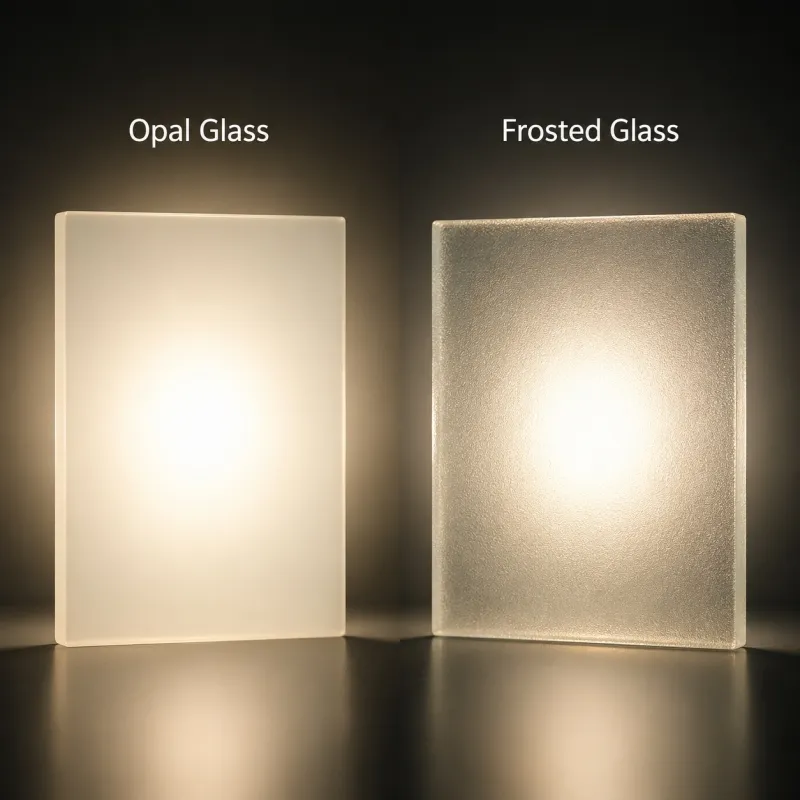
- Diffuser Lens Array: This type uses numerous microlenses to slightly scatter light, transforming a directional light source into a uniform surface illuminator. Typical applications include LED light homogenization, backlighting, and micro-projection devices.
Manufacturing Materials and Processes
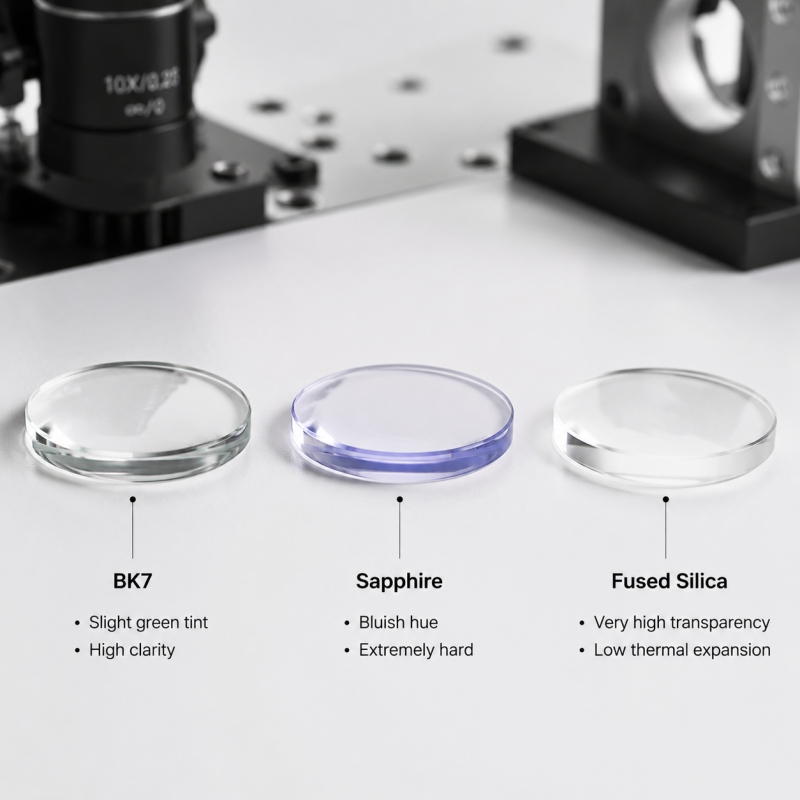
- Glass Lens Arrays: These offer high heat resistance, mechanical strength, excellent transmittance, and very high laser damage thresholds. They are suitable for industrial laser systems, precision optical instruments, and optical communication coupling. Manufacturing is more challenging, requiring ultra-precision mold pressing or glass micromachining.
- Polymer Lens Arrays: Polymer materials are lightweight, low-cost, and suitable for mass production, making them the most common choice for consumer electronics (e.g., smartphone 3D sensors). High-precision microlens arrays can be manufactured rapidly through injection molding, hot embossing, or UV nanoimprint lithography.
- Manufacturing Processes: The precision of manufacture critically determines optical performance. Key processes include ultra-precision mold machining, injection molding, photolithographic micromachining, nanoimprint lithography, and surface coating. Many lens arrays require nanometer-level surface roughness and sub-micrometer control of lens profile errors, representing a typical high-precision product in micro-optics manufacturing.
Core Functions of Lens Arrays
- Generating Multiple Beams: A lens array can split a single beam into tens, hundreds, or thousands of beams, creating a regular matrix of light spots. This is used in structured light, LiDAR scanning, multi-point positioning, and high-speed measurement systems. Each microlens outputs a stable and predictable independent spot.
- Beam Shaping and Homogenization: Lens arrays effectively improve beam energy distribution, making an initially non-uniform light field smooth and consistent. For industrial laser processing or optical inspection, this energy uniformity significantly enhances processing quality, imaging stability, and output consistency.
- Enhancing System Brightness: By improving light utilization efficiency and reducing losses, lens arrays can significantly increase source brightness and illumination efficiency. This is particularly important for micro-projectors, backlight modules, and short-throw imaging systems.
- Enabling Miniaturized Optical Design: As devices shrink, lens arrays allow complex beam modulation within millimeter or even sub-millimeter spaces, leading to shorter, more compact optical paths. They are foundational for highly integrated optical modules.
Typical Application Areas
- LiDAR: Lens arrays are used to structure laser emission into multi-point, multi-line, or multi-zone scanning patterns, increasing measurement density and recognition accuracy. They are key components for autonomous driving and robot vision.
- 3D Structured Light & Facial Recognition: Smartphone Face ID systems use microlens arrays to generate tens of thousands of infrared dot patterns. Depth information from these spots enables 3D modeling, representing the largest-scale consumer electronics application for lens arrays.
- Industrial Beam Shaping: In laser marking, cleaning, welding, and inspection, lens arrays provide stable spots and uniform energy distribution, improving processing quality and efficiency.
- Projection & Display Systems: Microlens arrays are used for light homogenization and brightness control, improving image uniformity and visual comfort in projectors. They are key components in micro-projectors.
- Optical Communication Coupling: Microlens arrays are used in fiber arrays, silicon photonic chips, and high-speed communication modules, significantly improving multi-channel optical coupling efficiency. They are fundamental elements for high-speed optical interconnects.
Design Considerations When Using Lens Arrays
Despite their small size, designing with lens arrays is highly challenging. Microlens size must closely match the light source dimensions; focal length must strictly adhere to optical path design; the source’s divergence angle determines the array’s effective utilization; materials must withstand operating temperature and laser power; and installation alignment errors must be extremely low to avoid spot deviation, reduced coupling efficiency, or worsened uniformity. Systems using lens arrays have stringent requirements for mechanical stability, thermal expansion control, and assembly precision.
Comparison with Other Beam Shaping Technologies
- Compared to Diffractive Optical Elements (DOEs), lens arrays generally offer higher optical efficiency and broader spectral tolerance. However, DOEs provide greater flexibility in phase control and generating complex light fields.
- Compared to Powell Lenses, which excel at generating uniform line lights, lens arrays are better suited for multi-point, multi-beam output.
- Compared to Fresnel Lenses, which are suitable for large-scale optical systems, lens arrays hold the advantage in millimeter-scale optical modules.
Schlussfolgerung
The essence of the lens array lies in its ability to “split, reconstruct, and reorganize” light beams, granting optical systems greater freedom, higher functional density, and more miniaturized capabilities. In fields like autonomous driving, AI sensing, AR/VR, semiconductor manufacturing, optical communications, and mobile 3D sensing, lens arrays have become a crucial and often irreplaceable optical foundation.
Future optical systems will trend towards even greater miniaturization and integration, and the lens array stands as a core force driving this evolution.