In optical communications, laser systems, and various sensing applications, optical solutions must achieve stable and reproducible performance within a limited space. Traditional spherical lenses typically use multiple elements in combination to correct spherical aberration and astigmatism, but this structure increases optical path length and assembly complexity while introducing more sources of error. Under mass production conditions, these problems often directly manifest as lower yield and higher costs. Molded aspheric lenses provide a more direct solution. By controlling light with a single aspheric surface, they reduce the number of lenses, shorten the optical path, and lower system complexity.
What Is a Molded Aspheric Lens
From an engineering perspective, understanding the molded aspheric lens is more about its manufacturing method than just its surface shape. Its core is not the “aspheric geometry itself,” but rather the production logic of “replicating optical precision through a mold.”
In the actual manufacturing process, the aspheric profile is first defined by a high-precision mold. Then, glass or plastic material is heated to a malleable state and pressed under controlled pressure and temperature conditions. Finally, it is solidified through a precise cooling process, allowing the final optical surface to directly inherit the mold’s topography.
This process is fundamentally different from traditional grinding and polishing methods. The latter relies on point-by-point material removal to approximate the designed surface, while a molded aspheric lens obtains its final structure directly in a single forming process. This means optical performance is largely determined by the mold, enabling high consistency in mass production.
Core Advantages in Real Optical Systems
1. Reducing Aberrations at the Source
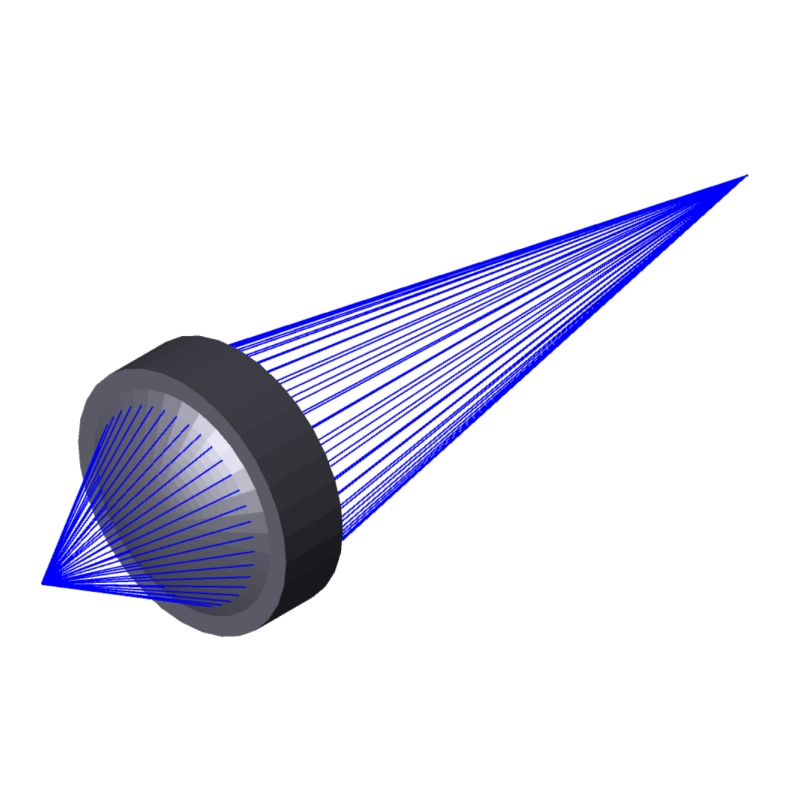
In practical applications, the advantage of molded aspheric lenses is first seen in how they control aberrations. Compared with gradually compensating for errors with multiple lens elements, an aspheric profile can modulate light more precisely at a single interface, effectively reducing major aberrations such as spherical aberration.
This approach reduces error accumulation in the system, making image quality more stable, rather than just locally optimizing sharpness. For systems requiring stable output, this ability to “reduce errors at the source” has greater engineering value.
2. Fewer Optical Elements, Simpler Systems
By integrating the functions of multiple spherical lenses into a single surface, molded aspheric lenses can significantly reduce the number of lens elements. This structural simplification not only shortens the optical path length but also reduces dependence on precise optical axis alignment during assembly.
In practical engineering, fewer lenses often mean lower assembly complexity and higher system stability. This is especially important in space-constrained devices or those requiring long-term stable operation.
3. Designed for Mass Production Consistency
Another key advantage of molded aspheric lenses is their batch-to-batch consistency. Since optical performance is determined by the mold rather than controlled during individual piece processing, once the mold is verified and operating stably, performance variations between different batches can be effectively controlled.
This consistency is particularly important for optical communications, sensing, and automation equipment, because system performance often relies on the coordinated work of multiple optical modules, and any deviation can affect overall performance.
4. Cost Efficiency in Scaled Manufacturing
From a cost structure perspective, molded aspheric lenses are more suitable for medium to high volume projects. Although mold development requires upfront investment, the cost per piece decreases rapidly as volume increases and remains stable.
This cost distribution gives them a clear advantage in fields requiring mass production, such as consumer electronics, automotive systems, and optical communications.
5. Enabling Miniaturization and Integration
Against the backdrop of an increasing trend toward system integration, molded aspheric lenses can effectively shorten optical paths and reduce structural complexity, thereby supporting higher-density optical integration designs. This makes them well-suited for LiDAR, small sensors, and portable devices.

Limitations You Must Understand
Although molded aspheric lenses have advantages in several areas, their applicability is still limited by certain engineering constraints that need thorough evaluation during the design phase.
First, their surface accuracy is limited by mold manufacturing capabilities and process control during molding. In high numerical aperture or ultra-high precision applications, they may not reach the performance level of ground aspherics.
Second, design flexibility is lower. Once optical parameters change, a new mold typically needs to be developed, which adds time and cost. Therefore, they are more suitable for relatively stable, mass-produced projects rather than frequently iterated R&D stages.
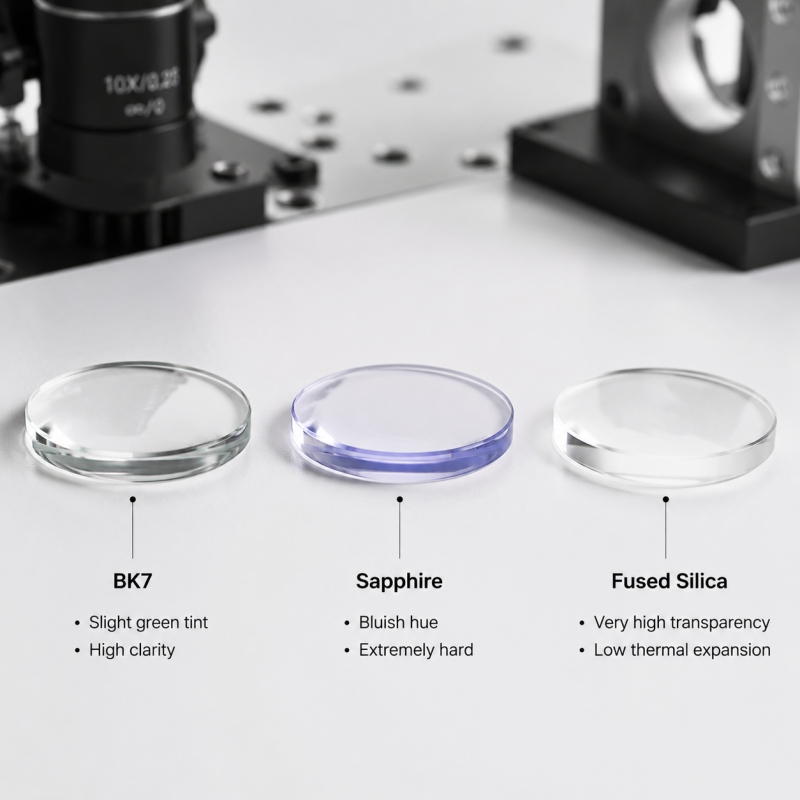
Additionally, material properties affect the range of use. Plastic materials have advantages in cost and weight but have limitations in temperature stability and long-term reliability. Glass materials offer more stable performance but have relatively higher processing costs.
Finally, because the molding process is irreversible, post-production corrections are nearly impossible, placing higher demands on design verification.
Typical Application Scenarios
In practical engineering, molded aspheric lenses are more often used in systems with clear requirements for size, cost, and consistency, rather than scenarios purely pursuing ultimate performance.
In laser systems, they are commonly used for beam collimation and fiber coupling, improving energy efficiency by optimizing the beam propagation path while maintaining a compact structure. In optical communication modules, their high consistency makes them suitable for large-scale integrated applications, helping achieve stable signal transmission performance.
In machine vision and industrial sensing, these lenses provide reliable imaging capabilities within limited space, meeting inspection and recognition needs. In consumer electronics, their miniaturization and cost advantages make them a mainstream choice, widely used in compact optical systems.
Molded vs. Ground Aspheric Lens
In engineering decisions, molded aspheric lenses and ground aspherics correspond to different application logics. The former emphasizes reproducibility and cost efficiency, while the latter focuses more on ultimate precision and design flexibility.
When a system requires mass production and has strict requirements for size and consistency, molded aspheric lenses have the advantage. In high-precision imaging or high-power laser systems, ground aspherics remain a more reliable choice. Therefore, these two technologies are not simple substitutes for each other, but rather optimized paths for different design goals.
Design Considerations for Engineers
In actual design, not all optical systems are suitable for molded aspheric lenses. Before deciding to use them, several key factors need comprehensive evaluation.
For example, the system’s numerical aperture directly affects the achievable precision range of the lens. Tolerance design needs to consider mold replication errors and the effects of thermal deformation. In environments with large temperature variations, the thermal stability of the material also needs assessment. Additionally, the degree of optical path compression and the coating solution will significantly impact final performance.
From an engineering perspective, choosing a molded aspheric lens is not about optimizing a single parameter, but rather a trade-off regarding the overall manufacturability of the system.
Solution-Oriented Summary
Molded aspheric lenses are not simply about improving optical performance, but about creating a more balanced solution between performance, structure, and manufacturing.
When system goals focus on miniaturization, high consistency, and mass production, this solution can effectively reduce complexity and improve overall stability. In applications requiring ultimate precision or highly flexible design, other optical technologies need to be combined for comprehensive design. Essentially, what it solves is not “how to make the system more complex,” but “how to make the system more controllable under given constraints.”
FAQ
Q1: What is the difference between molded aspheric lenses and traditional aspherics?
The main difference lies in the manufacturing method. Molded aspheric lenses are formed in one step using a mold, suitable for mass production, while traditional aspherics are typically obtained through grinding and polishing, better suited for high-precision requirements.
Q2: Are molded aspherics suitable for laser systems?
They are very suitable for beam collimation, coupling, and similar applications. However, for high-power or extremely high-precision laser systems, evaluation based on a specific design is needed.
Q3: Are they suitable for miniaturized devices?
Very suitable. Molded aspheric lenses can reduce the number of lenses and shorten the optical path, making them an important solution for compact optical systems.
Q4: How to determine if a design is suitable for molding?
The key is whether mass production is needed, whether the mold cost is acceptable, and whether the design is relatively stable. If the design changes frequently, this approach is less suitable.