When people first start taking photos, many find that the lens doesn’t quite capture what they want. Usually, this isn’t because they don’t know how to shoot—it’s because the scene doesn’t fit into the frame. Whether you’re standing by the sea trying to capture the entire beach and ocean, or out in the mountains wanting to photograph the star-filled sky, or taking a group photo with friends while traveling, you’ll run into the same problem: no matter how far you back up, the frame still isn’t wide enough. This limitation isn’t about shooting technique—it’s about the inherent field of view of the lens.
At its core, choosing the right field of view matters a great deal in photography. A wide lens removes this limitation, allowing the frame to cover a much larger area. When the field of view expands, you can not only capture more of the scene, but also create images that feel more immersive and visually compelling.
What Is a Wide Lens?
In simple terms, a wide lens is one that captures a broader scene. You can think of it as an expansion device for your field of view. When you use a standard fixed lens, the image looks closer to what your eyes focus on. When you switch to a wide lens, the frame visibly stretches out to the sides—like shifting your view from a single point to the whole scene.
But we usually need a clearer standard to define what counts as “wide.” In photography, this is determined mainly by focal length. Simply put, the shorter the focal length, the wider the scene the lens can capture. Using a full-frame camera as a reference (which is the industry standard), focal lengths roughly break down like this:
- 35mm and above: Close to human vision, considered standard lenses
- 24mm – 35mm: Wide lenses (good for everyday shooting, street photography)
- 14mm – 24mm: Ultra-wide lenses (commonly used for landscapes and architecture)
- Below 14mm: Extreme wide / fisheye lenses (field of view can exceed 100° or even approach 180°)

This is why the 0.5x setting on phone cameras essentially compresses the equivalent focal length to about 13mm–18mm, achieving a noticeably wider view. In traditional cameras, focal lengths like 24mm have become classics because they strike a balance between width and not introducing too much distortion.
One important point to note: a wide lens doesn’t magnify the scene—it changes the angle of light the lens accepts. It allows more light from different directions to reach the sensor, bringing in content that would otherwise fall outside the frame.
How Is a Wide Lens Achieved?
Achieving a wide view isn’t simply about stretching the image. The core principle lies in changing how light enters the imaging system so that more light from different directions can be captured effectively.
The Relationship Between Focal Length and Incident Angle
In a standard lens, light enters the sensor at a relatively narrow range of angles. A wide lens needs to accept light from a much wider range. This means the lens must allow light from larger incident angles to pass through and form a clear image on the sensor plane. By shortening the focal length, the optical system can receive light from a broader area within a limited space, thereby expanding the field of view.
Concave Lenses and Front Group Structure
In a wide lens design, concave lenses are used to spread light out as it enters the optical system. This allows light coming from wider angles to be guided into the rest of the optical structure, effectively expanding the field of view.
This design is especially common in the front group of wide lenses. You can think of the concave lens as an entrance that brings more light—light that normally wouldn’t make it into the system—into the imaging path. While this step is simple, it forms the foundation for achieving a wide view.

Aspherical Lenses for Width and Clarity
As the field of view expands, new issues emerge—most notably distortion and reduced image quality at the edges. Edge stretching and straight lines are typical in wide lenses. Without correction, while the frame may be wider, the usability of the image drops significantly.
Aspherical lenses were introduced to solve this. Unlike traditional spherical lenses, aspherical lenses can more precisely control the path of refracted light, maintaining better image quality even at wider angles. They reduce distortion and improve edge sharpness, allowing the frame to expand while staying under control.
In modern phone cameras, automotive cameras, and various compact optical systems, aspherical lenses have become nearly standard because they are essential for achieving a small form factor, wide field of view, and high image quality all at once.
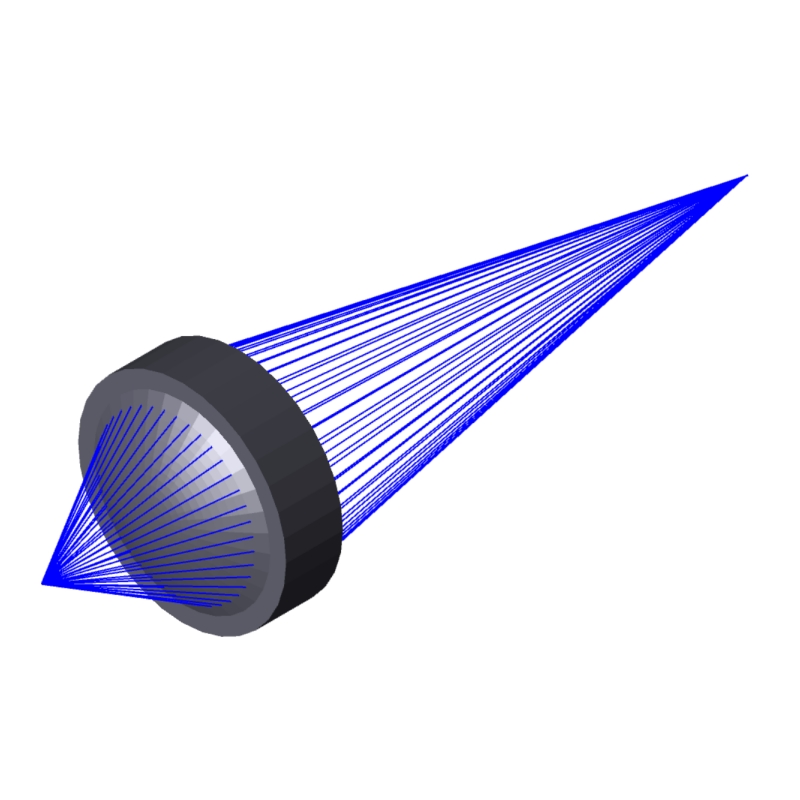
Multi-Lens Groups
A single lens cannot simultaneously deliver width, sharpness, and distortion control. High-quality wide lenses, therefore, typically consist of multiple lens elements. Each element plays a different role—some expand the field of view, others correct aberrations, and still others optimize color performance.
This multi-element design is not a simple stacking of lenses; it requires professional system-level optical design. Only with a well-planned structure can the field of view be expanded while controlling various optical issues and managing the lens size. In short, a good wide lens relies on the coordination of multiple optical elements, not just a single lens.
Ultra-Wide and Fisheye Lenses
As the field of view expands further, you enter the realm of ultra-wide and even fisheye lenses. These lenses can achieve fields of view exceeding 100° or even approaching 180°, but the trade-off is significant distortion. Straight lines become curved, edges are stretched, and the overall look becomes more exaggerated.
This isn’t a flaw—it’s a design choice. When extreme width is needed, some degree of visual distortion is part of the package. In action cameras, creative photography, and some surveillance systems, this type of lens actually offers unique value.
What Scenarios Are Wide Lenses Good For?
Once you understand the nature of wide lenses, their applications become clear. Wide lenses aren’t suited for every situation, but they excel in specific contexts.
- Landscape photography: Wide lenses are great at conveying the expansive feel of a scene, adding depth and openness. Whether it’s mountains, coastlines, or skies, a wide view makes the image feel more immersive.
- Architecture and interior photography: Wide lenses solve the problem of limited space. Even in tight environments, they can capture the full architectural style. This is why wide lenses are commonly used in real estate photography and hotel shoots.
- Portraits and group photos: Wide lenses can fit more people into the frame, making group shots feel more relaxed and natural. However, when shooting up close, faces may appear distorted, so it’s worth keeping an appropriate distance.
- Vlogs and daily documentation: Wide lenses capture both the person and the surroundings, giving the shot a more engaging feel. This combination of subject and environment is hard to achieve with standard lenses.
- Automotive and security applications: In these fields, the value of wide lenses lies in coverage. A wider field of view means fewer blind spots, which is crucial for safety and monitoring purposes.
What Are the Downsides of Wide Lenses?
Every lens design comes with trade-offs. While wide lenses offer a broader field of view, they inevitably introduce some level of distortion. This is especially noticeable at the edges, where objects may appear stretched, and faces may look unnatural. Additionally, wide lenses exaggerate perspective—nearby objects appear larger, while distant objects appear smaller. This “near-far” visual effect can add impact to images, but it may also compromise a sense of realism.
How to Choose a Wide Lens?
When you start exploring wide lenses, avoid the common mistake of focusing only on how wide the lens goes. Pay attention to focal length instead. For everyday use—like travel snapshots, street photography, or casual shots—a wide lens in the 24mm–28mm equivalent range is usually sufficient. This range expands your view without introducing obvious distortion, keeping the image looking natural. If you want to go further, such as shooting landscapes or architecture, consider the 16mm–24mm range. This will give your images more impact, but you’ll also need to watch out for edge distortion. I’d suggest paying attention to product reviews.


Also, pay attention to image quality control when comparing different lenses. For wide lenses, two key factors are distortion control and edge sharpness. A lens that is very wide but has blurry edges and severe curving of straight lines will end up being frustrating to use in practice.
Why Does the Front of a Wide Lens Look Convex?
Now that we understand how a wide lens achieves a broader field of view by shortening the focal length and expanding the range of incoming light, we can look at a very noticeable detail: the front element of most wide lenses appears to bulge outward.
At first glance, this seems counterintuitive. Since the goal of a wide lens is to capture a wider scene, many people naturally assume it would use a concave lens to spread light out and cover more area. But in actual optical design, the opposite is true—this convex front structure is actually a key part of achieving a wide field of view.


(The difference between the first piece being concave or convex)
To understand why, we need to look at how a wide lens actually works. A wide lens isn’t about creating divergence; it’s about handling light that already comes in at wide angles. This is especially true in ultra-wide systems, where light from the edges of the scene enters the lens at very steep angles—sometimes close to 60° or even more. In this situation, the main challenge isn’t how to spread light further, but how to maintain stable imaging under these large incident angles.
If the front surface were concave, it would increase the angle of incoming light even more, making an already steep light path even more extreme. This would introduce significant aberrations—particularly astigmatism and coma—and make it much harder for the rest of the lens elements to correct them. In some cases, it could even reduce the effective use of edge light, leading to lower image quality. So from a design perspective, a concave front doesn’t help achieve a wide view—it actually makes the system more difficult to control.
In contrast, designing the front surface as convex helps reduce the angle of incident light at the system entrance. It doesn’t simply converge light; it allows light to enter the subsequent optical structure at a more manageable angle, creating better conditions for later elements to correct aberrations. This approach essentially reduces system complexity at the very first step, which is one of the reasons wide lenses can maintain image quality across a large field of view.
It’s worth noting that many wide lenses still function as negative power systems overall, meaning the front group does play a role in spreading light. But that doesn’t mean the first surface has to be concave. In fact, the front group as a whole can achieve divergence while the first surface is shaped to optimize how light enters. These two goals can coexist in the same design.
This detail shows that achieving a wide lens isn’t simply about using one structure that makes the view wider—it’s the result of a series of carefully balanced design choices working together.
Conclusion
The real value of a wide lens is that it becomes an important tool for how you see and record the world. It lets you capture scenes more fully, makes spaces feel more vivid, and enriches your visual expression. A good wide lens isn’t just about having a wider field of view—more importantly, it maintains image quality without excessive distortion, giving you a lens that is both wide and usable.

FAQ
Is a wider lens always better?
Not necessarily. The wider the field of view, the more noticeable the distortion tends to become. The right choice depends on your specific needs rather than simply aiming for the widest option.
Why do people look distorted when shot with a wide lens?
This is due to a combination of perspective effects and lens distortion, especially when subjects are positioned near the edge of the frame.
Why does the 0.5x setting on phones look so exaggerated?
It falls into the ultra-wide range, offering a very wide field of view, which also creates a more pronounced spatial stretching effect.
Are wide lenses suitable for everyday photography?
Yes, but with some care. A moderately wide lens can enhance your images, while an overly wide one may make them look less natural.