A Laser (Light Amplification by Stimulated Emission of Radiation) is a highly coherent, collimated, and monochromatic light source generated through stimulated emission. Unlike conventional light sources such as incandescent lamps or LEDs, lasers exhibit minimal divergence and exceptional coherence, enabling the beam to remain highly concentrated with immense energy density over long distances. These unique characteristics render lasers indispensable across industrial manufacturing, medical surgery, scientific research, and telecommunications.
However, a laser source itself is merely an amplification medium; its ultimate performance and output characteristics do not depend solely on the gain medium or the pump source. Within a laser system, optical components—such as lenses, mirrors, prisms, and filters—play a critical role in shaping, guiding, and stabilizing the beam. Lenses adjust focal length and beam collimation; mirrors steer the optical path and enhance resonant feedback; prisms and beam-shaping elements control spot geometry and uniformity; and filters select or isolate specific wavelengths. Whether in precision laboratory measurements, high-power industrial processing, or fiber-optic telecommunication routing, these components serve as the core architecture ensuring stable, high-efficiency system performance.

The Physical Principles of Laser Operation
1. Stimulated Emission: The Core Mechanism of Lasers
The essence of laser light is rooted in quantum mechanics, specifically the phenomenon of stimulated emission. To understand this process, consider the energy level structure of an atom or molecule. Electrons reside at discrete energy levels. Upon absorbing external energy (such as optical or electrical pumping), an electron transitions to a higher energy state—a process known as stimulated excitation.
When these excited electrons encounter an incident photon possessing an identical energy quantum, they are “stimulated” to drop back down to a lower energy state. During this transition, the electron releases a new photon. Crucially, this emitted photon is a perfect replica of the triggering photon, sharing the same frequency, phase, polarization, and direction of propagation. In other words, they are completely coherent.

This mechanism drives the core characteristic of laser technology: coherent amplification. Within a gain medium packed with excited-state particles, a single passing photon can induce multiple high-energy particles to release coherent photons, resulting in an exponential cascade of optical amplification. Consequently, the resulting beam maintains a singular wavelength and a highly directional path, forming the collimated, coherent laser light we observe.
Put simply, stimulated emission allows a weak initial optical signal to continuously replicate and superimpose within the gain medium. Every quantum transition increases the photon count while locking the wavelength and phase in unison. This fundamental process is precisely why lasers deliver high-brightness, monochromatic, and highly controllable beams.
2. Population Inversion and Gain Media
To sustain stimulated emission within a laser system, a higher concentration of particles must reside in the upper energy state than in the lower state—a condition known as population inversion. Under thermodynamic equilibrium, the majority of atoms or molecules naturally occupy the ground state, meaning spontaneous emission dominates, causing photons to fire randomly without forming a stable laser beam. By applying an external energy source (known as a pump source), a sufficient number of particles can be elevated to the excited state, breaking the natural equilibrium and allowing stimulated emission to become the dominant process.
Different types of lasers utilize distinct gain media, which dictate the laser’s output wavelength, power capacity, and application scope:
- Solid-State Lasers (e.g., Nd: YAG): Utilize host crystals doped with rare-earth ions, pumped via flashlamps or laser diodes to achieve population inversion, delivering stable and adjustable output power.
- Gas Lasers (e.g., CO₂, He-Ne): Use electrical discharge to excite gas molecules, characterized by high output power and exceptional operational longevity.
- Semiconductor Lasers (Laser Diodes): Generate light via electron-hole recombination within a semiconductor PN junction. They feature ultra-compact form factors and rapid modulation speeds, making them ubiquitous in telecom and consumer electronics.
- Fiber Lasers: Implement stimulated emission within an optical fiber doped with rare-earth elements, offering high brightness, superior beam quality, and seamless coupling efficiency.
The choice of gain medium heavily influences the precise requirements placed on the system’s optical components. For instance, high-power solid-state systems demand optics capable of withstanding high laser-induced damage thresholds (LIDT), whereas fiber lasers rely on ultra-precision collimators and coupling optics to maximize transmission efficiency.
3. Optical Resonators and Feedback
The formation of a functional laser beam relies not only on stimulated emission and population inversion but also on the feedback loop provided by an optical resonator (or optical cavity). A standard resonator consists of two mirrors aligned parallel to each other: a total reflector (HR mirror) and a partial reflector (output coupler). This configuration forces the beam to bounce back and forth through the gain medium repeatedly, continuously stacking and amplifying the stimulated emission.
The design of the resonator directly dictates the laser’s spatial modes and overall beam quality. By adjusting mirror spacing, surface curvature, and integrating internal elements like lenses or prisms, engineers can meticulously govern the transverse electromagnetic mode (such as the fundamental TEM₀₀ mode versus higher-order modes), spot size, and beam divergence.
Furthermore, internal optical components are crucial for stabilizing the beam, minimizing intra-cavity losses, and ensuring uniform energy distribution. Lenses control beam focusing, prisms alter propagation trajectories, and filters isolate target wavelengths. Through the calculated optimization of the resonator and its optical components, a laser system can deliver the high-brightness, monochromatic, and stable output required for rigorous industrial, scientific, and telecommunication applications.

Key Optical Components in Laser Systems
Within a laser configuration, optical components do not merely transmit light; they actively participate in beam shaping and beam modulation. Based on their primary functions, they are classified into the following categories:
1. Lenses and Collimators
Lenses are used to focus or collimate laser beams. By adjusting the focal length and spatial positioning of the lens, engineers can manage beam divergence angles and focal spot sizes to satisfy varying precision requirements. Collimators ensure the beam maintains a stable direction during propagation, maximizing energy concentration and minimizing attenuation over distance.
2. Reflectors and Prisms
Reflectors (mirrors) and prisms are primarily deployed to alter the optical path and guide beam propagation. Inside the resonator, mirror combinations dictate spatial modes (such as TEM₀₀), while prisms enable optical path folding, image rotation, or polarization adjustments. Strategic placement of these components stabilizes beam modes and optimizes intensity distribution.
3. Beam Shaping Optics
Beam shaping components, such as Powell lenses or beam expanders, transform standard Gaussian laser beams into uniform flat-top profiles or specific spot geometries, ensuring consistent processing and measurement accuracy.
4. Filters and Windows
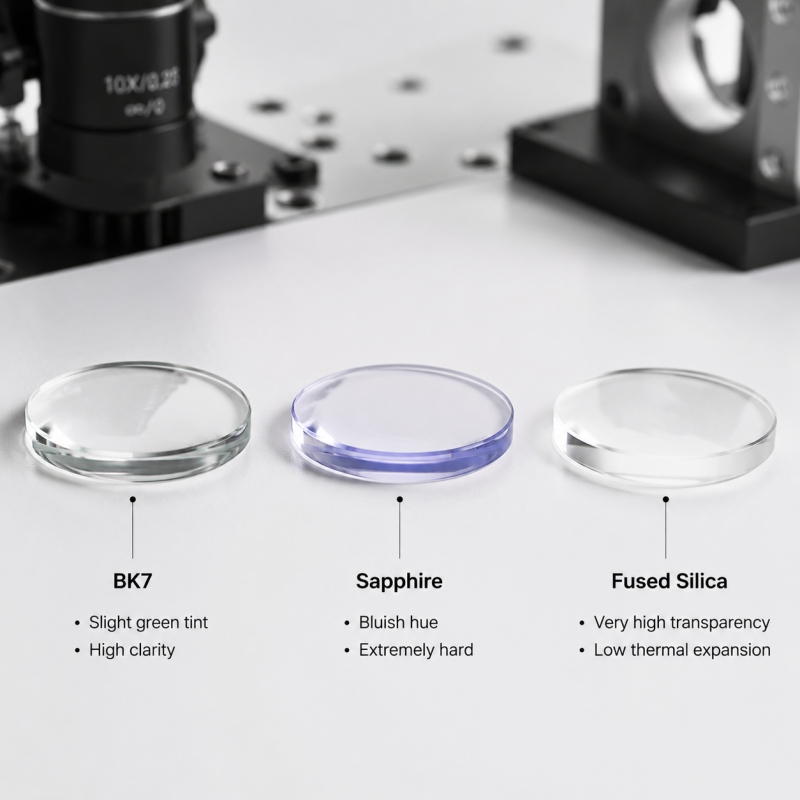
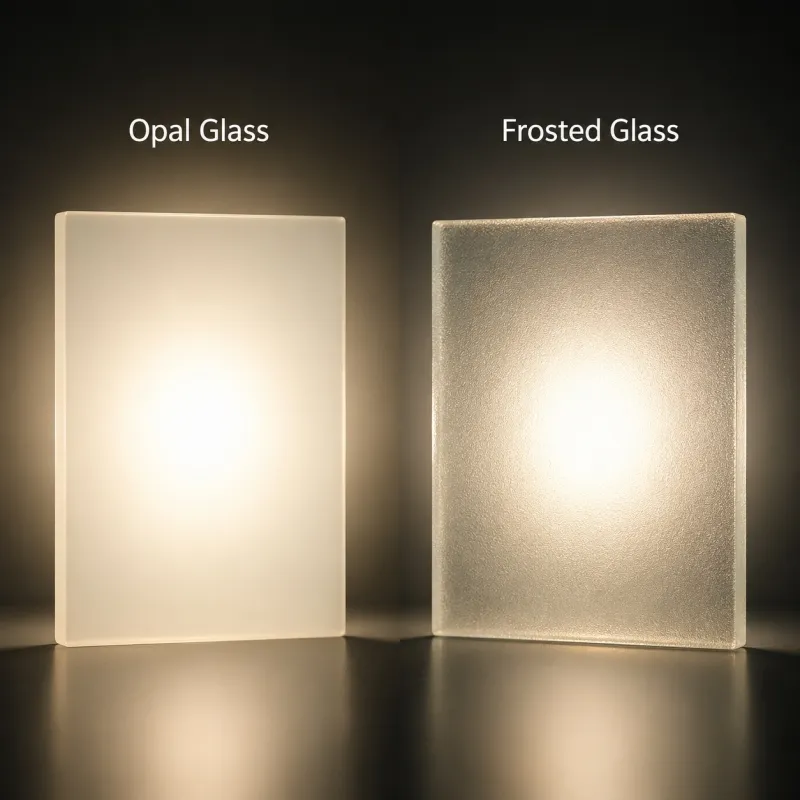
Filters isolate or restrict specific wavelengths, while anti-reflective windows protect sensitive internal laser components from environmental contamination or structural degradation. High-quality optical coatings and excellent substrate transparency directly influence total power transmission efficiency and long-term system stability.
By understanding the synergy of these precision-engineered optical components, one can easily grasp how spatial modes, spot geometries, and energy profiles are manipulated to achieve precise pulsed or continuous-wave (CW) laser outputs. Optical components represent the core architecture required to deliver high-quality, stable, and controllable laser output.
Laser Configurations and Their Specific Optical Requirements
Lasers vary widely in wavelength, output power, beam profiles, and component tolerances depending on their gain media and operating designs. Selecting the correct optical sub-assemblies is critical for optimizing performance and extending system lifespan. The table below outlines the core laser types and their respective optical mandates:
Laser Type: Solid-State (Nd:YAG)
- Gain Medium: Doped Crystal (Nd:YAG)
- Typical Wavelength: 1064 nm
- Output Power: Medium to High (Watts to hundreds of Watts)
- Beam Mode: TEM₀₀ (Fundamental) or Multi-mode
- Optical Component Requirements: High damage threshold (LIDT) optics, high-precision mirrors, thermal-lensing compensation coatings
- Typical Applications: Precision machining, welding, and medical surgeries
Laser Type: Gas (CO₂, He-Ne)
- Gain Medium: CO₂ or He-Ne Gas
- Typical Wavelength: 10.6 µm (CO₂), 632.8 nm (He-Ne)
- Output Power: Low to High (Milliwatts to Kilowatts)
- Beam Mode: TEM₀₀ (Fundamental)
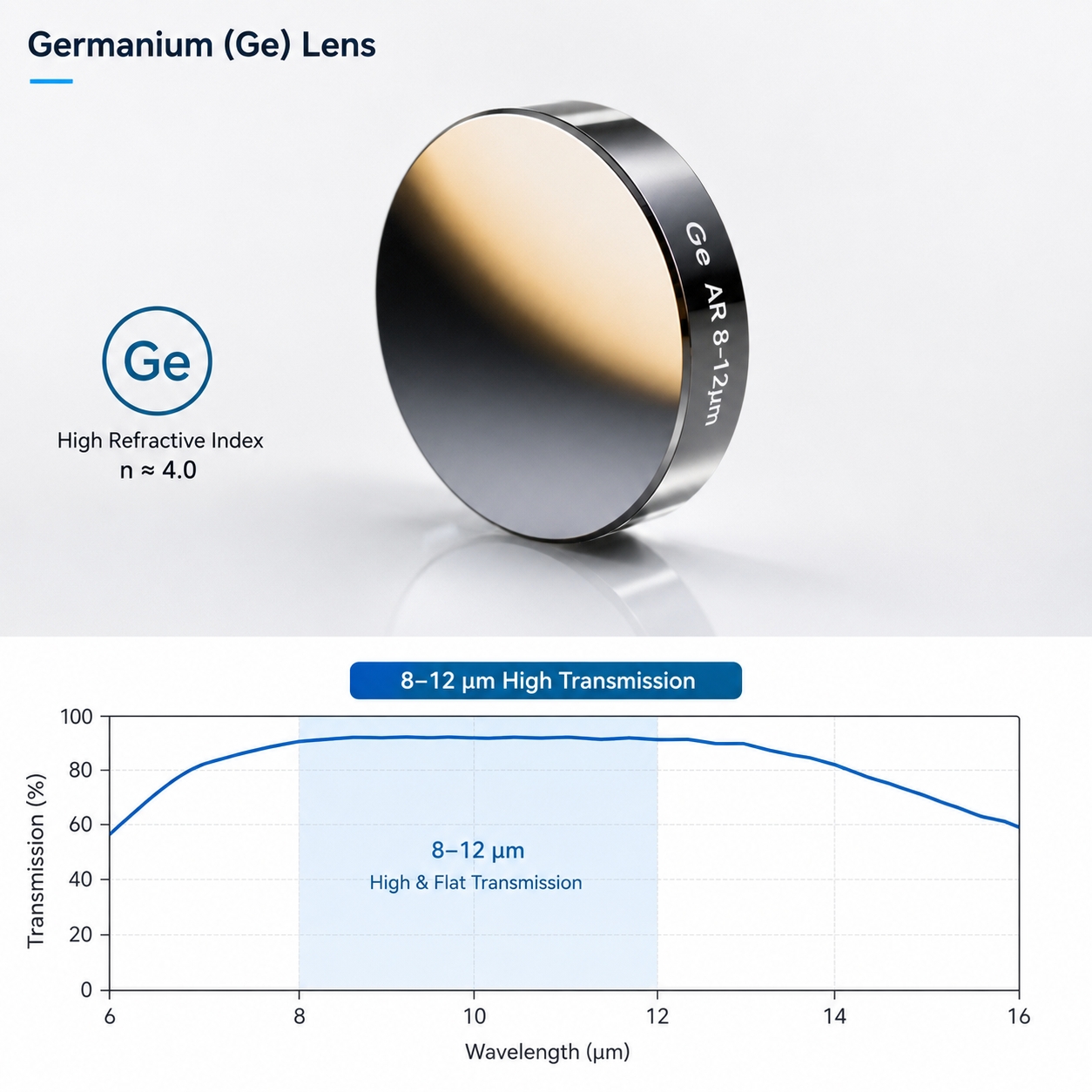
- Optical Component Requirements: High-reflectivity mirrors, low-absorption infrared windows, highly stable cavities
- Typical Applications: Laser cutting, interferometry, and scientific demonstrations
Laser Type: Semiconductor (Laser Diode / LD)
- Gain Medium: Semiconductor PN Junction
- Typical Wavelength: 780–980 nm (Common)
- Output Power: Low to Medium
- Beam Mode: Single-mode or Multi-mode
- Optical Component Requirements: High numerical aperture (NA) collimating lenses, fiber coupling optics, thermal management
- Typical Applications: Optical communication, barcode scanning, consumer electronics
Laser Type: Fiber Laser
- Gain Medium: Rare-earth doped fiber (Yb³⁺)
- Typical Wavelength: 1030–1100 nm
- Output Power: Medium to Ultra-High
- Beam Mode: TEM₀₀ (Fundamental)
- Optical Component Requirements: High-precision collimation, high-efficiency coupling optics, fiber end-face protection windows
- Typical Applications: Industrial macro-machining, advanced research, telecom routing
The Role of Lasers in Modern Applications
Leveraging high brightness, exceptional collimation, and dynamic programmability, laser technology has transformed industrial, medical, scientific, and defense landscapes. In these sectors, optical components are critical enablers that unlock the full potential of the laser source.
1. Industrial Manufacturing
In macro and micro-machining, lasers drive cutting, welding, and surface treatments. The extreme energy density and low divergence allow material processing tolerances far exceeding conventional mechanical tooling. To guarantee burr-free cut edges and uniform weld depths, engineers utilize lenses, collimators, and galvo-scanning mirrors to dynamically modulate focal positions and spot scales. Furthermore, beam-homogenizing optics like Powell lenses transform Gaussian distributions into flat-top profiles, preventing localized overheating and improving processing repeatability.
2. Medicine and Biotechnology
Medical laser applications span refractive eye surgeries, soft-tissue ablation, and high-resolution optical imaging. Precise beam control enables micron-level focusing, optimizing therapeutic accuracy while sparing surrounding healthy tissue. In these clinical applications, high-transmission optics, low-reflection biocompatible coatings, and narrow-band bandpass filters guarantee that a stable, safe beam reaches the target site, safeguarding patient outcomes.
3. Scientific Research
In advanced laboratories, lasers are foundational to spectroscopy, interferometry, quantum computing, and non-linear optics. The high coherence and phase stability of the beam ensure reliable experimental data. Here, optical elements maintain spatial mode purity, control wavefront topology, and handle complex optical path routing. For example, focusing lenses govern spot size, high-reflectivity mirrors maintain beam alignment, and waveplates or polarizers modulate quantum states.
4. Telecommunications and Defense
In fiber-optic networks and Light Detection and Ranging (LiDAR) systems, lasers provide high-speed, long-distance data transmission and environment mapping capabilities. In telecommunications, the narrow linewidth and single-mode purity of lasers maximize fiber bandwidth and transmission distances via Wavelength Division Multiplexing (WDM). In LiDAR, high-brightness, short-pulsed laser arrays enable long-range proximity mapping and high-definition 3D imaging. Optical components within these infrastructures ensure optimal beam collimation, low insertion-loss coupling, and routing efficiency.
Emerging Trends in Laser Technology (2026)
Driven by demands for hyper-precision and efficiency across global manufacturing, medical, and telecom sectors, the laser industry in 2026 is experiencing a wave of disruptive innovations that redefine engineering boundaries.
1. Ultra-Short Pulse (USP) Lasers
Femtosecond and picosecond USP lasers are driving a paradigm shift in micromachining and life sciences. Their ultra-short pulse widths enable a true “Cold Processing” mechanism—vaporizing material faster than thermal energy can conduct into the substrate, thereby completely eliminating the Heat-Affected Zone (HAZ).
- Semiconductor Fabrication: Companies like TRUMPF have integrated femtosecond laser systems directly into semiconductor wafer dicing and micro-via drilling lines, achieving nanometer-scale feature sizes while avoiding micro-cracking or thermal deformation of delicate silicon architectures.
- Medical Optics: In advanced refractive surgery, systems like Alcon’s femtosecond laser suites manage corneal incisions with single-digit micron tolerances, drastically improving the safety profiles of LASIK and refractive lenticule extraction procedures while accelerating patient recovery times.
2. Ultra-High-Power Lasers
High-power Continuous Wave (CW) and high-energy pulsed lasers are redefining structural design limits and throughput speeds for heavy industries.
- Automotive Industry: High-power fiber lasers from industry pioneers like IPG Photonics dominate modern automated Body-in-White (BiW) tailoring, welding, and blanking lines. Industrial data indicates that replacing traditional CO₂ gas lasers or mechanical stamping presses with high-power fiber laser cells boosts comprehensive manufacturing efficiency by over 50%, while producing smooth, dross-free edges that eliminate secondary grinding costs.
- Aerospace Engineering: GE Additive utilizes ultra-high-power Laser Powder Bed Fusion (LPBF) matrices to manufacture complex titanium and nickel-alloy aerospace components. This advanced laser 3D printing approach enables light-weighted topology-optimized designs while boosting overall structural fatigue strength.
3. Tunable and Multi-Wavelength Lasers
Agile wavelength control is serving as the primary engine for next-generation information superhighways and analytical chemistry.
- Optical Communications: Market leaders like Ciena are deploying agile multi-wavelength laser transceivers within modern Data Center Interconnect (DCI) networks. By leveraging ultra-dense Wavelength Division Multiplexing (WDM), these platforms have pushed single-fiber transmission capacities well into the hundreds of Tbps (Terabits per second) threshold.
- Frontier Materials Research: Laboratories like the MIT Optical Infrastructure Group leverage sub-megahertz linewidth tunable lasers to plot the optical absorption profiles of novel quantum materials, providing highly precise spectroscopic footprints required to engineer tomorrow’s topological insulators.
4. Laser Miniaturization and Integration
The maturation of micro-laser modules and Photonic Integrated Circuits (PICs) allows complex optical architectures to be embedded into small form factors like commercial drones, edge robotics, and handheld diagnostic devices.
- Autonomous Driving & Automotive LiDAR: Industrial giants such as Hesai Technology and Ouster have transitioned 2026 architectures toward true solid-state, chip-integrated LiDAR designs. By condensing complex vertical-cavity surface-emitting laser (VCSEL) arrays and SPAD receiver matrices onto a palm-sized silicon-photonic platform, they provide autonomous vehicles with high-resolution, long-range 3D spatial intelligence.
- Point-of-Care (PoC) Diagnostics: New generations of portable flow cytometers and rapid blood analyzers utilize sub-miniature semiconductor laser diodes. These devices enable reagent-free cell counting and fluorescence-based blood panel mapping directly at the patient’s bedside, vastly shortening clinical screening timelines.
5. Intelligent Laser Systems
The convergence of advanced optical loops with Machine Learning (ML) algorithms is transforming traditional “passive optics” into “active, cognitive optical systems.”
- Adaptive Industrial Welding: Intelligent welding stations from TRUMPF leverage deep learning vision networks to monitor molten weld pools in real-time, dynamically adjusting beam power, focus position, and spatial scanning paths mid-weld. In high-volume production lines, this closed-loop AI control scheme has slashed scrap rates for complex, non-linear trajectories by over 30%.
- Metrology & Ultra-Precision Measurement: Teams at the Stanford University Physics Labs use neural network models to stabilize laser interferometry experiments. By predicting and counteracting environmental micro-seismic vibrations via real-time active phase stabilization, they have pushed relative displacement interferometry resolution down to the picometer threshold.
Conclusion
The outstanding performance of a laser system depends on a harmonious balance between its internal gain physics and external optical control. Lenses, mirrors, prisms, and filters dictate beam collimation, focusing, profile homogeneity, and overall phase stability, serving as the unsung foundation for lasers across industrial, clinical, scientific, and telecommunication sectors.
In an era demanding ever-higher precision, choosing premium-grade optics is a critical step in modern optical engineering. Hobbite delivers a comprehensive portfolio of professional optical components, helping you optimize laser system configurations to achieve peak performance across industrial, research, and medical applications.