In the jewelry industry, sapphires and rubies are known for their meanings of nobility and rarity, mesmerizing many with their bright colors and designs. But in other industries, such as optics and research, these types of crystals are as vital. They are used as important components in laser windows and sensors that can withstand powerful rays.
This article will draw a comprehensive comparison between optical sapphires/rubies and their jewelry counterparts in five different areas, including their essence, principles, processing conditions, usage, and value. This will help readers gain a complete understanding of their different uses in different sectors.

Material Essence: Shared Origin, Different Purposes
Sapphire and ruby are both corundum crystals, which are Al₂O₃. The key differences between these gemstones are as follows:
- Ruby: Has trace amounts of chromium ions, which make it red in color.
- Sapphire: Iron and titanium ions cause it to be blue, but corundum can also be other colors, such as yellow or pink.
Although their compositions are identical, different conditions are needed for the two types of crystals, which are determined by their application, namely, Materials for jewelry emphasize visual attractiveness: They need to possess a pure color, a high degree of clarity, and a lack of observable cracks.
Such optical materials require peak performance. This means that these materials require low impurities, a uniform crystal structure, and stress-free and crack-free structures. So, in jewelry, the value of a corundum crystal would depend on its looks and rarity, whereas in optics, a corundum crystal would be valued for its performance.
Optical Principles and Material Properties
The use of optical-quality sapphires and rubies is based on their properties, which provide superior performance in high-precision optical components:
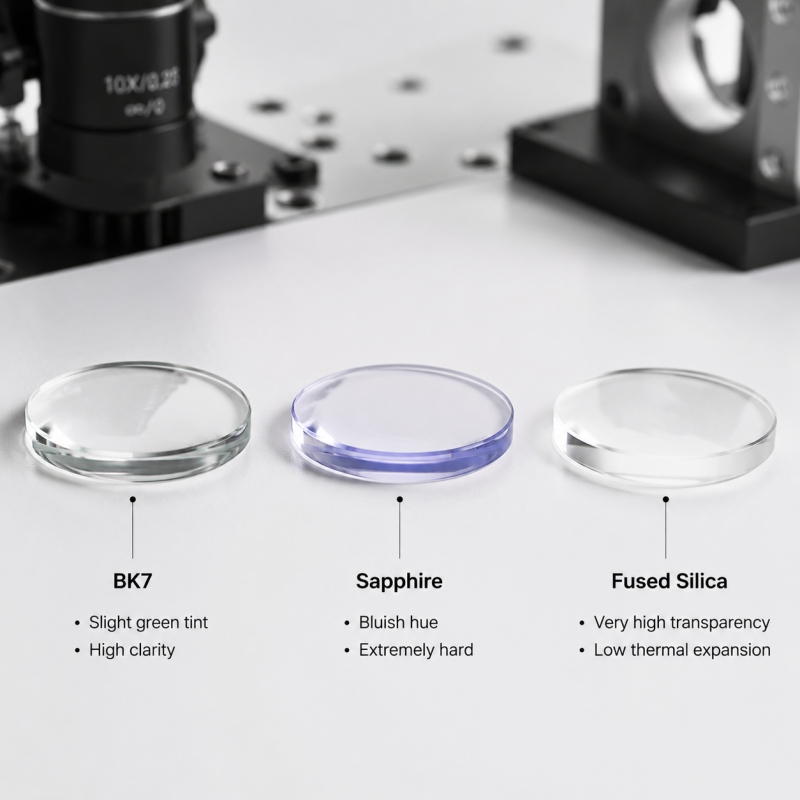
High hardness and wear resistance
Corundum has a Mohs hardness of 9, second only to diamond, which means it has a high resistance to scratching and mechanical abrasion. This ensures that laser windows and components used in laser technology are free from any damage due to prolonged use.
Broad Optical Transmission Range
Sapphire and ruby both have high transmission properties in the ultraviolet range up to the infrared. Ruby lasers working near 694 nm find use in optical ruby, which served as the key component in the first successful solid-state laser developed in 1960 by Theodore Maiman.
Anisotropic Crystal
Corundum has a trigonal crystal system, which gives it anisotropic properties. This means that for this crystal, the speed of light, as well as the index of refraction, depends on direction. This property makes it ideal for use in polarization, wave plates, and optical modulation.
Thermal Stability
The corundum has a low expansion coefficient that provides it with a robust structure that withstands even high-power lighting. This ensures that there are no deviations in the optical paths. Such properties make it not only possible for optical-quality sapphires and rubies to resist intense light and heat but also help in maintaining a stable laser beam.
Differences in Processing and Specifications
The processing techniques immediately affect the application area of the material:
Optical Sapphire
High precision needed: There are requirements for thickness, flatness, and surface roughness on a nanoscale.
- Surface Treatment: Surface polishing, grinding, and/or application of anti-reflective coatings or high-reflection coatings.
- Function-centered strategy: There are certain requirements for dimensions and shapes in relation to optical design, for example, for windows, lenses, and laser crystals.
Jewelry Sapphire
Aesthetics-oriented approach: Values pristine colors, immaculate faceting, and a glossy surface.
- Inclusion tolerance: Slight inclusions that do not negatively impact beauty can even increase uniqueness.
- Different craftsmanship: This involves cutting and polishing, but it has no relation to corrected optics.
Although sharing a common origin, optical and jewelry crystals are processed in utterly different ways, with the former aimed at performance stabilization and control, while the latter focuses on aesthetic appeal.
Comparison of Application Scenarios
Optical Applications
- Laser windows: Provide a stable transmission environment for high-power lasers, with low absorption.
- Lenses and Optical Components: Used in scientific instruments, optical measurement systems, and lasers.
Optical sensors and LED substrates: High transparency and durability ensure reliable functioning.
Jewelry Applications
Adornments: Rings, necklaces, earrings, with emphasis on color, cut,
Collection and investment: Natural gemstones are considered a valuable form of collectible investment.
In summary: While optics concerns performance, precision, and durability, jewelry concerns visual appeal, color, and rarity.
Historical Context and Market Differences
- Optical Ruby: Its most prominent application was in ruby lasers. Ruby lasers were invented in 1960 by Theodore Maiman.
- Optical Sapphire: Because of its wide transmission range in the optical domain and high hardness, it has found widespread use in laser windows and high-quality instrumentation.
Market Differences:
- Optical Materials: Primarily use synthetic crystals. The price remains constant, as value rests with processing and specifications.
- Jewelry Materials: Either natural gems or treated gems will do. The costs are greatly affected by factors like color, clarity, carat, and uniqueness.
Conclusion
Sapphires and rubies are identical in their basic material, but their purpose for use differentiates their value and processing.
- Optical use: For optics, it is all about performance, accuracy, stability, and functionality.
- Jewelry: The emphasis here is on aesthetics, rarity, and art.
Such a crystal can be a precision part in an optical instrument and a precious gem in a jewel. This insight will help scientists and engineers, as well as consumers, understand corundum in a proper perspective as a multifaceted substance.