In modern optical imaging, “infrared” is no longer a vague term associated solely with thermal imaging. With the rapid advancement of sensors and optical materials, the infrared spectrum has been subdivided into more specific bands tailored for various engineering applications. Among these, the two most commonly referenced segments—near-infrared (NIR) and shortwave infrared (SWIR)—differ significantly in wavelength range, imaging principles, material responses, and application areas. Understanding the physical and engineering distinctions between these bands is essential for selecting the appropriate optical system.
Band Definition and Range Limit
- Near-infrared (NIR): Wavelength range of approximately 0.75–1.4 μm (750–1400 nm).
- Shortwave infrared (SWIR): Wavelength range of approximately 1.4–3.0 μm (1400–3000 nm).
Although both are located behind visible light, their imaging behavior and material transmission properties are significantly different. Especially around 1.1–1.4 μm, the response of silicon materials is sharply attenuated, and the water absorption properties are enhanced, which is an important physical basis for the boundary between near-infrared and shortwave infrared.

Core Physical Differences
Detectors and Photosensitive Materials
- NIR: Mainly uses silicon (Si) sensors (CCD/CMOS), which are well-manufactured, low-cost, high pixel density, and low noise, and are suitable for most routine imaging tasks.
- SWIR: Infrared detectors such as InGaAs (indium gallium arsenic) or HgCdTe (cadmium mercury tellurium) are required. These materials respond to longer wavelengths but are more expensive, and some models require cooling to suppress dark current noise.
In short, NIR is cost-effective, and SWIR performance is deeper.
Interaction with Matter
The reflection characteristics of NIR are closer to visible light, and the surface color and roughness are significantly different, making it suitable for surface identification and sorting. SWIR can detect molecular absorption characteristics inside substances. Especially around 1.4 μm and 1.9 μm, the water and organic matter absorption peaks are obvious, which can be used to analyze moisture content, substance purity, and composition. Therefore, SWIR is particularly important in the fields of materials science, agriculture, food testing, and semiconductors.
Transmission and Penetration Ability
SWIR can penetrate some media, such as plastics, fog, or silicon wafers, and has high transparency ability for translucent materials; NIR is more suitable for surface reflection imaging, such as identifying color differences and detecting surface imperfections. This is why SWIR is often used to “see” through surfaces and probe internal structures, while NIR is better at high-resolution surface images.
Optical Materials and Design Requirements
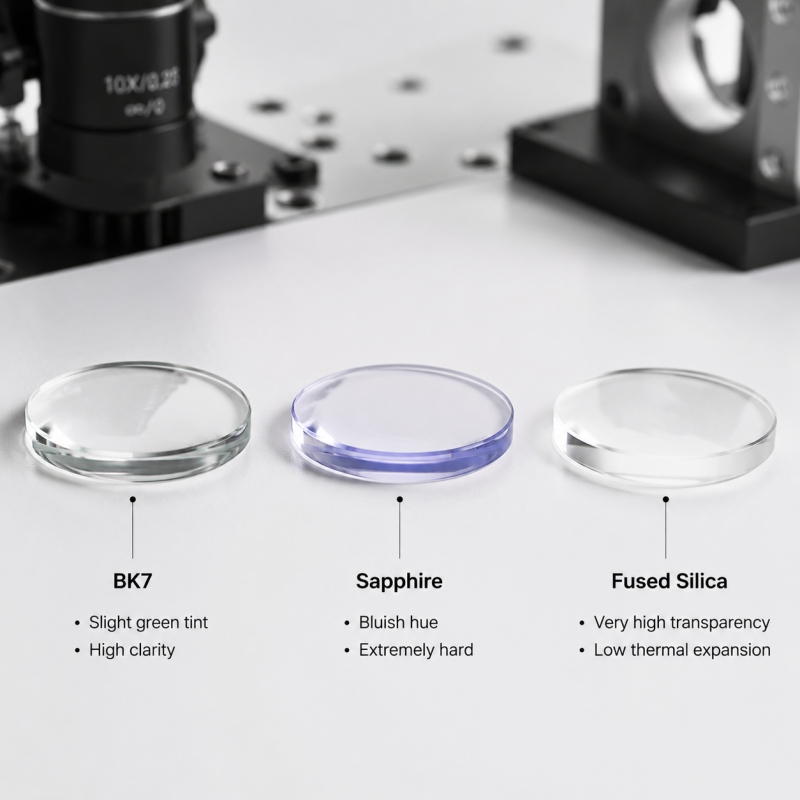
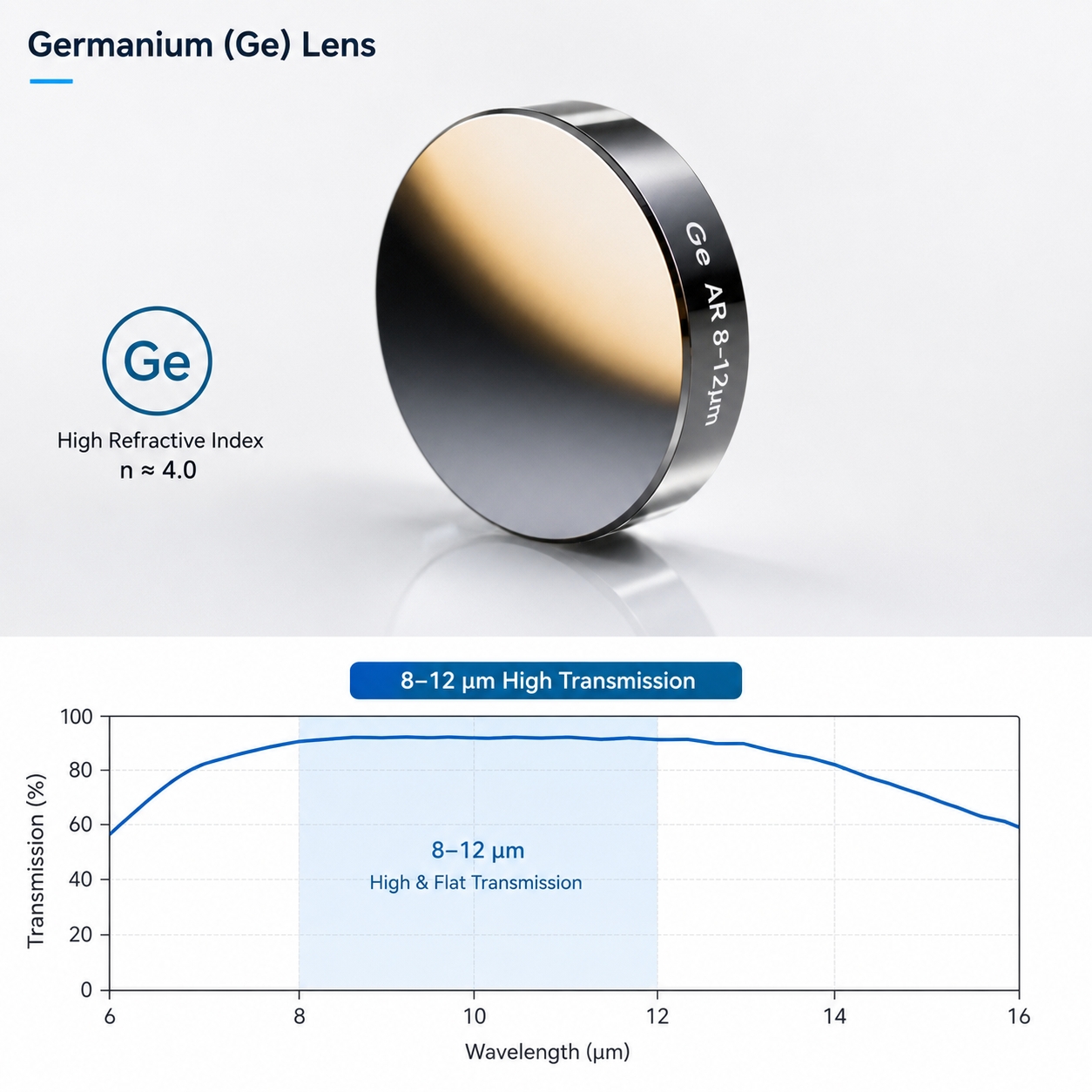
NIR optics can usually be made of conventional optical glass (e.g., BK7, fused silica) with a coating that is close to visible light. SWIR optical systems require higher transmittance infrared materials such as CaF₂, ZnSe (zinc selenide), or sapphire, and anti-reflective coatings for the infrared band. As a result, SWIR systems are not only more costly but also place more stringent requirements on optical path design and thermal stability.
System Design and Engineering Considerations
Light Source Selection
NIR can use inexpensive LED or laser diode light sources. SWIR light sources (e.g., broadband halogen lamps, SWIR LEDs, quantum dot light sources) are more expensive and require stronger energy output to obtain a sufficient signal-to-noise ratio.
Pixels vs. Resolution
Si sensors have high pixel density and fine image quality. InGaAs sensors have larger pixels and relatively limited resolution, but have a wider spectral response.
Noise and Cooling
As the wavelength increases, thermal noise rises dramatically, and SWIR detectors often use thermoelectric cooling (TEC) to maintain a high dynamic range.
Filter and Band Selection
NIR is commonly used with 760–900 nm narrowband filters for vegetation or contrast imaging. SWIR systems can select specific bands based on the target absorption peak for chemical composition identification or humidity analysis.
Comparison of Typical Applications
Applications | NIR Advantages | SWIR Advantages |
Industrial inspection | Surface reflection detection, contrast enhancement | Material internal defect analysis, perspective inspection |
Agriculture & Food | Color & Maturity Detection | Moisture content, sugar, and internal structure of tissues Analysis |
Security and night vision | Low-light imaging, infrared supplementary light monitoring | Imaging in smoke and fog environments |
Semiconductor inspection | Wafer surface inspection | Identifies the chip layer structure through the silicon layer |
Medical and scientific research | Surface tissue reflection analysis | Deep tissue absorption spectroscopy research |
Project Examples and Practical Suggestions
Food & Agriculture Testing
NIR was used to judge crop health, chlorophyll content, and surface maturity. SWIR can accurately detect the moisture, sugar content, and spoilage areas inside the fruit to achieve “non-contact quality grading”.
Electronics & Semiconductors
NIR can detect surface cracks and micro-defects. SWIR penetrates silicon wafers to observe internal circuit layers for chip package inspection and bond verification.
Security and Surveillance
NIR is suitable for low-light imaging; SWIR maintains image contrast in fog and soot and is commonly found in military, port, and border surveillance systems.
Practical Factors to be Aware of
- Cost: NIR systems are economical and easy to use, and SWIR systems have high performance but significantly higher costs.
- Imaging requirements: If the main focus is on surface information, NIR is sufficient; For compositional analysis or penetration imaging, SWIR is more suitable.
- Optical components: SWIR requires higher transmission materials and coating accuracy, and Hobbite custom optical components are recommended to ensure system transmittance and stability.
Future Trends
1. Detector Technology Advancements: InGaAs array resolution continues to increase, and costs are decreasing, and SWIR imaging is expanding to civilian and portable devices.
2. Multispectral Fusion Imaging: Integrating NIR with SWIR allows for both surface reflection and internal absorption characteristics in the same system.
3. AI + Spectral Recognition: Artificial intelligence algorithms can better analyze infrared data to achieve automatic detection, sorting, and identification.
Conclusion
Near-infrared and shortwave infrared are not about who replaces whom, but complement each other.
- NIR: Low cost, high resolution, suitable for large-scale detection and rapid analysis.
- SWIR: Informative and penetrating, it can reveal spectral details beneath the surface.
Understanding the fundamental differences between the two spectra helps customers balance performance and cost. Hobbite, an optical supplier with extensive experience in optical design and imaging, is committed to helping customers achieve greater success through advanced optical solutions and high-performance infrared optical components.