Light is tricky. Not because it’s mysterious, but because it refuses to behave the same way twice. One wavelength bends differently from another, scatters in unexpected ways, and interacts with materials in subtle, often overlooked ways. If you’ve ever noticed that a lens that works fine with green light leaves blue slightly blurry, you’ve already seen wavelength in action.
Materials Don’t Treat All Light Equally
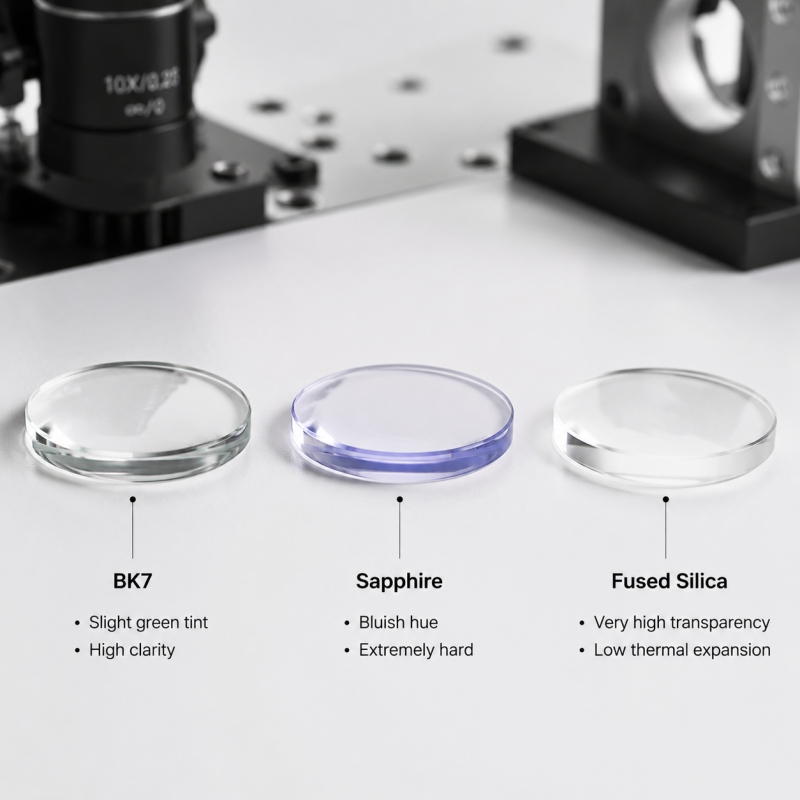
Take fused silica. It transmits visible light easily, but ultraviolet or infrared light tells a different story. The refractive index isn’t a single number—it drifts with wavelength. Even scattering and absorption vary. That means a lens, a window, or a fiber isn’t a neutral path for light; it’s a medium with personality, revealing itself differently depending on which color of light passes through.
Sometimes, small differences can have a big impact. For example, blue light scatters more easily than red light. While the difference isn’t significant, it’s enough to blur an image slightly or weaken the signal. These subtle changes often quietly influence the performance of everything from cameras to fiber optic systems.

Lenses and the Color Problem
Lenses never deal with light impartially. Green might focus perfectly, but red and blue can end up slightly out of focus. Chromatic aberration is the word engineers use, but in practice, it just feels like frustration: a perfectly aligned lens that still leaves one color hazy.
Using an achromatic design can improve this problem by combining different materials to focus multiple wavelengths as close to the same point as possible. However, even with this design, spherical aberration and wavefront distortion will still vary slightly with wavelength. This reminds us that even a seemingly perfect lens often only performs optimally at a specific wavelength.
Coatings: Tiny Layers, Big Impact
AR coatings are another place where wavelength matters. One layer designed for 550 nm can backfire at 650 nm, reflecting more light than intended. Multi-layer coatings broaden the effective range, but only if the deposition is precise. Tiny thickness errors can reduce transmission or, in high-power lasers, damage components.
Coatings might seem superficial, but their behavior across wavelengths often dictates whether a system succeeds or fails.
Fiber and Laser Systems: Wavelength in Action
Fibers are particularly sensitive. Short wavelengths spread faster, which can limit data rates. Longer wavelengths travel straighter but may interact differently with doped fibers. The same goes for lasers. Nd: YAG lasers peak at 1064 nm, erbium-doped fiber amplifiers at 1550 nm. Each choice balances gain, stability, and efficiency, and the wrong one quietly eats away at system performance.
Bringing It Together
Wavelength isn’t just a number—it’s a lens into the behavior of light. It influences materials, lenses, coatings, fibers, and lasers, often in ways that aren’t obvious until a system is built. Calculations help, but experiments reveal the nuances: tiny material imperfections, subtle temperature shifts, or microscopic surface variations can change everything.
Observations to Take Away
Different wavelengths behave differently, and that difference matters. Short, long, or in-between, every photon carries its own rules. Recognizing them doesn’t just improve optical performance—it prevents surprises.
In summary, the behavior of light doesn’t always match theoretical predictions, and materials can exhibit subtle variations. Often, truly valuable discoveries come from noticing subtle deviations in the way light behaves in real systems. Careful observation of these differences can often provide more insight into optimization and design than relying solely on formulas.