Aspheric lenses are widely used in optical communications, laser systems, imaging optics, and consumer electronics because they effectively correct aberrations and optimize optical system performance. Compared to traditional spherical lenses, molded aspherical lenses achieve high imaging quality with fewer optical components, making them indispensable in high-performance optical systems. To meet the demands for high volume, high precision, and low cost, molding has become one of the preferred manufacturing technologies for producing molded aspherical lenses.
Raw Material Selection and Pretreatment
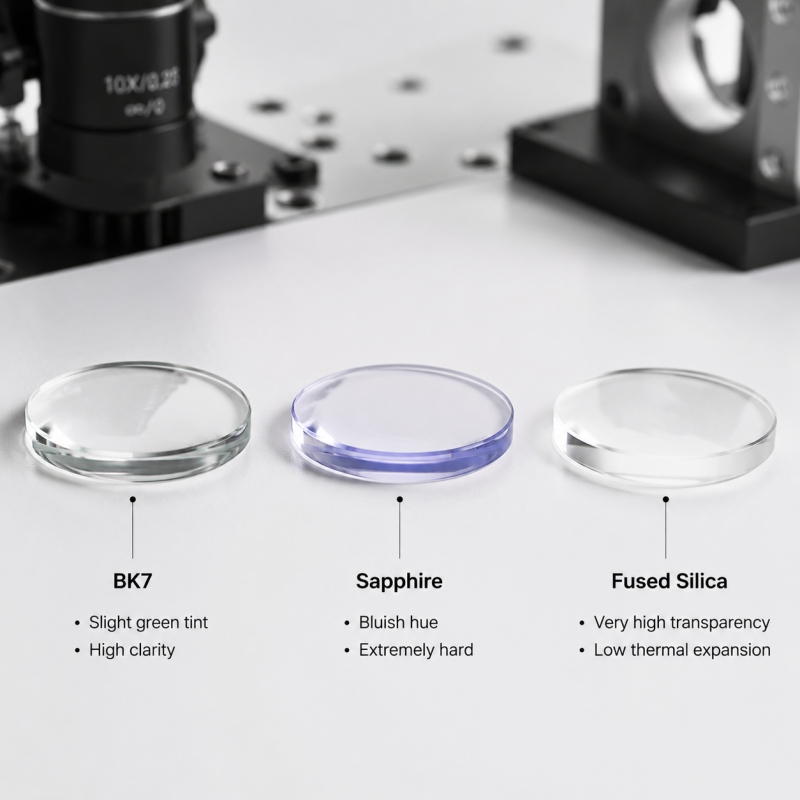
The optical properties of molded aspherical lenses are closely related to the raw materials. Common materials include optical glass (e.g., high index glass, low dispersion glass) and optical plastics (e.g., PMMA, COC, PC). The material’s refractive index consistency, thermal expansion coefficient, stress optical properties, as well as purity and internal bubble inclusions, directly affect the imaging effect and molding accuracy of the final lens.
Before formal molding, the material undergoes strict pretreatment. Plastic raw materials need to be dried to avoid bubbles and uneven refraction caused by moisture; optical glass sheets require initial cutting and removal of rough edges, and in some cases, low-precision polishing or preforming to minimize defects during the molding process.
Mold Design and Preparation
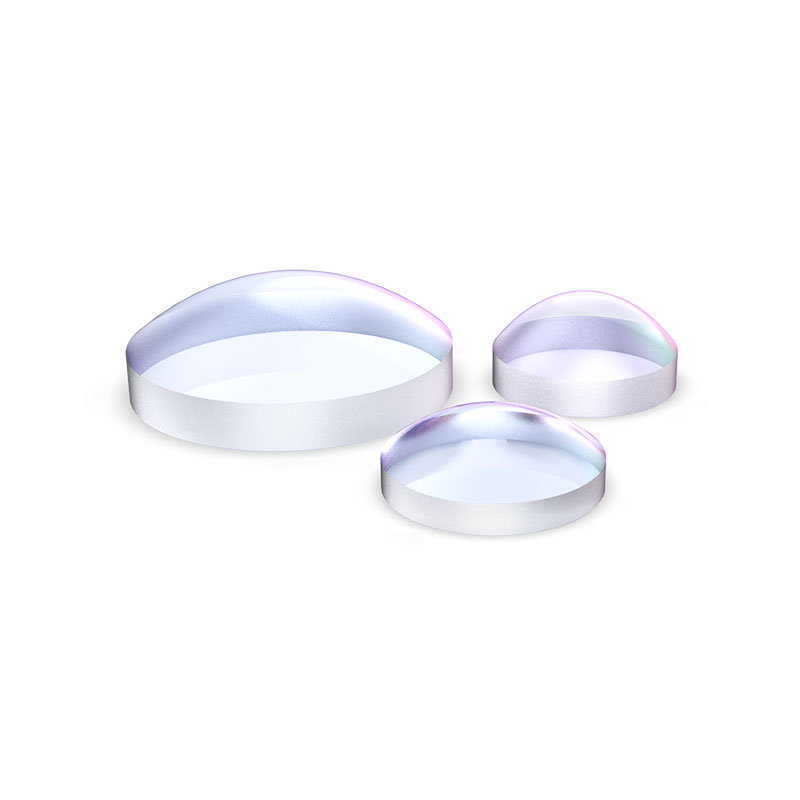
The mold is the heart of molded aspherical lens molding, and its design directly determines the accuracy and surface finish of the finished product. The mold material is usually selected from high-hardness steel (such as hardened steel or tungsten steel), and the surface may be gold-plated or chrome-plated to ensure wear resistance and optical surface quality. Mold processing relies on precision CNC milling and single-point diamond cutting, combined with the final polishing treatment, resulting in an optical-grade finish on the mold surface.
During the design process, thermal expansion matching, release angles, and shrinkage compensation need to be fully considered. The mold size and shape must remain stable at high temperature and pressure; otherwise, it is easy to warp or deviate from the intended aspherical morphology during the molding process. Mold life, surface wear resistance, and batch-to-batch consistency are also important design considerations.
Compression Molding Process
The molding process varies depending on the material properties. For plastic lenses, the raw material is first heated to a softening temperature, and then the material is filled into the mold cavity by injection or pressing. For glass lenses, the glass needs to be heated to a malleable state, and then mold pressure is applied to complete the molding. The entire process requires strict temperature, pressure, holding time, and cooling rate control, which directly affect the aspherical topography accuracy, surface finish, and residual stress distribution.
After molding, the lens needs to be demolded. During the demolding process, warping, cracks, and surface scratches should be avoided, and preliminary optical inspections should be carried out to ensure that the focal length and surface curvature are within the allowable error range. Any molding defects can make it difficult to correct subsequent polishing and coating processes.
Subsequent Processing and Precision Polishing
Molded lenses often require precision trimming to remove tiny burrs and flash. For high-precision applications, further grinding and polishing are also performed to ensure that the aspherical topography meets the design specifications. Surface treatments typically include anti-reflective coatings or multi-layer coatings with enhanced transmittance, as well as strict cleaning and anti-contamination treatments to ensure the optical performance and long-term stability of the lenses.
Quality Testing and Performance Verification
The quality inspection of molded aspherical lenses involves multiple dimensions. The topography detection is completed by a three-dimensional contour measurement instrument, which can accurately measure aspherical errors. Optical performance testing includes focal length measurement, aberration analysis, transmittance, and scattering checks. In addition, attention needs to be paid to stress distribution and thermal stability to ensure that the lens does not degrade in performance under actual use conditions.
Continuous feedback on molding parameters and material properties optimizes processes, extends mold life, and improves finished product consistency. This is especially important for high-volume production and high-precision optical systems.
Challenges and Optimizations in Engineering Practice
Molded aspherical lenses face many challenges in the mass production process: precision control of tiny lenses, thermal expansion matching of materials, relationship between surface finish and mold wear, residual stress distribution after molding, etc. These problems can be effectively addressed through precise process control and mold design optimization. For example, lens dimension stability can be guaranteed by calculating shrinkage compensation, and warping and surface defects can be reduced by optimizing temperature control and pressure curves.
Summary
The molding process provides an efficient, economical, and high-precision production method for molded aspherical lenses. From material selection, mold design, to molding process, post-processing, and testing, every link is directly related to the optical properties of the lens. Understanding and mastering these process details is a core capability for mass production of high-quality molded aspherical lenses. In the future, with the development of free-form optics, microlens arrays, and nanoscale surface treatment technology, the molding process will play a more important role in optical design and manufacturing, providing a reliable guarantee for optical communication, laser systems, and high-precision imaging.