In optics, not all challenges are solved by “concentrating light.” Often, a system’s true need is control, balance, and correction, rather than simple imaging capability. It is in these critical positions that the Concave Lens plays its unique and irreplaceable role.
While the concave lens does not aim for a visually “magnifying effect,” it is deeply involved in beam shaping, aberration compensation, and system structure optimization, making it a fundamentally vital component in sophisticated optical systems.
What is a Concave Lens?
A concave lens is a lens with at least one inwardly curved (concave) surface, characterized by being thinner at the center and thicker at the edges. When parallel light rays strike a concave lens, they deviate away from the optical axis, exhibiting a diverging trend; hence, it is also known as a Diverging Lens.

From an optical functionality perspective, a concave lens is not responsible for forming a real focal point but is instead used to alter the propagation state of a light beam, making rays appear to originate from a virtual point in space.
Optical Principles of Operation
Refractive Behavior and Diverging Property
The diverging effect stems from the combined influence of the lens surface curvature and the material’s refractive index. Light refracts upon entering the lens material from air and refracts again upon exiting back into air. The combined effect of these two refractions causes the overall ray path to deviate away from the optical axis.
For incident parallel rays, the extensions of the outgoing rays converge at a point in front of the lens. This point is the Virtual Focal Point of the concave lens.


The Physical Meaning of Negative Focal Length
In optical definitions, the focal length of a concave lens is designated as a negative value. This is not merely a mathematical convention but a direct description of its diverging behavior. A negative focal length signifies that the lens itself does not create a real convergence point along the light propagation path; instead, it acts to “spread the rays apart.”
Image Formation Rules and Characteristics
Consistency in Image Type
Regardless of the object’s position, the image formed by a concave lens always shares these characteristics:
- The image is virtual.
- The image remains upright.
- The image is diminished(smaller than the object).
This stable imaging nature means a concave lens is unsuitable for use alone in imaging systems, but it becomes highly valuable in compound optical designs.
Why a Concave Lens Cannot Form a Real Image Alone
Forming a real image requires light rays to physically converge in space. A concave lens, by its nature, causes rays to diverge. Therefore, from a physical mechanism standpoint, a concave lens cannot inherently form a real image on its own. This is the fundamental reason it typically functions as a “system auxiliary component.”
Common Structural Types and Their Differences
Biconcave Lens
Both surfaces are concave. It offers strong diverging power and is suitable for applications requiring significant beam angle expansion. Its symmetric structure leads to relatively straightforward optical behavior, but it has limited aberration control capability.
Plano-Concave Lens
Comprising one flat (plano) and one concave surface, this lens is structurally simple and easy to mount and align. In laser systems, it is often used as the front element in beam expanders or as a divergence adjustment component.
Negative Meniscus Lens
Although it features both convex and concave surfaces, its overall focal length remains negative. Compared to biconcave or plano-concave types, this structure better facilitates aberration control while maintaining the diverging function. It is thus commonly used in systems with higher demands for image quality.
Key Optical Parameters Explained
Focal Length and Divergence Strength
The focal length determines the degree to which the lens diverges light. A shorter focal length corresponds to stronger diverging power and a more pronounced effect on the beam.
Aperture and Effective Beam Size
The lens aperture directly limits the size of the beam that can pass through. In high-power or large-spot applications, an insufficient aperture may cause vignetting or uneven energy distribution.
Material and Refractive Index Selection
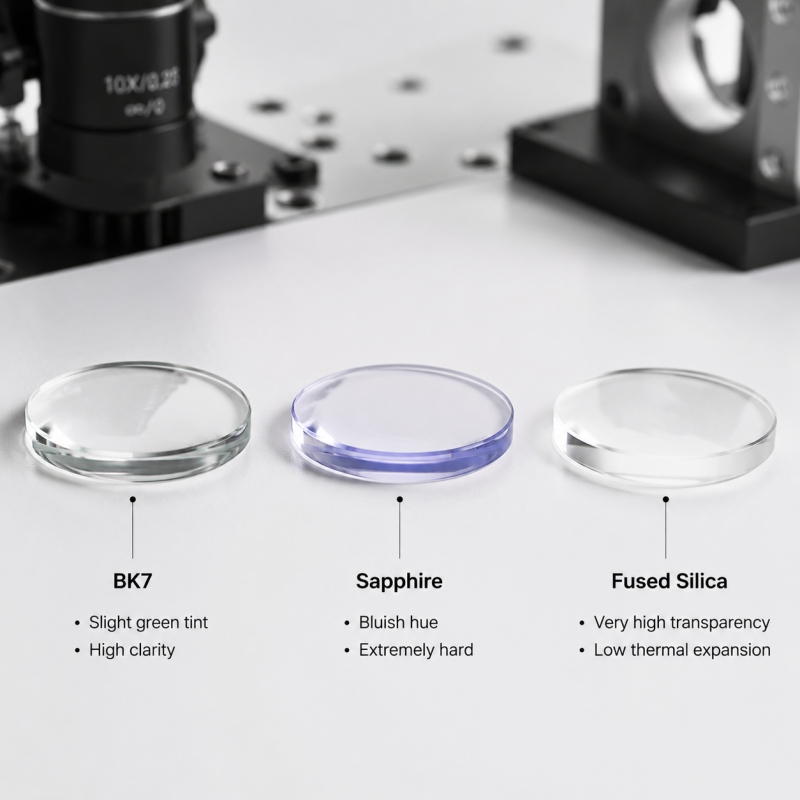
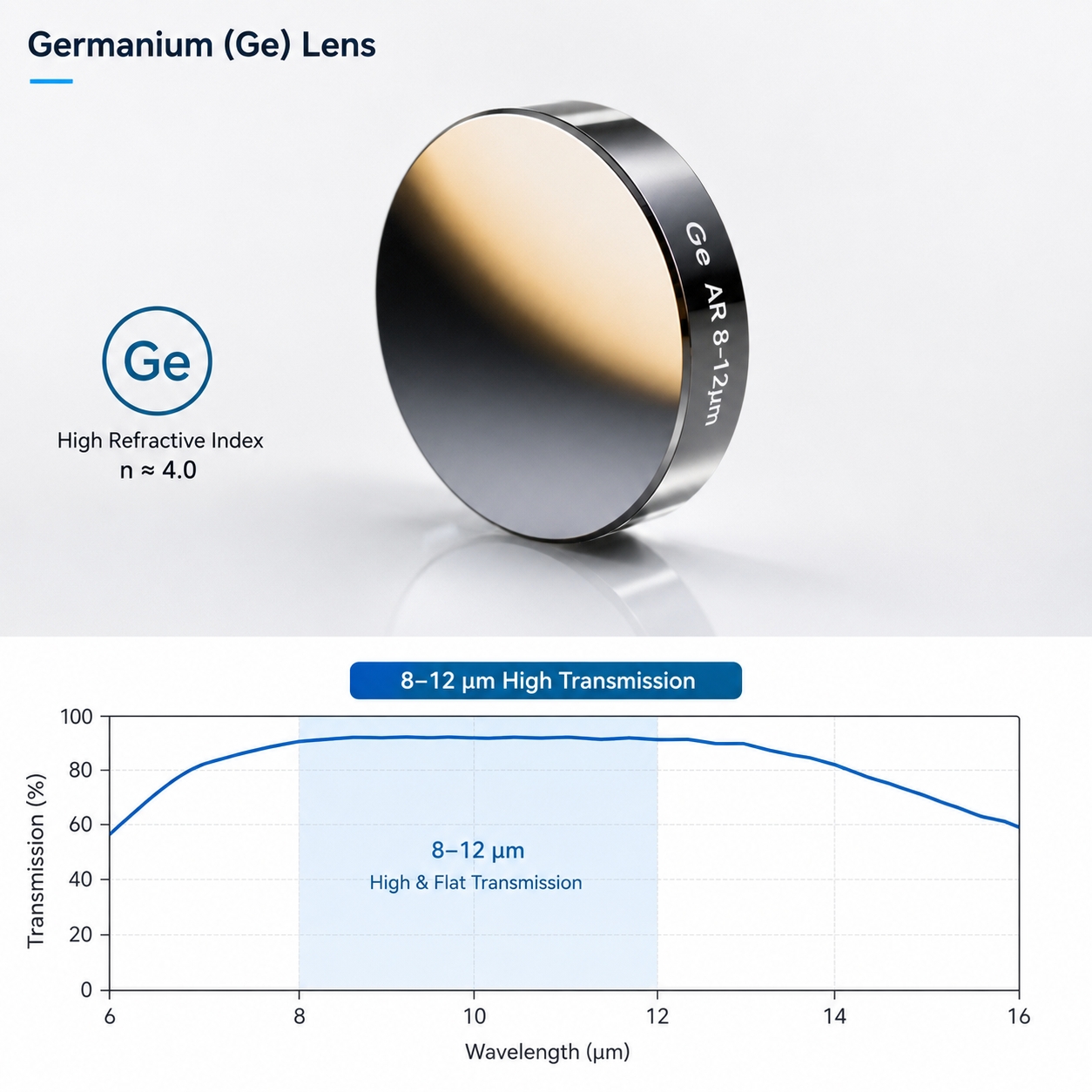
Different optical glasses or crystal materials possess varying refractive indices and dispersion properties, affecting the lens’s performance across different wavelength bands. This is particularly critical in broadband or high-precision imaging systems.
Typical Applications in Optical Systems
Laser Beam Expansion and Shaping
In laser systems, concave lenses are often used as the front element in beam expanders, working in conjunction with a subsequent convex lens to achieve precise control over beam diameter and divergence angle.
Aberration Compensation and System Balancing
By introducing negative optical power, concave lenses can compensate for spherical aberration, field curvature, or other higher-order aberrations within a system. They are a key component in multi-element lens designs.
Optical Instruments and Inspection Equipment
In telescopic systems, measuring instruments, and laboratory setups, concave lenses are frequently employed to adjust the optical path, making the overall structure more compact or performance more stable.
Role in Compound Optical Systems
Synergistic Relationship with Convex Lenses
In most practical systems, concave lenses do not exist in isolation but work in conjunction with convex lenses to form optical combinations. The concave lens “spreads the optical path,” and the convex lens “re-focuses” it. Their coordinated interaction is essential for achieving high-performance designs.
Functioning as a System “Regulator” Rather Than the “Primary Lens”
The value of a concave lens lies not in its imaging magnification but in its ability to regulate the state of the optical path. It acts more like a fine-tuning regulator than the dominant element of a system.
Advantages, Limitations, and Engineering Trade-offs
Advantages of Using a Concave Lens
- Stable and predictable optical behavior.
- Simple structure and high reliability.
- Contributes to overall system optimization without overcomplication.
Limitations of a Concave Lens
- Functionally limited when used alone.
- Heavily dependent on the overall system context.
Unsuitable for scenarios solely pursuing magnification or primary imaging functions.
Determining the Need for a Concave Lens in the Design Phase
In practical engineering design, the decision to use a concave lens often hinges on the following considerations:
- Is there a need to control or expand the beam divergence angle?
- Do system aberrations require negative optical power for compensation?
- Are mechanical constraints limiting the available optical path length?
- Is the goal to reduce system complexity rather than increase the number of elements?
Correctly employing a concave lens often indicates that the system design has matured.
Conclusion
The concave lens does not strive to be the most prominent part of an optical system, yet it is deeply integral to the system’s stability and controllability. Truly excellent optical design is seldom achieved by a single element; it is accomplished through the collaborative effort of multiple components, including the concave lens.
When you begin to seriously contemplate the role of a concave lens, it signifies that you are no longer merely “using optical components” but are genuinely designing an optical system itself.