At first glance, aspheric lenses seem to be all about surface shape. Design discussions often revolve around curvature, deviation from a sphere, or how many aberrations can be corrected. But in real optical systems, shape is only half the story.
Two aspheric lenses with identical geometries can behave very differently once installed. The difference usually comes down to one quiet factor: material choice. Material determines how an aspheric lens reacts to temperature, stress, laser power, and time. In many systems, it is the material—not the surface—that ultimately limits performance.
Optical Glass
Optical glass is still the most commonly used material for aspheric lenses, and for good reason. It offers a reliable balance of refractive index stability, controlled dispersion, and excellent polishability. For many engineers, optical glass represents the “safe baseline” when performance consistency matters.

Where optical glass works best
- Imaging systems with tight wavefront tolerances
- Scientific and laboratory instruments
- Laser systems require a stable beam quality
- Applications where long-term performance drift is unacceptable
Glass behaves predictably under normal operating conditions, which makes system modeling far more trustworthy.
Limitations worth considering
That reliability comes at a cost. Optical glass lenses are heavier than plastic alternatives and typically more expensive to manufacture—especially for complex aspheric surfaces. Some glass types are also sensitive to thermal shock, which can limit their use in harsh environments.
Crystalline Materials
Crystalline materials occupy a more specialized position in aspheric lens design. Unlike optical glass, which is amorphous, crystals have an ordered internal structure that gives them optical properties that glass simply cannot provide. These materials are rarely chosen for general-purpose systems, but when specific performance requirements cannot be met by glass or fused silica, crystals become the only viable option.

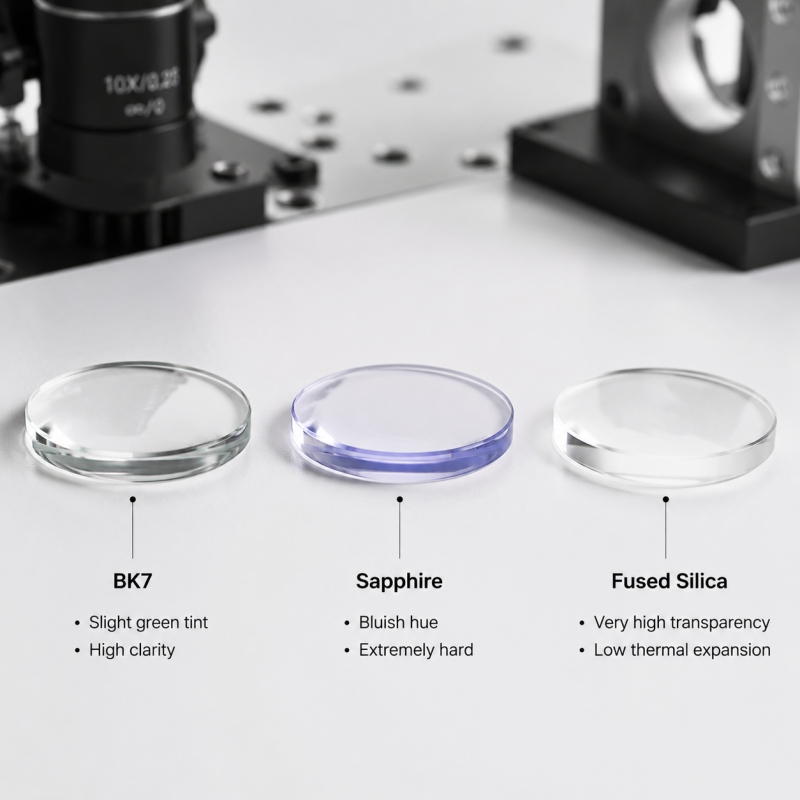
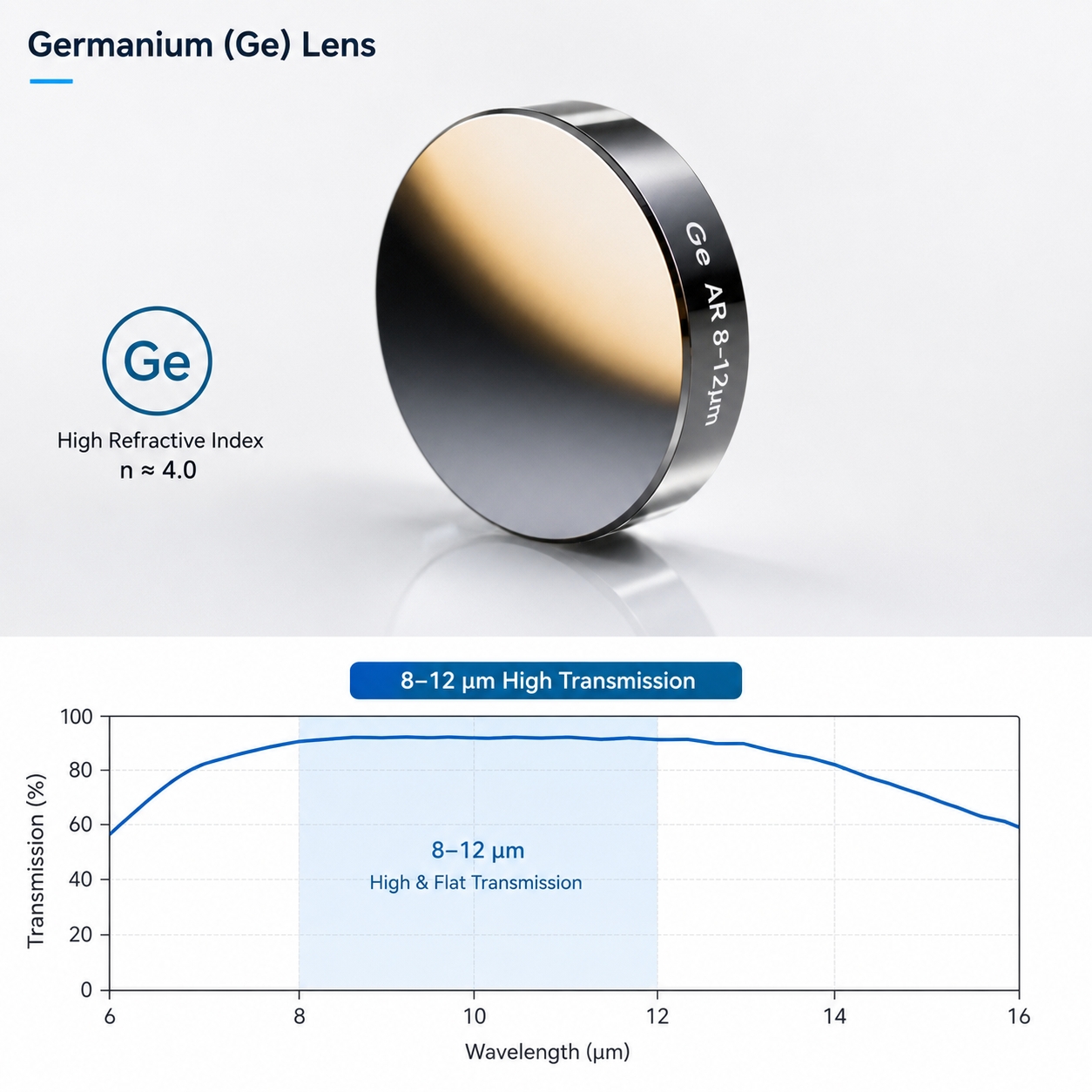
One of the defining advantages of crystalline materials is their access to spectral regions that are otherwise difficult or impossible to reach. Materials such as sapphire, calcium fluoride (CaF₂), and silicon offer excellent transmission in ultraviolet, infrared, or mid-infrared ranges, making them indispensable in spectroscopy, thermal imaging, and semiconductor-related applications. In these systems, the material choice is not an optimization—it is a necessity.
Crystals also exhibit exceptional mechanical strength and thermal stability, particularly in the case of sapphire. This allows crystalline aspheric lenses to survive extreme environments involving high temperatures, pressure, or mechanical wear. However, these advantages come with strict constraints. Crystals are anisotropic, meaning their optical behavior can vary with orientation, and improper crystal alignment can introduce unwanted birefringence or polarization effects.
From a manufacturing standpoint, crystalline materials are among the most demanding to process. Their hardness makes polishing slow and tool-intensive, especially for complex aspheric surfaces. Yield rates are typically lower, and costs rise quickly as surface accuracy requirements tighten. As a result, crystalline aspherics are usually reserved for systems where performance boundaries are defined by physics rather than budget.
In practice, choosing a crystalline material signals that the optical system has moved beyond conventional limits. It reflects a design decision where material properties are no longer a background consideration, but a central part of the optical strategy itself.
Fused Silica and Quartz
When optical systems move into high-energy or high-temperature territory, designers often turn to fused silica or quartz. These materials are chosen not for convenience, but for survival.

What sets fused silica apart
Fused silica offers an extremely low coefficient of thermal expansion and an exceptionally high laser damage threshold. It also maintains excellent transmission from ultraviolet (UV) through near-infrared (NIR) wavelengths. This makes it ideal for systems where even small thermal distortions would compromise performance.
Typical use cases
- High-power laser systems
- UV optics and lithography
- Precision metrology equipment
- Environments with large temperature fluctuations
One often overlooked benefit is reduced thermal lensing. Under intense illumination, fused silica deforms far less than most optical glasses.
The trade-off
Fused silica is more difficult and time-consuming to polish, especially for aspheric profiles. Manufacturing costs are higher, and lead times are usually longer. As a result, it is rarely selected unless its unique properties are truly required.
Optical Plastics
Plastic aspheric lenses are frequently misunderstood. They are sometimes seen as low-cost replacements for glass, yet are expected to deliver glass-like stability. In reality, plastics excel when used within their proper boundaries.

Why are plastics widely used?
Optical plastics allow complex aspheric surfaces to be replicated efficiently at scale. They are lightweight, cost-effective in volume production, and enable compact system designs that would be impractical with glass. Common materials include PMMA, polycarbonate, and cyclic olefin polymers (COP/COC), each offering different optical and mechanical characteristics.
Ideal applications for plastic aspherics
- Compact imaging modules
- Consumer electronics
- Portable optical devices
- Systems with controlled thermal environments
Important limitations
Plastic lenses are far more sensitive to temperature, humidity, and mechanical stress. Even moderate mounting pressure can introduce surface deformation, subtly degrading optical performance over time. Plastic aspherics are not inferior—they simply demand realistic expectations and careful system design.
How Material Choice Affects Manufacturing Reality
Not every aspheric lens design can be produced in every material. Material selection directly impacts:
- Achievable surface accuracy
- Surface roughness after finishing
- Manufacturing yield
- Cost per unit at scale
For example, ultra-precision glass aspherics often require CNC polishing, while plastic lenses depend heavily on mold quality. Fused silica, although stable in use, demands longer polishing cycles and stricter process control. A material that appears perfect in optical software may become impractical once manufacturing constraints are taken into account.
Common Mistakes in Aspheric Lens Material Selection
Even experienced designers fall into these traps:
Prioritizing refractive index alone
A higher index can reduce lens thickness but often increases sensitivity to thermal and mechanical stress.
Ignoring mounting conditions
A lens that performs well in isolation may degrade once fixed into a housing.
Over-engineering the material
Choosing fused silica for a benign environment incurs additional cost without providing a tangible benefit.
Treating material as a late decision
Material choice should be part of early optical system planning, not a final adjustment.
A Practical Checklist Before Finalizing Material Choice
Before locking in a material, it helps to ask a few grounded questions:
- Will the system experience temperature changes?
- Is long-term optical stability critical?
- Is weight a limiting factor?
- Will the lens handle high laser power?
- What is the expected production volume?
Clear answers to these questions often point naturally toward the most suitable material.
Conclusion
Aspheric lenses are celebrated for their ability to correct aberrations and simplify optical systems. But behind every successful aspheric design is a material quietly doing its job. The right material doesn’t draw attention to itself. It simply allows the optical design to perform as intended—today, and years from now. And in optical engineering, that quiet reliability is often the most valuable feature of all.