In modern optical systems, lenses are fundamental components, yet they often suffer from chromatic aberration, which degrades image sharpness and contrast. To address this, achromatic lenses have been developed. By combining materials with different dispersion characteristics and precision-engineered geometries, these lenses bring multiple wavelengths of visible light to nearly the same focus, delivering more accurate, true-to-life images. This article explores the definition, operating principles, and critical applications of achromatic lenses in optical communications, medical imaging, laser processing, and scientific research.

1. Basic Concepts: Lenses and Chromatic Aberration
1.1 Types of Lenses and Their Functions
- Convex Lenses (Positive Lenses): Converge parallel light beams to a focal point; commonly used in camera optics and fiber coupling modules.
- Concave Lenses (Negative Lenses): Diverge incoming light beams; often used to correct aberrations or in beam expansion setups.
- Compound Lenses: Assemblies of multiple lens elements designed to correct spherical, coma, and other aberrations for high-quality imaging.
These lenses find broad applications in ophthalmic devices, optical communication couplers, laser cutting systems, and microscopy setups. Their performance dictates the system’s resolution and stability.
1.2 How Chromatic Aberration Arises
Chromatic aberration occurs because different wavelengths of light (e.g., red, green, blue) refract at slightly different angles when passing through a single lens element. Uncorrected, this leads to colored fringes at image edges and reduced focus accuracy. Prism dispersion of white light vividly demonstrates this effect.
2. Definition and Structure of Achromatic Lenses
2.1 What Is an Achromatic Lens?
An achromatic lens is a compound element made of two or more lenses with contrasting dispersion properties, engineered to bring two wavelengths—typically in the blue (around 450 nm) and red (around 650 nm) regions—into a common focus. This dramatically reduces chromatic aberration across the visible spectrum.
2.2 Typical Achromatic Doublet Design
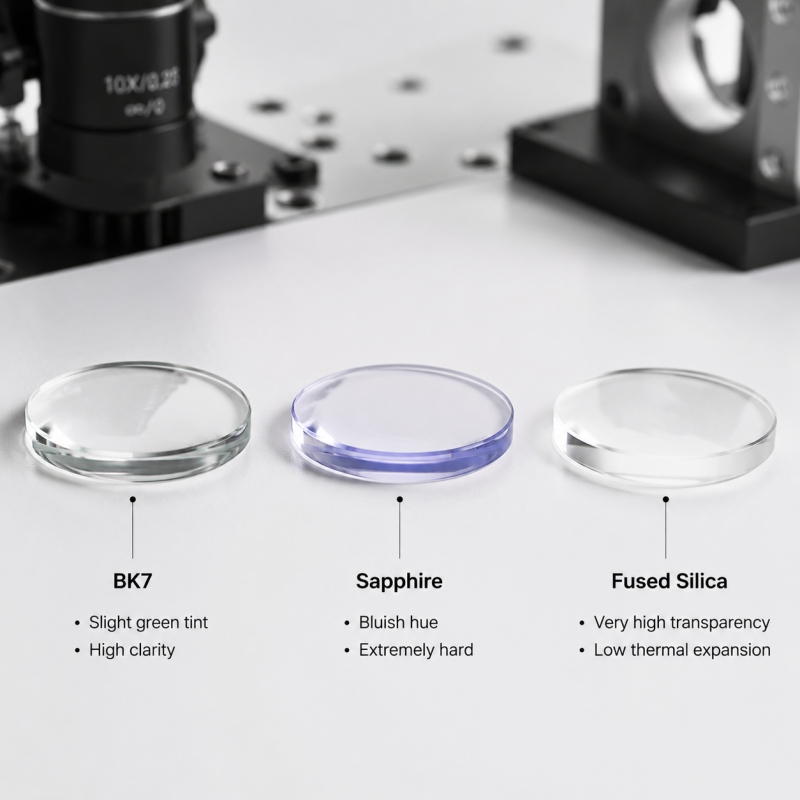
- Crown Glass Element: Low-dispersion glass (e.g., BK7)
- Flint Glass Element: High-dispersion glass (e.g., F2, SF11)
Advanced designs incorporate extra-low dispersion (ED) or ultra-low dispersion (UD) glass to further suppress residual chromatic errors, especially important for high-resolution microscopes and telescopes. Precise control of curvature radii, refractive indices, and Abbe numbers through optical design software ensures optimal achromatic correction.
3. Operating Principles of Achromatic Lenses
3.1 Material Dispersion Characteristics
- Crown Glass: Low refractive index, high Abbe number → minimal dispersion
- Flint Glass: High refractive index, low Abbe number → strong dispersion
Emerging materials include fused silica for UV applications and calcium fluoride (CaF₂) for deep UV transparency, as well as sapphire for IR windows. ED/UD glasses provide superior chromatic correction for demanding imaging systems.
3.2 Physical Mechanism of Chromatic Correction
From a wave optics perspective, each element introduces wavelength-dependent optical path differences. By pairing materials whose dispersion curves counteract one another, an achromatic lens aligns focal points of red and blue light. Lensmakers employ the thin lens formula alongside dispersion equations to calculate the precise geometry and material pairing needed for the desired achromatic performance.
4. Advantages of Using Achromatic Lenses
- Enhanced Image Clarity: Eliminates color fringing and boosts detail resolution—crucial for high definition microscopy and photographic optics.
- Improved Measurement Accuracy: Minimizes chromatic errors in interferometry and fiber endface inspection, yielding more reliable quantitative data.
- Broader Spectral Utility: Maintains consistent focus from ultraviolet to near infrared (UV–NIR), enabling versatile applications in laser processing and multi-spectral imaging.
5. Key Application Scenarios
- Optical Communications: Precise beam alignment in fiber couplers and WDM modules reduces insertion loss and enhances link stability.
- Medical Imaging: Endoscopes and surgical microscopes utilize achromatic objectives to deliver high contrast, artifact-free views of soft tissues, supporting accurate diagnosis and delicate procedures.
- Laser Material Processing: In cutting, marking, and welding systems, a consistent focused spot—achieved via achromatic optics—ensures micron-level precision and uniform energy distribution.
- Scientific Research: Techniques such as Raman spectroscopy, fluorescence microscopy, and astronomical observations depend on achromatic lenses to maximize signal-to-noise ratio and data fidelity.
6. Other Common Optical Materials
- Fused Silica: Exceptional UV transmission and low birefringence for ultrafast laser systems.
- Calcium Fluoride (CaF₂): Superior deep UV transparency for laser resonator optics.
- Sapphire: Hard, scratch-resistant—ideal for high-power IR windows and durable microscope slides.
- Optical Plastics (PMMA, PC): Lightweight, cost-effective for wide field or wearable optics.
7. Conclusion & Hobbite Brand Introduction
Achromatic lenses, with their robust chromatic aberration correction, are vital in optical communications, medical diagnostics, laser machining, and scientific instrumentation. Proper material selection and precise design unlock higher imaging quality and measurement accuracy across diverse spectral ranges.
Hobbite specializes in bespoke optical components, including achromatic doublets, ED/UD lenses, aspheric elements, and UV/IR windows. From material procurement and optical design to precision fabrication and testing, we deliver end-to-end solutions for the telecommunications, medical, laser, and research sectors.