An optical diffuser is a critical optical component designed to distribute light uniformly across a target surface. Its primary function is to eliminate high-intensity hot spots and significantly improve the illumination uniformity of optical systems.
Whether in industrial lighting, display backlighting, or precision imaging and laser homogenization, optical diffusers play a vital role. However, since different applications have varying requirements for light distribution and luminous flux, the geometric design—combined with the control of Diffusion Angles (FWHM)—is a decisive factor in optical performance.
This article explores the three primary morphologies—Square, Circular, and Fan-shaped—and analyzes how they achieve uniform scattering and their respective application scenarios based on material properties.
Working Principles of Optical Diffusers
The ability of an optical diffuser to achieve uniform light distribution relies on the synergy between material properties and geometric structures. When incident light enters a diffuser, it undergoes scattering and refraction either on the surface or within the bulk material, forming a uniform light field on the output surface.
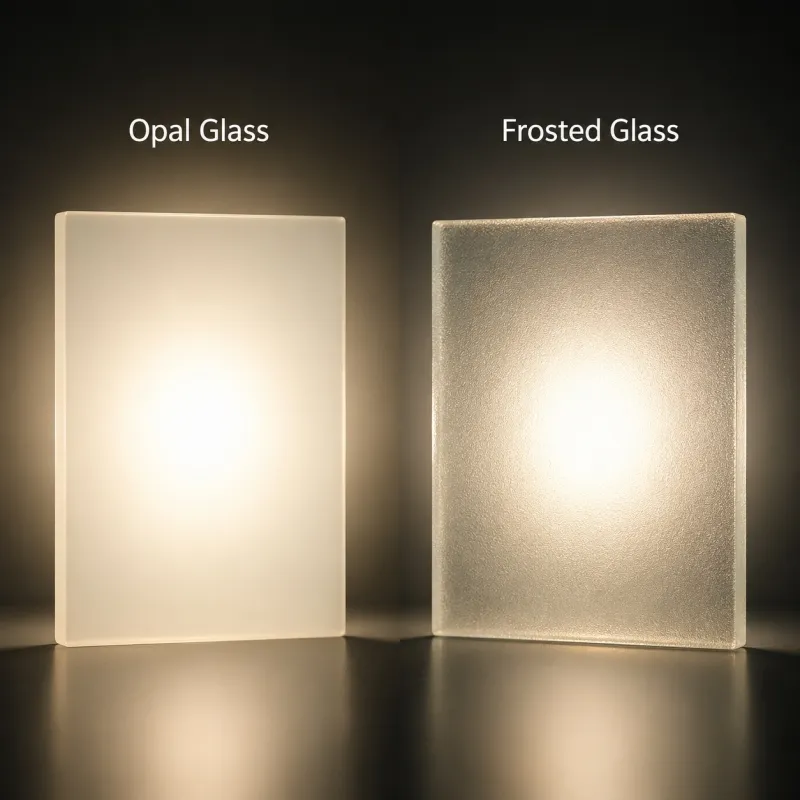
The material selection dictates the scattering efficiency, Optical Transmission, and energy loss. Matte glass diffusers scatter light through fine, micro-rough surface structures, maintaining high transmittance while effectively reducing glare—ideal for low-loss industrial applications.
Holographic glass diffusers utilize microstructures to control light direction precisely, often achieving transmittance rates exceeding 90% while ensuring superior field uniformity. This makes them ideal for high-efficiency industrial lighting and scientific research. In contrast, opal glass diffusers produce a near-Lambertian distribution through internal scattering particles, allowing the light field to spread uniformly over large areas, albeit with higher light loss.
Square Optical Diffusers
With their sharp geometric edges, square optical diffusers are engineered to achieve high-uniformity light distribution for rectangular or square light sources. As light passes through, the edges and corners are effectively homogenized by fine scattering structures, eliminating local hot spots and ensuring consistent intensity across the entire output surface.
Square diffusers are particularly suitable for LED panels, display backlighting, and laboratory benchtop homogenization. Material choice is critical: matte glass provides homogenization with minimal loss, while opal glass is better suited for producing natural, large-area Lambertian illumination. Holographic square diffusers can further optimize transmission efficiency while maintaining uniformity, especially for high-brightness sources.

Circular Optical Diffusers
Unlike square versions, circular optical diffusers feature symmetrical scattering, enabling uniform distribution for circular beams or point light sources. A circular diffuser naturally guides light to expand radially, maintaining high symmetry and consistency in the output light field.
This morphology is essential in spotlights, downlights, and Laser Homogenization systems, as it prevents the “center-heavy” intensity profile where the beam center is too bright relative to the edges.
Material choice directly impacts performance; while matte and holographic circular diffusers meet high-transmission needs, UV Fused Silica matte glass—with its high laser damage threshold (LIDT)—is the standard for efficient scattering in the UV band or high-power laser applications.

Fan-Shaped Optical Diffusers
Fan-shaped or angular diffusers feature directional diffusion to distribute light within a specific angular range (often using non-symmetric diffusion angles such as 10° × 60°).
Unlike square and circular diffusers, the fan-shaped design limits the beam diffusion area to a target zone, reducing spill light and environmental interference. These diffusers offer unique advantages in stage lighting, advertising light boxes, and the optimization of the Field of View (FOV) for optical sensors.
Regarding materials, opal glass fan-shaped diffusers provide wide-angle homogenization, while matte or holographic glass performs excellently in maintaining directionality and reducing scattering loss.

Impact of Geometric Morphology on Optical Performance
The geometric morphology of an optical diffuser directly dictates the distribution pattern and uniformity on the output surface. Square diffusers match rectangular sources to eliminate corner bright spots, while circular diffusers prevent center intensity spikes in point sources—a critical requirement for projection and laser paths.
Fan-shaped diffusers provide controlled directional distribution, ensuring the beam spreads uniformly within a limited target area. Furthermore, modern systems often utilize Line Diffusers to transform light into narrow, uniform strips for machine vision and line-scan inspection.
These different geometries affect not only beam uniformity but also the distribution of scattering angles and the overall efficiency of luminous flux utilization.
Common Materials and Characteristics
Material selection is the other core factor determining performance. Based on industry standards, common materials include:
- Milky White Glass diffusers: Features internal volume scattering for a near-Lambertian light. Best for large-area uniformity, though Transmission typically ranges from 50% to 70%.
- Matte Glass: Scatters light via surface micro-roughness. Offers low scattering loss and excellent uniformity for industrial lighting and backlight modules.
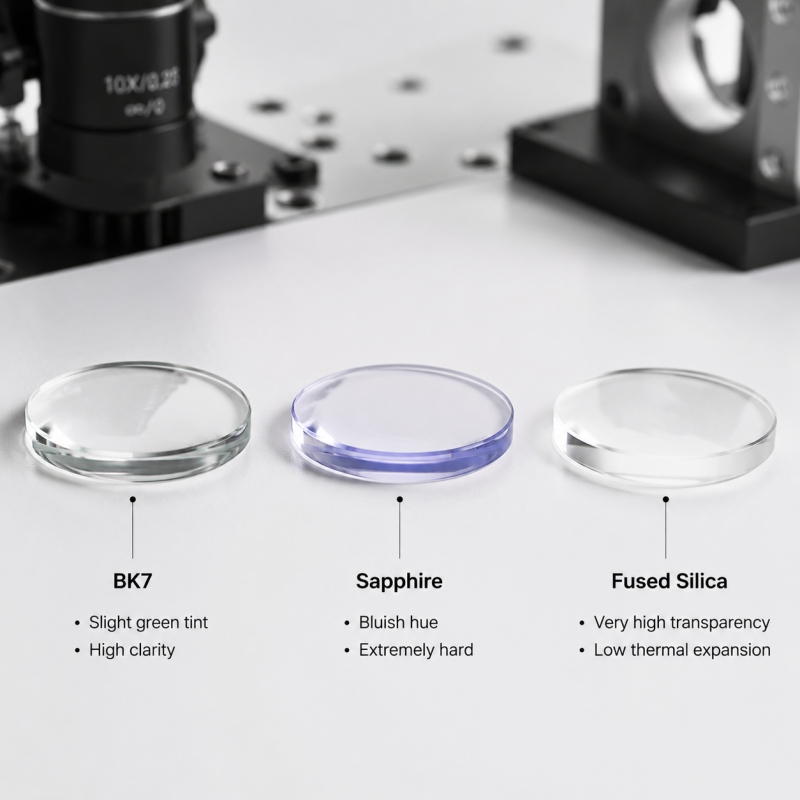
- UV Fused Silica Matte Glass: Combines surface scattering with a low coefficient of thermal expansion. It provides high stability for UV applications or high-power laser homogenization.
- Colored Glass: Provides spectral selectivity, enabling integrated control of color and light distribution in stage or display applications.
- Holographic/Sandblasted Glass: Uses precise micro-structures or adjustable surface roughness. These offer high transmittance (>90%) and highly customizable scattering angles.
Conclusion
Optical diffusers achieve uniform light distribution and eliminate hot spots through the synergy of geometric design and material science. Square diffusers are optimized for rectangular sources, circular ones for point sources and laser beams, and fan-shaped ones for directional lighting.
By scientifically matching geometric parameters (such as FWHM) with materials like matte, holographic, or opal glass, engineers can ensure precise and stable optical performance across the industrial, display, and scientific research sectors.