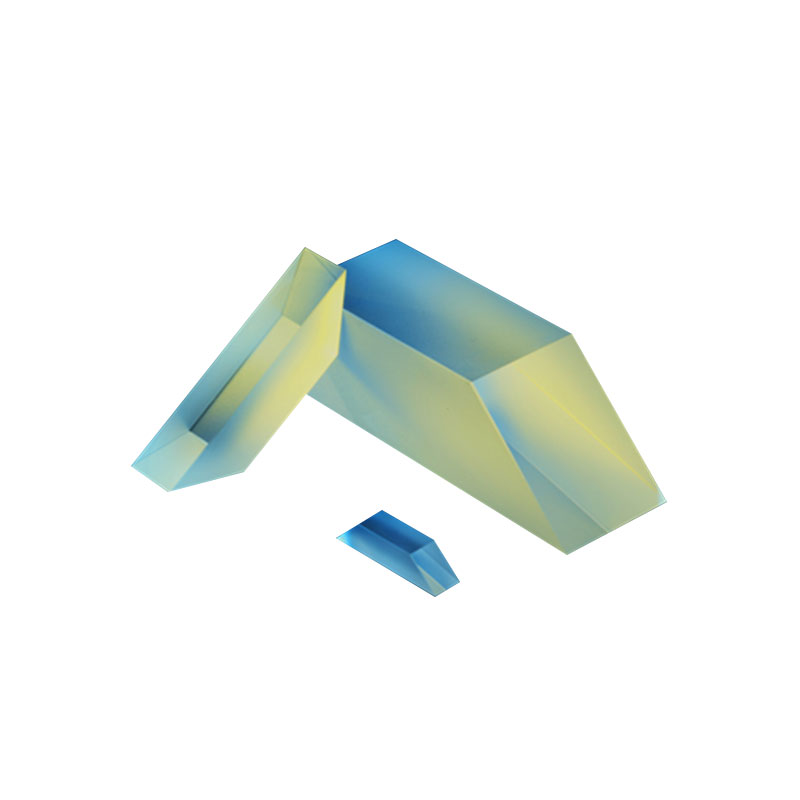
A Dove Prism is a widely used component in optics, primarily designed to rotate and flip images. It typically features a truncated right-angle shape with an isosceles trapezoidal cross-section. It functions through a combination of precise refraction and Total Internal Reflection (TIR).
Unlike traditional lenses, Dove prisms can process specific images within an optical path while maintaining beam collimation, earning them a vital role in scientific research and industrial optical systems. Thanks to advancements in optical materials—such as High-Transmission Synthetic Fused Silica and Low-Dispersion Optical Glass—the performance of Dove prisms has reached new heights, allowing for precise image flipping across broad wavelengths.
Often referred to as a “reversion prism,” the Dove prism’s compact design and high optical efficiency allow it to adapt to various industry needs. Below, Hobbite provides a detailed look at the design principles, applications, and unique advantages of Dove prisms.
Design Principles of Dove Prisms
The Dove prism relies mainly on the principle of Total Internal Reflection (TIR). When a collimated beam enters through one sloped face, it undergoes a single reflection at the bottom surface before exiting through the opposite sloped face, resulting in an inverted image.
- Key Characteristic: A unique feature of the Dove prism is that when the prism rotates by an angle of θ, the transmitted image rotates by an angle of 2θ.
- Precision Control: In high-precision systems, Dove prisms are often paired with rotation stages to allow for the exact adjustment of the beam rotation angle.
- High Efficiency: Because the beam travels through the prism under TIR conditions, there is virtually no energy loss. This design also avoids the mechanical axial deviations often caused by multi-lens assemblies, which is critical for applications like interferometry, laser scanning, and optical imaging.

Optical Challenges Solved by Dove Prisms
In high-end research and industrial optics, many sectors face challenges such as image inversion distortion, imprecise beam control, and energy loss caused by complex optical paths.
In laser processing or precision imaging, beams often pass through multiple reflections. Even a slight deviation can cause image inversion or laser focus shift, directly impacting the final quality. Traditional lenses or simple mirrors cannot rotate an image without changing the position of the optical axis.
Dove prisms provide an elegant solution: They solve beam flipping and rotation issues while ensuring the image remains distortion-free. Due to their unique structure, they allow for extremely fine step-control and reduce light loss, providing a reliable and controllable solution for complex systems that standard components cannot handle.
Application Fields
Scientific Research & Interferometry:
Dove prisms make the direction of interference fringes controllable, improving the accuracy and repeatability of experiments. They also stabilize the beam rotation vector in laser equipment.
Optical Imaging Systems:
Used in microscopes and sensors for image flipping and rotation. They allow for real-time adjustment of image orientation without affecting resolution, making multi-angle imaging more efficient than using bulky multi-mirror setups.
Laser Processing & Beam Shaping:
In laser engraving, cutting, and welding, Dove prisms adjust the direction of asymmetric beams to achieve uniform distribution or specific projection effects, reducing system complexity.
Optical Communications & Fiber Testing:
With the growth of high-speed networks, Dove prisms are used in fiber testing and CPO (Co-Packaged Optics) spatial coupling to precisely adjust signal direction and polarization, reducing interference.
Other High-Precision Systems:
They are also a top choice for astronomical observation, optical projectors, and laser scanning systems where precise image alignment is required.
Comparison: Dove Prism vs. Penta Prism
Comparison Metric | Dove Prism | |
Structure | Rectangular/Compact | Pentagonal/Slightly Larger |
Main Function | Image Rotation & Flipping | Constant 90° Beam Deviation |
Rotation Ability | 2θ Multiplier Adjustment | Fixed Direction |
Optical Efficiency | Extremely High (TIR) | Stable (Requires Coatings) |
Typical Applications | Laser Scanning, Image Alignment | Surveying, Fixed Optical Paths |
Summary: Dove prisms are ideal for scenarios requiring flexible rotation control or multi-angle compensation, while Penta prisms excel in providing steady, fixed-angle beam deviations.

(Hobbite Penta Prism)
Material and Manufacturing Considerations
Penta Prisms focus on the stability of the fixed deviation angle. The manufacturing process is mature, utilizing grinding, polishing, and precise cutting, often with coatings to reduce reflection loss.
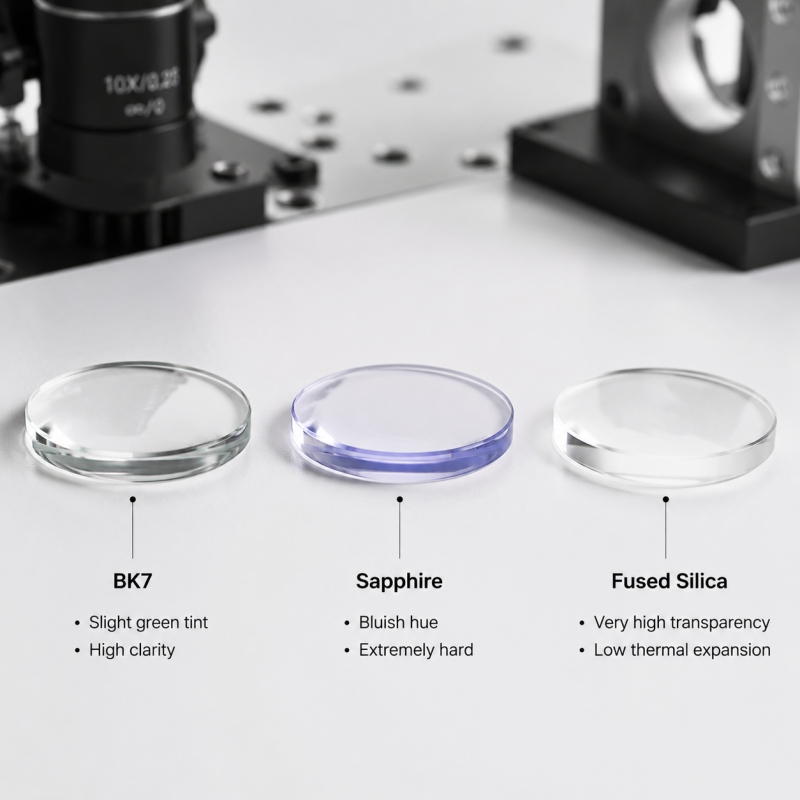
Dove Prisms require much higher material uniformity and tighter angular tolerances. To achieve high-quality image rotation, High-Transmission Synthetic Fused Silica or K9 (BK7) low-dispersion glass is typically used. Due to the specific aspect ratio and high sensitivity to the rotation axis, Dove prisms are generally more difficult and costly to manufacture than standard Penta prisms.
Conclusion
In 2026, the rise of AI computing infrastructure and optical interconnection technology has further increased the demand for Dove prisms. In high-speed optical communications, especially CPO systems, they enable precise beam alignment and multi-channel management. In AI-driven optical systems, flipping or rotating beams at the hardware level reduces software processing latency and improves real-time accuracy. As high-precision systems continue to evolve, the Dove prism remains an indispensable and growing component in the industry.