In optical design, attention often gravitates toward convex lenses for their “focusing and imaging” capabilities, overlooking the equally fundamental component: the concave lens. In reality, whether in vision correction, laser systems, or complex imaging lens assemblies, concave lenses play a crucial role in shaping light beams and optimizing system performance. Understanding how concave lenses work is essential for grasping the broader principles of geometrical optics. Let’s explore what a concave lens is.
Definition and Basic Characteristics
A concave lens, also known as a diverging lens, is characterized by being thinner at its center than at its edges. Its most notable optical property is its ability to cause parallel incident light rays to diverge, bending them outward away from the optical axis after passage. The backward extensions of these diverging rays converge at a virtual focal point located in front of the lens. Consequently, a concave lens has a negative focal length.
Since light rays do not physically converge in space, a concave lens cannot form a real image on its own. It produces only upright, diminished virtual images. This imaging characteristic dictates that concave lenses are typically employed for beam control and system correction rather than as primary imaging elements.
In optical diagrams, a concave lens is symbolically represented by a line curved inward at its ends, visually reflecting its core function of reducing convergence or enhancing divergence.

Imaging and Light Propagation Principles
When parallel or diverging light enters a concave lens, the curvature of its surfaces alters the light’s propagation direction, bending the rays outward relative to the optical axis. The exiting rays diverge and do not meet at any real point in space.
If these divergent rays are traced backward (in a reverse direction), their extensions intersect at a point in front of the lens: the virtual focal point. As no light actually passes through this point, a concave lens is incapable of forming a real image.
This principle underpins the typical functions of a concave lens within an optical system:
- Beam Expansion (Increasing beam divergence)
- System Focal Length Adjustment
- Imaging Position Control


Primary Structural Types and Their Differences
- Biconcave Lens: Features two inward-curving (concave) surfaces. It offers strong divergence, a symmetrical structure, and is suitable for basic optical layouts and systems that require significant divergence angles.
- Plano-Concave Lens: Has one flat (plano) and one concave surface. This design offers advantages for mounting and system integration, making it particularly suitable for applications like beam expansion and power density control in laser systems.
- Negative Meniscus Lens: Possesses a more complex shape with one concave and one convex surface, where the concave surface has a greater curvature. In practical engineering, it is often used to reduce spherical and coma aberrations, making it common in high-quality imaging lens groups.
Analysis of Key Optical Parameters
In engineering applications, the performance of a concave lens is determined by the following parameters:
- Focal Length: Determines the lens’s ability to control beam divergence. A smaller absolute value of the (negative) focal length results in greater ray bending and a larger divergence angle of the output beam. In system design, the focal length influences the beam expansion rate, the system’s effective focal length, and the overall optical path length, necessitating coordination with spatial constraints and functional goals.
- Clear Aperture: Defines the maximum beam diameter that can effectively pass through the lens, directly impacting the system’s light throughput and energy distribution. An insufficiently clear aperture can lead to beam vignetting, energy loss, and enhanced diffraction effects, making this parameter critical in high-power or large-beam applications.
- Center and Edge Thickness: These dimensions affect the lens’s mechanical strength, reliability, manufacturability, weight, and required installation space. For compact optical systems, thickness becomes a key compromise between mechanical design and optical performance.
- Numerical Aperture (NA): Characterizes the lens’s ability to receive and control light rays at high angles. A larger NA indicates a wider range of ray angles the lens can handle. In practice, NA selection must balance divergence requirements, aberration control, and the system’s tolerance for ray angles.
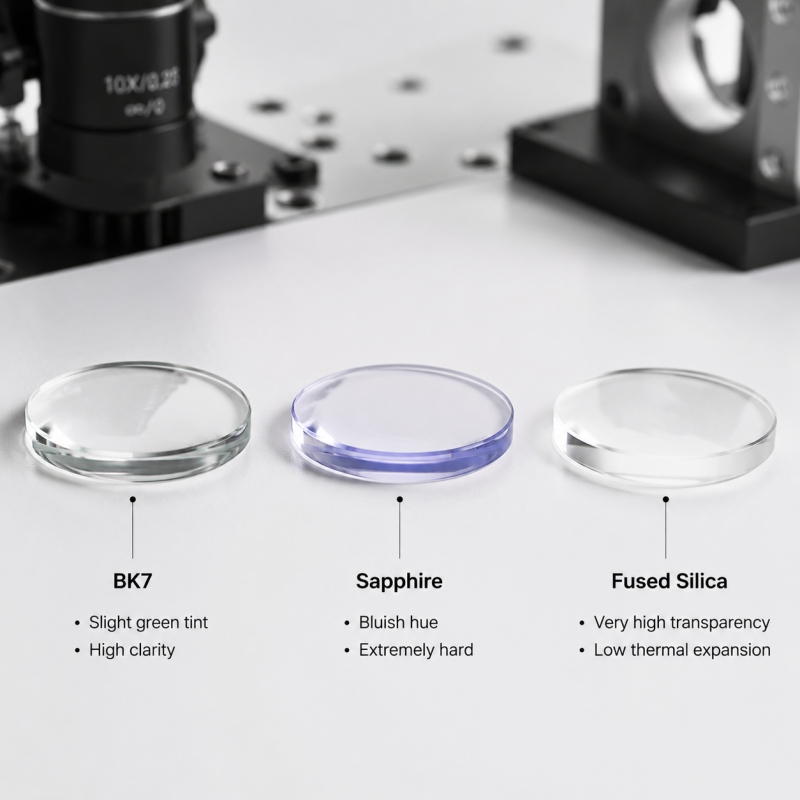
- Material and Wavelength Compatibility: Different optical materials (e.g., N-BK7, Fused Silica) exhibit varying refractive indices, dispersion properties, and transmittance across wavelengths (visible, NIR, IR). Incorrect material selection can lead to reduced transmission efficiency, increased chromatic aberration, or poor thermal stability. Therefore, material choice must align with the system’s operational wavelength and environmental conditions.
Is Coating Necessary for a Concave Lens?
From an engineering perspective, the need for coating a concave lens depends on the specific application. As concave lenses are typically used in combination with other optical elements, surface reflection losses can accumulate significantly within a system. Without an anti-reflective (AR) coating, each uncoated glass-air interface reflects approximately 4% of incident light. In multi-lens systems, this loss can substantially reduce overall transmission and potentially introduce stray light. Therefore, coating is generally recommended for concave lenses in the following scenarios:
For use in laser systems or optical paths demanding high transmission: In laser systems, concentrated beam energy makes every surface reflection a direct loss to output power. Reflections can also create internal parasitic paths, increasing safety risks and thermal load. For high-transmission paths, the cumulative ~4% loss per uncoated surface quickly degrades system efficiency. Dedicated AR coatings designed for the laser wavelength are typically required to enhance transmission and ensure stable operation.
For use in imaging systems requiring suppression of ghost images and stray light: In imaging systems, surface reflections can create unintended paths within the optics, leading to ghost images, flare, or reduced contrast. Uncoated surfaces on a concave lens can be particularly problematic as their reflections may be amplified by the imaging system, directly affecting image quality. A coating to reduce reflectivity effectively suppresses stray light, improving image clarity and system signal-to-noise ratio.
For systems containing multiple optical elements where reflection loss is non-negligible: In multi-lens assemblies, reflection losses from each element are additive. Even small per-surface losses can lead to significant overall transmission reduction. Coating concave lenses in such systems helps improve total efficiency, optical path stability, and consistency, representing a common and necessary engineering choice for complex optics.
Common coating types include:
- Single-layer AR coating (e.g., MgF₂): Suitable for cost-sensitive, narrow-bandwidth applications.
- Broadband Anti-Reflective (BBAR) coating: Used for visible or near-infrared imaging systems.
- Laser-line AR coating: Designed for specific laser wavelengths and power levels.
For simple optical paths with lower cost or performance requirements, concave lenses can be used uncoated, accepting the associated light loss.
Typical Applications of Concave Lenses
Vision and Visual Correction: In eyeglasses for myopia (nearsightedness), concave lenses diverge incoming light, moving the image point backward to fall precisely on the retina.
Laser and Beam Shaping Systems: Concave lenses are frequently used for:
- Beam expansion
- Divergence angle adjustment
- Reducing energy density per unit area to protect downstream optics
Imaging Optical Systems: In complex imaging lenses, concave lenses often serve as auxiliary elements for:
- Aberration compensation (e.g., correcting spherical or chromatic aberration introduced by convex lenses)
- Focal length fine-tuning
- Making the system more compact
Optical Communication and Sensing Systems: In applications like fiber coupling or sensor matching, concave lenses help control spot size to improve coupling efficiency and system stability.
Advantages and Limitations
Advantages:
Concave lenses feature simple, stable, and reliable structures. They are relatively easy to manufacture, install, and offer mature, cost-effective fabrication processes. Their unique ability to diverge and correct light is indispensable in many optical systems. Whether for beam expansion, aberration compensation, or optical path adjustment, concave lenses enable precise optical control with minimal structural impact.
Limitations:
A concave lens cannot form a real image by itself and typically must be used in conjunction with other lenses or optical components to be effective. In high-precision or demanding applications, stringent requirements are placed on material refractive index, dispersion properties, and surface quality; otherwise, optical performance may be compromised, leading to issues like stray light or aberrations.
Selection and Engineering Guidance
In practical engineering projects, selecting a concave lens requires a comprehensive trade-off based on the system’s specific optical function and constraints. Key considerations and detailed recommendations include:
Define the Core Optical Objective: Precisely identify the lens’s primary role in the light path, which determines parameter priority and design focus.
For beam divergence: Focus on the absolute value of the negative focal length and its ability to control the divergence angle. Calculate and match the required divergence.
For beam expansion systems(combined with a convex lens): As the input element in a Galilean or Keplerian beam expander, its focal length (absolute value) must match that of the subsequent convex lens to achieve the target expansion ratio. While individual lens aberration tolerance might be moderate, the combined wavefront quality is critical.
For aberration correction: In complex systems, concave lenses are often paired with convex lenses to correct spherical aberration, chromatic aberration, etc. Selection should be guided by optical simulation to optimize its focal length, material (Abbe number), and curvature for optimal aberration balancing within the specific conjugate distances, rather than evaluating it in isolation.
Coordinate Focal Length with System Optical Path Length: The negative focal length (-f) is the core parameter determining the lens’s optical strength and must be evaluated within the full system context.
Absolute Focal Length (|f|) and Working Distance: A smaller |f| indicates stronger optical power, producing a virtual image point closer to the lens for a given object distance. Ensure this virtual point or diverging beam meets the position and aperture requirements of downstream components (e.g., subsequent lenses, detector windows).
Total System Length Constraints: Utilizing the divergent property of a concave lens can effectively “fold” the optical path within a physically constrained system, extending the optical throw distance. This allows achieving a longer effective focal length within a compact form factor. Ray tracing should be performed during selection to verify that it achieves the desired optical effect within the given space.
Precise Matching of Working Wavelength and Lens Material: Material properties vary significantly across wavelengths; improper selection severely impacts efficiency and introduces aberrations.
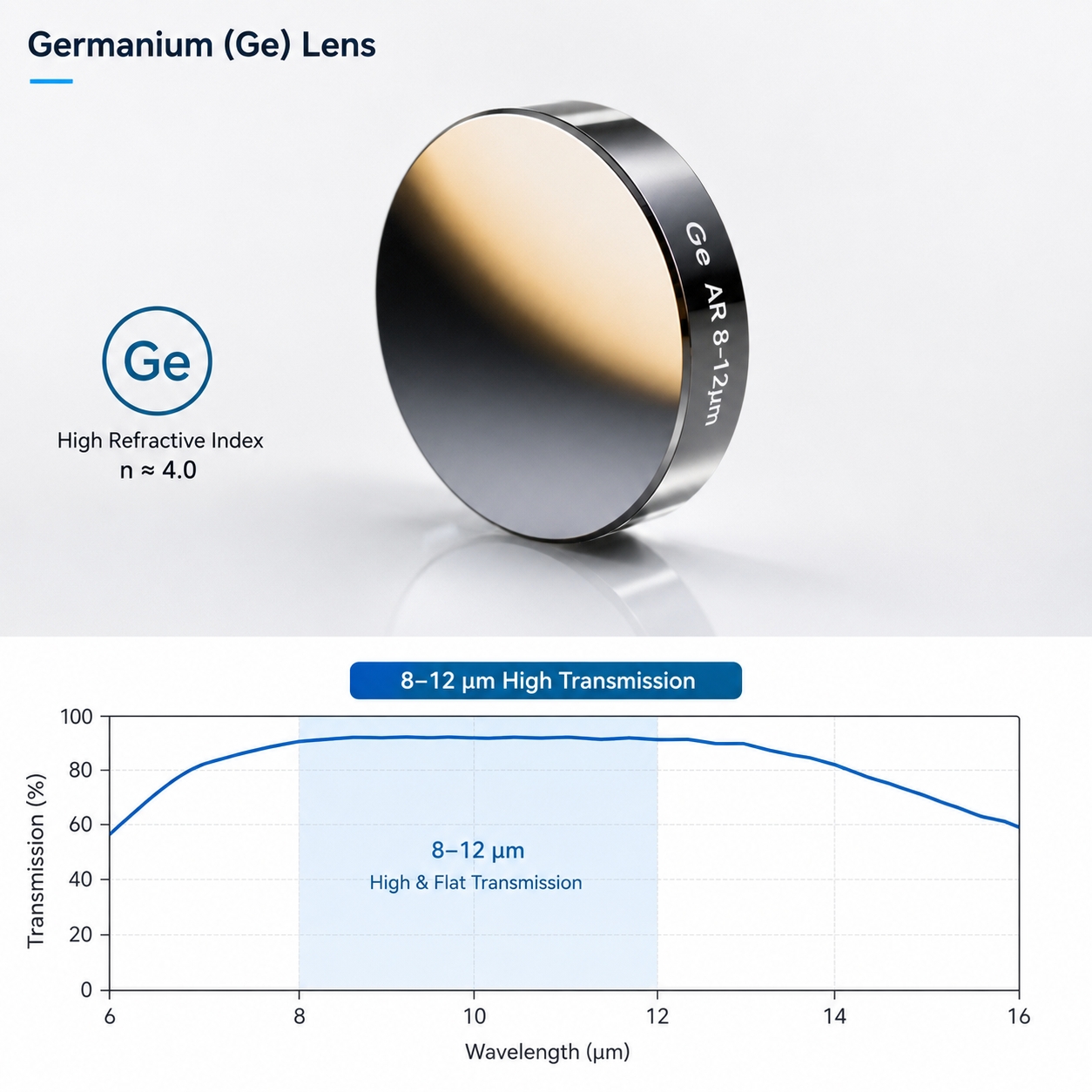
Material Transmission Range: Ensure the chosen material (e.g., N-BK7, Fused Silica, CaF₂, ZnSe for IR) has high transmittance across the system’s operational wavelength range to avoid energy loss or thermal lensing from material absorption.
Dispersion (Abbe Number): For broadband systems or those sensitive to chromatic aberration, select a material with an appropriate Abbe number. For chromatic aberration correction, a high-dispersion (low Abbe number) glass is often paired with a convex lens made of a different material.
Environmental Suitability: Consider the impact of temperature, humidity, etc., on the material’s refractive index and dimensional stability, especially for field or industrial environments.
Decision Between Standard Components and Custom Design: Balance project cost, timeline, and performance.
Evaluate Standard Components First: Consult product catalogs from major suppliers (e.g., Edmund Optics, Thorlabs) to identify standard lenses matching requirements for focal length, diameter, material, and coating (e.g., AR). This significantly reduces cost and lead time and is suitable for many general or prototyping needs.
Identify Need for Customization: Consider custom design in these cases:
Special Geometries: Required aperture, thickness, or edge shape falls outside standard offerings.
Extreme Optical Performance: Requires non-standard focal lengths, high-precision surface figure (e.g., > λ/10), or extremely low wavefront distortion.
Harsh Environments or Material Needs: Applications in deep UV, far IR, or requiring resistance to high power, radiation, chemical corrosion, etc.
Integration Requirements: The lens needs special processing as part of a complex assembly (e.g., cementing, aperture integration, aspherization).
Production Volume Optimization: For mass production, a custom design optimized for the specific application may lower total cost by enhancing performance or simplifying assembly/alignment.
Lens selection is an iterative trade-off process. It is advisable to start from a clear optical objective, use preliminary ray tracing to determine the focal length range, filter materials based on the working wavelength, and prioritize searching for solutions within standard component libraries. When standard components cannot meet performance, size, or environmental requirements, collaborate with optical manufacturers to initiate a custom project based on a detailed optical design, ensuring the lens operates reliably and efficiently within its subsystem.
Conclusion
While not typically the primary element in an imaging lens, the concave lens is an indispensable foundational component in nearly all sophisticated optical designs. By providing precise control over beam divergence and optical path manipulation, it plays a key role in ensuring image quality, optimizing system size, and managing energy distribution. A true understanding of the function and application of concave lenses is a crucial step in progressing from merely using optics to actively designing with them.