In optical communication applications, one critical aspect is connection – especially as high-speed transmission and high-precision applications continue to evolve. The quality of fiber termination directly determines system stability and loss levels. Compared with field-installing connectors or directly butting fibers, a fiber pigtail offers a more controllable and stable solution.
From an engineering perspective, every interface in a fiber link introduces additional loss and potential reflections. If the termination process is inconsistent, it can cause insertion loss fluctuations or even return loss issues. Therefore, the core reason fiber pigtails are widely used is that they provide high-consistency termination while maintaining flexibility.
What Is a Fiber Pigtail?
A fiber pigtail is a short fiber assembly with a connector pre-installed on one end and bare fiber on the other. Its design principle is to separate the precision connector end-face processing from the field splicing operation, thereby improving overall connection quality.
Structurally, a standard fiber pigtail consists of a pre-terminated connector (such as LC, SC, FC, etc.), the fiber itself, and a protective coating. The connector end is typically polished and inspected in a professional factory to ensure stable end-face geometry and optical performance.

Difference Between a Pigtail and a Patch Cord
Although a fiber pigtail looks similar to a common patch cord, their uses are completely different. A patch cord has connectors on both ends and is mainly used for direct connections between equipment. A fiber pigtail, in contrast, has a connector on only one end, and the other end is spliced to a backbone fiber.
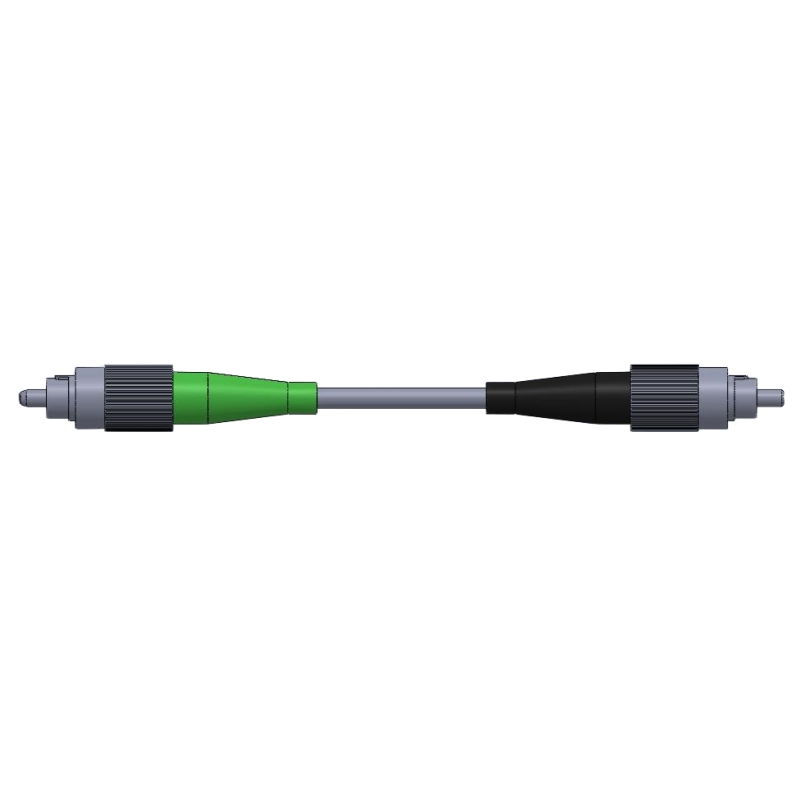
This structural difference means pigtails are more suitable for terminal access and fixed connections, rather than for frequent plugging and unplugging.
Core Functions of a Fiber Pigtail
Reliable Splicing Between Fiber and Equipment
In practical engineering, backbone fibers are usually not connected directly to equipment ports. Instead, a fiber pigtail acts as a transition. The bare fiber end is spliced to the backbone fiber, and the connector end is plugged into equipment or a patch panel, creating a stable, low-loss connection path.
This approach significantly reduces field construction difficulty and avoids the risks of installing connectors directly on backbone fibers.
Providing a High-Consistency Connector Interface
Because the connector part of a fiber pigtail is factory-pre-terminated, its end-face quality and geometric precision are far better than field-made connectors. This means the performance of each connection point is more controllable, improving overall system stability.
For systems sensitive to return loss (such as high-speed communications or laser applications), this consistency is especially important.
Improving Overall Optical Performance Stability
By moving critical end-face processing to the factory, fiber pigtails effectively control the variation range of insertion loss and return loss. Compared with field termination, the performance scatter is much smaller, allowing more accurate power budget calculations during system design.
Main Application Scenarios for Fiber Pigtails
Optical Distribution Frames (ODF)
In ODF systems, fiber pigtails are widely used for fiber termination management. Backbone fibers are spliced into the distribution frame, and the connector ends enable flexible patching, making the system both stable and easy to maintain.
Optical Communication Networks (FTTH / Metro Networks / Long-Haul Transmission)
In various optical communication networks, fiber pigtails serve as an important part of link termination, connecting the backbone network to equipment interfaces. Their stability directly affects the transmission quality of the entire link.
High-Density Cabling in Data Centers
In data center environments, even though high-density interfaces (such as LC) are mainstream, the underlying cabling still relies heavily on fiber pigtails to transition between backbone cables and the patching system, improving deployment efficiency and maintenance convenience.
Laser and Precision Optical Systems
In laser systems or high-precision measurement equipment, fiber pigtails are often used for light source coupling or signal output. These applications are extremely sensitive to return loss, so APC polished connectors are usually chosen to reduce reflections.
Types of Fiber Pigtails
By Fiber Type
Fiber pigtails can be single-mode or multimode. Single-mode is suitable for long-distance and high-bandwidth transmission, while multimode is mostly used for short-distance communication or intra-data-center connections.
By Connector Type
Depending on the interface, fiber pigtails can be equipped with LC, SC, FC, ST, or other connector types. Also, UPC or APC polish can be selected to meet different return loss requirements.
By Fiber Count
Structurally, a fiber pigtail can be simplex (single fiber) or multi-fiber (ribbon), accommodating high-density or batch splicing needs.
Key Performance Parameters
In engineering applications, evaluating fiber pigtail performance mainly focuses on the following aspects: insertion loss determines signal transmission efficiency; return loss affects system stability; and splice loss reflects the connection quality to the backbone fiber.
In addition, mechanical reliability and long-term stability are also important indicators.
Why Choose a Fiber Pigtail
From an engineering practice perspective, making connectors directly in the field not only demands high technical skill from installers but also makes it difficult to guarantee consistent quality. A fiber pigtail, using the approach of a factory-pre-terminated connector plus field splicing, effectively avoids these problems.
This solution not only improves installation efficiency but also significantly reduces the risk of system instability. Therefore, a fiber pigtail is more of an optimization strategy than a simple connector substitute.
Challenges and Precautions in Real-World Use
Although fiber pigtails offer high reliability, several details still need attention during use. For example, splice quality directly affects overall loss, and end-face contamination can introduce extra reflections.
Also, choosing mismatched fiber types or connector styles can degrade performance. Therefore, during design and deployment, one must consider the supplier’s process quality or rely on qualified systems for practical verification.
Conclusion
In essence, the function of a fiber pigtail is to reasonably separate precision connector manufacturing from field fiber deployment, achieving high-consistency connections while maintaining flexibility. Whether in communication networks, data centers, or laser systems, it remains one of the fundamental building blocks for stable optical connections.
As optical communication systems move toward higher speeds and higher densities, fiber pigtails are also evolving toward lower loss, better consistency, and multi-core integration.