Expertise Note
In practical engineering, whether a link performs well often depends not on the fiber itself, but on how it is connected. Therefore, choosing between a fiber-optical pigtail and a patch cord is not about selecting a product, but about deciding how the link will be built.
Technical Basis
The judgments in this article are primarily based on differences in common connection methods in practical engineering, including the performance of fusion splicing versus connector mating in loss control, return loss, and long-term stability, while also considering typical link structures in optical communications and data centers.
Core Difference Between a Fiber Optical Pigtail and a Patch Cord
Simply put, a fiber optical pigtail is a single-ended fiber assembly used for “fusion splicing to create a permanent connection, while a patch cord is a double-ended fiber assembly used for pluggable connections between equipment. The difference is not just structural – one is oriented toward the basic connection layer, and the other toward the equipment interconnection layer.
In real systems, a fiber optical pigtail typically serves as a termination point in the fiber network, spliced into the backbone fiber to ensure low loss and long-term stability. A patch cord, on the other hand, appears more often at the equipment side, enabling flexible connections between switches, optical modules, or patch panels.
What Is a Fiber Optical Pigtail?
Structure and Working Principle
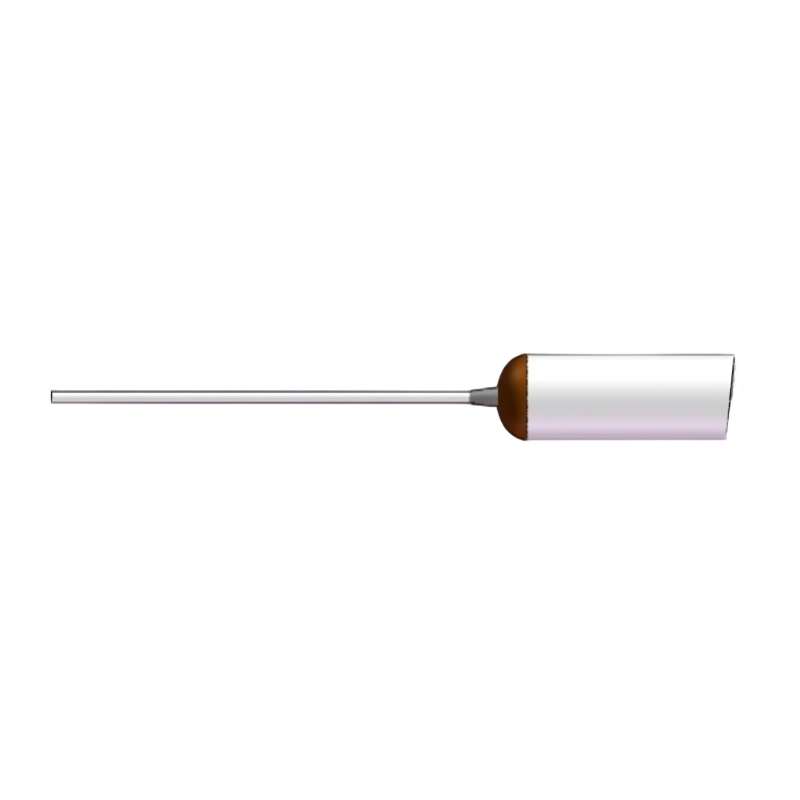
A fiber optical pigtail is essentially a fiber assembly with a connector on one end and bare fiber on the other. The unconnectorized end is not a flaw – it is meant to be fusion-spliced directly to a backbone fiber, creating a nearly interface-free connection point.
The core value of this connection method is that it avoids the air gap and end-face error problems inherent in traditional connector mating, allowing optical signals to propagate in a more continuous manner. Therefore, in systems with high link quality requirements, fiber optical pigtails are often the preferred choice.
Why Is It More Stable?
From a physical standpoint, fusion splicing creates a glass-to-glass bond rather than an interface-to-interface connection. This means that over long-term operation, it is almost unaffected by plugging, vibration, or contamination. For this reason, fiber optical pigtails are more commonly found inside patch panels, fiber terminal boxes, and backbone networks – places that do not require frequent changes.
What Is a Patch Cord?
Structure and Usage Logic
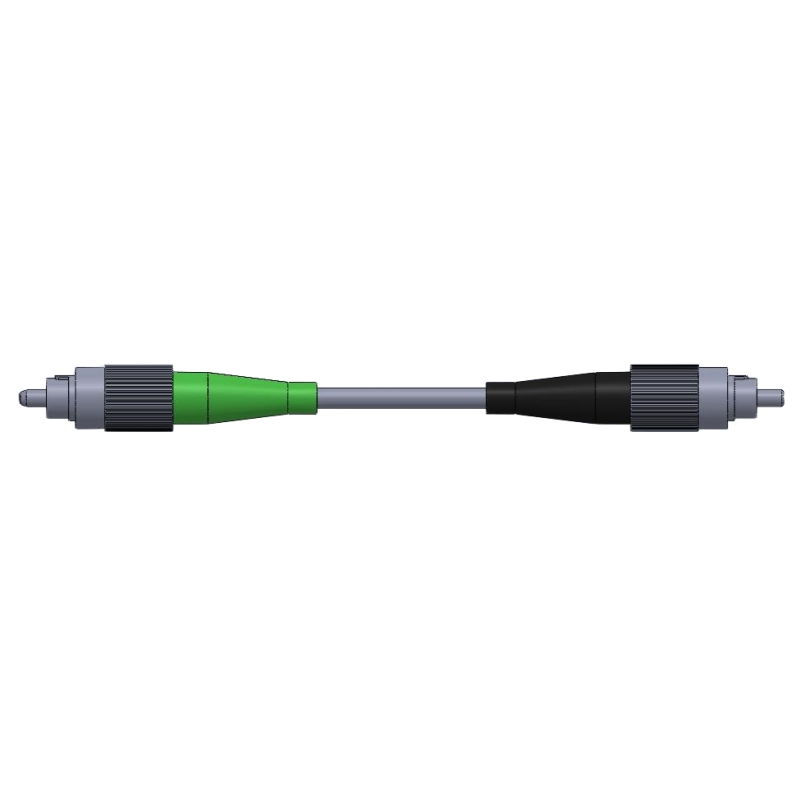
Unlike a fiber optical pigtail, a patch cord is a complete fiber assembly with connectors on both ends. Its design goal is very clear: to make fiber connections as simple as plug-and-play.
In practice, patch cords play the role of connecting equipment – for example, between switches and optical modules, or between different patch panel ports. This structure allows the system to be adjusted at any time without needing new splicing or construction.
Why Is It More Flexible?
The advantage of a patch cord is not that it has the lowest loss, but that it offers maintainability. Any connection problem can be quickly resolved by re-plugging or replacing the patch cord. This is especially important in data centers or test environments. In other words, patch cords prioritize flexibility.
How Structural Differences Affect Applications
The most fundamental difference between a fiber-optic pigtail and a patch cord lies in the connection method. The former relies on fusion splicing, while the latter relies on connector mating. This difference affects not only link stability and loss levels, but also long-term maintenance approaches.
When an optical signal passes through a fiber optical pigtail connection, it propagates through what is essentially a continuous fiber. When it passes through a patch cord connection, the signal must cross connector interfaces, inevitably introducing additional loss and reflection. However, one easily overlooked point is that a patch cord’s performance is not inherently poor just because it has connectors – it depends largely on the quality of the connectors themselves and their end-face preparation.
In practice, if high-quality connectors are used, and end-face cleaning and matching are done properly (e.g., selecting the right APC or UPC type), the loss and reflection introduced by connectors can be controlled to low levels. For this reason, in many data center or equipment connection scenarios, patch cords remain the more reasonable choice.
Therefore, in long-distance or high-performance systems, the advantages of fiber optical pigtails become more apparent. But in scenarios that require flexible connections and maintainability, connector design and quality are equally critical to link performance.
Real Performance Differences
From a practical usage perspective, the difference between fiber optical pigtails and patch cords is often not reflected in a single parameter, but in the stability of overall link performance.
In a simple link, the difference between the two may not be obvious. But as the number of connection points increases, or as the system runs for longer periods, the differences gradually magnify. Links using pigtails tend to behave more “cleanly,” with less fluctuation in test results. Links with multiple patch cord connections are more prone to minor variations – sometimes not due to equipment issues, but because the connection state is changing.
Another typical difference is long-term performance. A fusion-spliced fiber optical pigtail is essentially set once and requires almost no subsequent intervention. Patch cord connections, however, are affected by dust, temperature changes, and human operations. End-face contamination, incomplete insertion, or even slight mechanical stress can cause link metrics to fluctuate.
In the maintenance phase, this difference becomes even more noticeable. Systems using patch cords, while flexible to adjust, also require regular inspection of connector condition; otherwise, problems tend to be intermittent and not easy to locate quickly. For links using pigtails, once the initial installation quality is reliable, maintenance pressure is much lower.
From a testing perspective, this is also why engineers pay special attention to the number and type of connection points when doing OTDR or link acceptance testing. It is not that patch cords are necessarily bad, but the more connection points, the more variables, and the higher the link uncertainty.
Typical Loss Reference Table
Parameter | Typical Value | Remarks |
Single-mode Splicing Loss | ≤0.1 dB | A high-quality splicer with skilled operation can achieve 0.02–0.05 dB |
Multimode Splicing Loss | ≤0.15 dB | Multimode fiber is more sensitive to alignment, resulting in slightly higher loss |
LC/SC/FC Connector (UPC) | ≤0.3 dB | Products from quality manufacturers |
LC/SC/FC Connector (APC) | ≤0.3 dB | Insertion loss comparable to UPC, but return loss is significantly better |
MPO/MTP Multi-fiber Connector | ≤0.35 dB | Multi-fiber alignment is more complex, resulting in slightly higher typical values |
What Are the Application Scenarios?
When to Use a Fiber Optical Pigtail
In practice, fiber optical pigtails are more often used after the backbone fiber network enters the equipment room, where they are typically spliced into an optical distribution frame (ODF). This step, using pigtails for splicing, stabilizes the backbone fiber so that no matter how the equipment is later adjusted, this segment of the connection remains unchanged. Similarly, in fiber terminal boxes, building riser closets, or outdoor splice enclosures, pigtails are preferred because once these locations are sealed, they are not accessible for frequent maintenance.
Another typical case is in systems with high link quality requirements, such as long-distance transmission or links that require high consistency. In these situations, engineers usually minimize the number of pluggable connection points, preferring fusion splicing to reduce uncertainty to the lowest possible level.
When to Use a Patch Cord
Patch cord usage scenarios are just the opposite. The most typical is on the equipment side of data centers or equipment rooms. Connections between switches, optical modules, and servers cannot be done by fusion splicing because equipment may be changed, expanded, or recabled at any time. In this situation, the plug-and-play nature of patch cords is essential. If a problem occurs, it can be fixed by direct replacement, and topology adjustments require no additional construction.
The same applies to test environments. Whether in lab debugging or field commissioning, links need to be constantly changed. Using pigtails in such situations would be very inconvenient, while patch cords allow quick connection and reconfiguration.
Another easily overlooked scenario is daily operations and maintenance. When a temporary bypass of a link segment, equipment replacement, or fault diagnosis is needed, patch cords provide a low-cost way to try different configurations – something highly valuable in complex systems.
Putting the Two Scenarios Together
If you break down a fiber system, a typical pattern emerges:
- Near the backbone and fixed cabling → fiber optical pigtails are preferred
- Near equipment and user interfaces → patch cords are preferred
The front end uses pigtails for stable connections, and the back end uses patch cords for flexible patching.
Cost and Engineering Considerations
From a unit product perspective, fiber optical pigtails are generally less expensive than patch cords, mainly because their structure is simpler. A pigtail has a connector only on one end, with bare fiber on the other, requiring no additional end-face processing or double-end inspection. A patch cord, on the other hand, requires connector assembly, end-face preparation, and consistency testing on both ends – all of which add to product cost.
However, this is only part of the material and manufacturing cost. In actual use, pigtails also require fusion splicing equipment and labor, which adds one-time equipment investment and installation costs. Therefore, in scenarios with few connections or where rapid deployment is needed, patch cords are actually more efficient because they eliminate the splicing step and enable direct connection.
But in large-scale network construction, the situation changes. As the number of connection points increases, the low-loss and high-stability advantages of fusion splicing become more apparent, while also reducing maintenance costs caused by connection issues over time. From a long-term perspective, this approach often offers better total cost efficiency than a solution heavily reliant on patch cords.
Conclusion
Simply put, fiber optical pigtails are more often used in places where fibers are fixed in place, while patch cords are used where connections need to be made and changed frequently. In real system design, both types are typically used together. Pigtails are used for backbone and non-moving parts, and patch cords are used on the equipment side or where adjustments are needed. Few people would choose only one type for an entire system.
FAQ
Can a fiber-optical pigtail be used directly as a patch cord?
Generally, no. A fiber optical pigtail has a connector on only one end, with bare fiber on the other – it is designed specifically for fusion splicing. Forcing it to be used as a patch cord would not only result in an incomplete connection but also introduce additional loss and instability.
Can a patch cord replace a fiber-optic pigtail?
In some simple or temporary connection scenarios, yes. But it is not recommended for backbone or long-term fixed links. The advantage of patch cords is flexibility, but the more connectors in a link, the higher the uncertainty – especially when there are many connection points.
Why do some links using patch cords still have very low loss?
This usually depends on the connector quality and end-face condition. If the connectors are manufactured with high precision, the end faces are clean, and the types are well matched (e.g., APC to APC), patch cord performance can be quite stable. The issue is often not with the patch cord itself, but with how well the connectors are made.
When must a fiber-optical pigtail be used?
When a fiber needs to be terminated into a patch panel, terminal box, or is part of a backbone link, fiber optical pigtails are almost always used. These locations prioritize long-term stability over later adjustability.
Why do many field problems occur on patch cords?
Because patch cords are the part that gets handled. Plugging, unplugging, bending, dust contamination, or even incomplete insertion can all affect connection status. Once a pigtail is fusion-spliced, it is rarely disturbed by human factors again, so naturally, fewer problems occur.
What is the difference between UPC and APC?
UPC (Ultra Physical Contact) and APC (Angled Physical Contact) are two common polishing styles for fiber optic connector end-faces. UPC has a slightly spherical end-face, which causes reflected light to return along the original path. APC has an 8-degree angled polish, which directs reflected light away from the original optical path. As a result, APC typically provides better return loss performance than UPC (APC can achieve -60 dB or lower, while UPC is typically around -50 dB to -55 dB).