In many systems involving lasers, much attention is usually paid by users to the laser itself, the shaping component, or to the focusing lens. Rarely, one notices that the laser window at the front of the system usually faces the external environment first, is the most vulnerable, and influences the lifetime of the whole machine.
It may look transparent as an optical sheet, but it provides a key role in protecting the interior optical structure and in ensuring beam quality by keeping particles of contamination and spatters outside. Most of the shortcoming in laser head performance and poor contaminated lenses, even system burnouts, often relate to inappropriate selection of the window or improper long-term maintenance.
Starting from the basic principles, this article conducts an in-depth analysis with performance indicators, comparison of materials, to the actual selection, and helps users make more accurate choices in different application scenarios, such as processing in industry, medical lasers, and scientific research systems.
The Importance of Laser Windows
The laser window is usually the first line of defense for the laser system, and its major functions include the following:
- Isolate the environment and the optical cavity to block dust, metal splashes, moisture and chemicals, and avoid damage to the internal optical components caused by external factors.
- Protect the internal precision optical components from contamination or scratches, ensure service life of core components such as lenses and lenses.
- Keep the beam quality stable when the high-energy laser passes through to prevent scatters, diffraction or wavefront distortion from affecting the processing effect.
- Withstand pressure from temperature changes, pulse energy, or mechanical shock for reliable operation in very harsh environments.
Typical problems with which many users often face for the first time are:
- Why is the laser output power getting lower and lower?
- Why do burning lenses always burn out?
- Why is the window prone to explosion during high-power processing?
These phenomena are often caused by a variety of reasons: when the laser window absorbs tiny energy (even if the absorption rate is only 0.1%–0.2%), this energy is quickly converted into local high-temperature hot spots under the action of high-power or high-energy pulsed lasers. Long-term accumulation or instantaneous energy that is too high can lead to damage to the window coating, cracks on the surface, or even cracking of the entire window.
At the same time, if dust, soot or splashes are attached to the window surface, these contaminations will form local “hot spots” that will exacerbate thermal stress, causing the beam to scatter or shift as it passes through, thereby reducing the laser output efficiency and damaging the back-end optical components. Windows with insufficient thickness or unsuitable coatings are more likely to deform or burst under thermal expansion or pulsed impact.
These risks can be greatly reduced by the correct selection of window materials and coating types, supplemented by regular cleaning and maintenance for the long-term stability of operation for laser systems.

What is a Laser Window?
A laser window, otherwise called a laser window, is a transparent optical component mounted at the front of the laser device or optical cavity. Its main purpose is to protect the internal optical components from environmental contamination, splashes, or mechanical damage, while ensuring that the laser beam maintains its original wavefront shape and energy distribution when passing, without excursion, scattering, or unnecessary losses.
Compared with ordinary optical windows, laser windows are designed with high-performance coatings for specific laser wavelengths, representing a higher laser damage threshold and lower absorption and scattering rates. Besides, their materials often have excellent thermal stability with high purity and are capable of maintaining stability under high-power or pulsed laser conditions.
Therefore, the laser window is not just a “transparent protective sheet” but a key component of the long-term stable and efficient operation of the laser system. If it were not for the laser window, one would hardly ensure the beam quality, system efficiency, or service life of the laser.
How The Laser Window Works
The laser beam will undergo complicated optical processes such as refraction, reflection, absorption, and scattering while passing through a window. A good laser window minimizes these adverse effects while maintaining beam quality, thereby maximizing system efficiency and protecting the internal optical components. By using high surface hardness materials, windows can effectively resist scratches and abrasions, while using low-absorbance materials to reduce the conversion of laser energy into heat and avoid local high temperature build-up.
The high-quality coatings not only reduce reflection loss significantly, but also inhibit the effects that heat return has on the laser. Good thermal stability also ensures that the window will not bend or crack due to heat in high-power laser or pulsed laser conditions. It should be noted that even a quite small absorption rate of 0.1% or 0.2% would form a high-temperature hot spot in a very short time under hundreds of watts or even kilowatt lasers, which would eventually lead to window explosions or coating burns. Therefore, proper material selection, high-quality coatings, and regular maintenance are necessary for extending the life of a laser window in order to ensure system stability.
Laser window key performance indicators
A good laser window often needs to meet several performance requirements at once, including:
- Transmission: High transmission reduces energy loss and increases the efficiency of processing.
- Laser-induced damage threshold: This tells whether the window can withstand high-power or short-pulse lasers.
- Surface Flatness and Wavefront Distortion (WFD): This affects the imaging quality of beam focusing and high-precision applications.
- Surface Quality (Scratch-Dig): Scratches and impurities can cause scattering or heat absorption, which is a common hazard in laser windows.
- AR Coating: Anti-reflective coatings reduce reflection and heat build-up and are among the most critical parts of the laser window.
- Thermal stability-material uniformity: High-power lasers result in a thermal expansion of the windows and unstable materials can lead to beam shift.
These performance indicators determine if the laser window can work stably for a long time and also determine the scenarios that the system is suitable.
Common materials for laser windows and their advantages and disadvantages
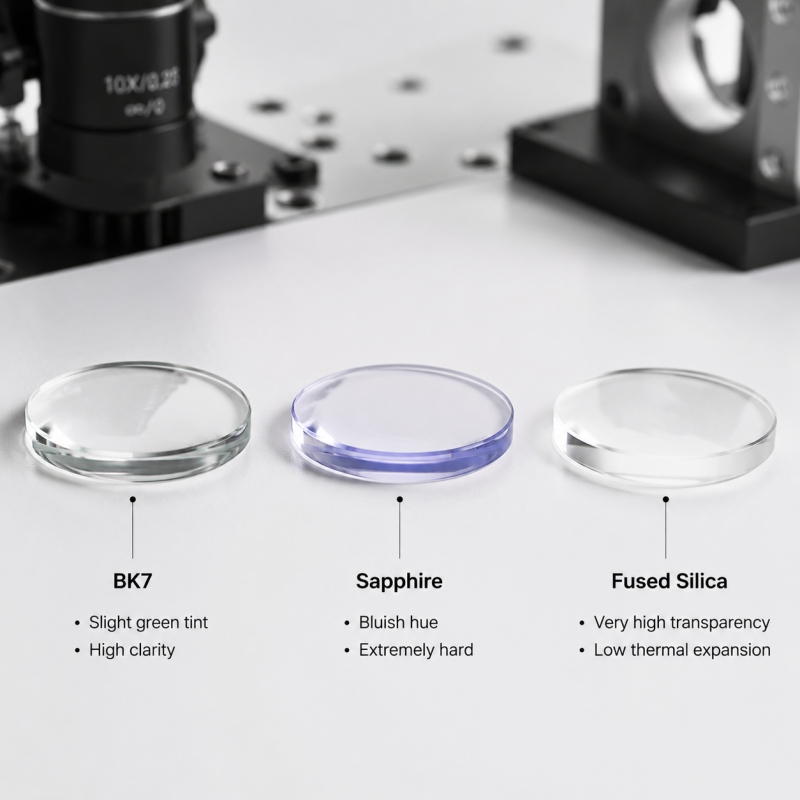
The most common window material in industrial lasers is fused silica, which has a low absorption rate. Fused silica is thus well adapted to high-power laser applications. Also, the good thermal stability of fused silica reduces the chances of deformation or damage when operating under high-energy laser conditions. Fused silica is cost-effective and has rather balanced performance, so these window materials are among the favorites in many industrial laser systems.
- Sapphire has high hardness, scratch resistance, impact resistance, and high thermal conductivity. It is a standard part in applications such as medical devices, beauty equipment, and high-voltage windows, which require resisting extremely harsh environments. Its high hardness can ensure long-term stable operation, but the cost is higher, so the choice needs to be weighed according to the application scenario.
- BK7 optical glass is inexpensive and suitable for low- to medium-power laser systems. While the absorption rate is higher than in fused silica, making it unsuitable for high-power lasers, BK7 is cost-effective for scenarios that fit within a tight budget or where the required power is low.
- CaF₂ / MgF₂ is normally used in UV or infrared laser systems and is a common material for special spectral windows. They have the advantage of strong resistance to UV damage, but this material is brittle and requires extra caution in installation and maintenance to avoid cracking.
Proper material selection will directly determine the service life and performance of the laser window and should be considered comprehensively according to laser wavelength, power, environmental conditions, and system requirements.
Coating Selection for Laser Windows
High-quality anti-reflective coatings are one of the core performance features of laser windows, directly influencing not only beam transmission efficiency but also thermal stability and system safety of the window. When the laser beam passes through the window, an uncoated or poorly coated window will generate a large reflection loss, and part of the energy will be reflected to the laser or form a hot spot on the window surface, which easily leads to coating damage or even window explosion under long-term action.
The right AR coating can minimize reflection loss, enabling more laser energy to pass through efficiently with reduced local heat buildup while avoiding deformation or cracking caused by local overheating of the window. In addition, coatings in high-power or pulsed laser systems prevent reflected light from returning to the laser and protect the optical components inside the laser from interference with feedback light, thereby improving the stability and service life of the whole system.
Different types of coatings suit different applications:
- Single-wavelength AR coatings: optimized for a specific laser wavelength to realize the lowest reflectivity and the highest transmittance.
- Wideband AR coatings: suitable for laser systems with multiple wavelengths or continuous spectrums, ensuring good light transmission over the whole operating band.
- AR coatings for high-power lasers: designed to bear high-power pulses or continuous laser exposure without any damage.
- Enhanced AR coatings: dust and oil resistance, suitable for industrial processing or complex environmental use scenarios.
High-quality coatings have stringent requirements in terms of thickness uniformity, interlayer bonding, surface finish, etc., and any small deviations may result in beam scattering, increased absorption, or local hot-spot formation; thus, the quality of the coating may be even more important to the stability and safety of the laser system than the material of the window itself.
How to Choose the Right Laser Window?
When choosing a model, one needs to consider:
- Laser wavelength
- Laser power and pulse type
- Operating environment conditions, including splash, dust, pressure, and temperature
- Window thickness
- Coating type and damage threshold
- Installation angle
- Requirements on airtightness
Laser wavelength will determine material transmittance and coating selection, power and pulse type affect material absorption and heat resistance, environmental factors are related to protection needs and durability, thickness needs to take into account thermal expansion and optical quality, the coating type directly influences reflection loss and the laser damage threshold, and installation angle and tightness determine the system stability and reliability under long-term operation.
Frequently Asked Questions and Answers
Why does soot always pollute the window in the course of processing?
→ Caused by splashes or dust in the working environment, installation of protective covers or cleaning the windows regularly is recommended; at the same time, choosing dust-proof and oil-proof coatings will effectively minimize the accumulation of pollution.
Why do windows burn every few days?
→ It may be due to the insufficient material absorption rate or coating tolerance, thus giving rise to local high-temperature hot spots; therefore, a low-absorption material like fused silica is recommended to be selected and matched with a special AR coating for high-power lasers.
Does high power necessarily require the use of fused silica?
→ Fused silica is preferred for most kilowatt-scale industrial laser systems but other materials can be used in low- to medium-power systems.
Where is sapphire expensive? Do I need it?
→ Sapphire is extremely hard, highly thermal conductive, and impact resistant in harsh environments; however, it can be traded at the cost of fused silica or other optical glasses at mild power.
Typical application scenarios of laser windows
Laser cutting/welding heads
The window is mainly used for splash protection to block damage to the internal optical components by metal particles, smoke, and slag, and at the same time needs to withstand the heat load brought by high-power pulsed lasers, so low-absorption, high-temperature resistant fused silica or high-hardness sapphire materials are often selected and equipped with high-power special AR coatings to reduce reflection loss.
Laser medical devices
The window not only has to isolate the optical cavity for beam stability but also has to meet hygiene and safety requirements; thus, the material needs to be resistant to chemical cleaners, easy to sterilize, and ensure high transmittance and low absorption to provide precise output of the treatment laser.
Scientific research equipment
For example, in high-precision wavefront systems or interferometers, the window should have minimal influence on the beam wavefront. Therefore, a fused silica window with strict surface flatness and wavefront distortion control was chosen, matched with corresponding coatings according to wavelengths, to ensure the accuracy of the experiments.
LIDAR/Aerospace Optical Systems
Preferably, the window materials of choice are sapphire windows or special high-strength optical glass, with wideband or high-power coatings that can accommodate the requirements for multi-band laser applications.
CO₂ laser systems
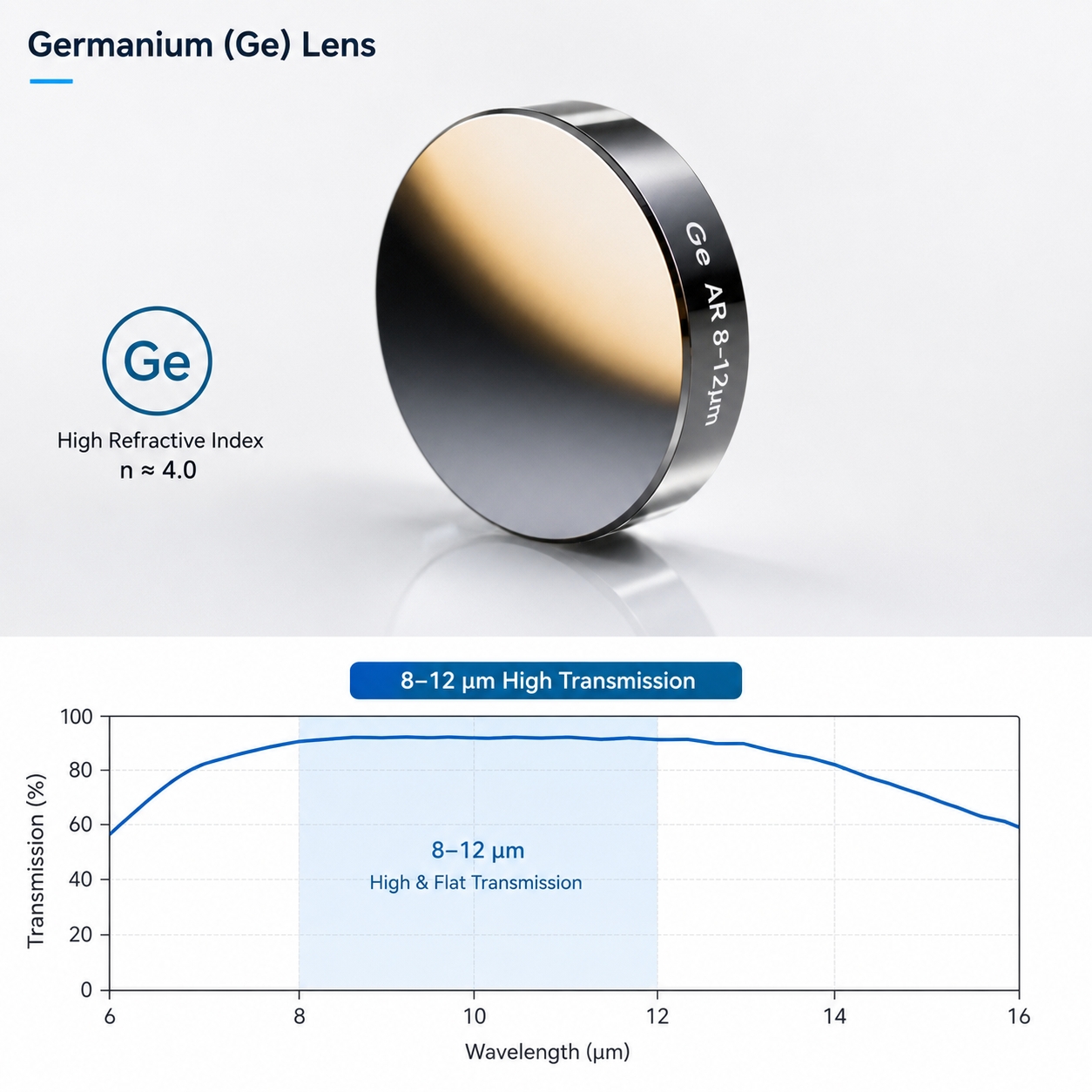
This is accomplished using special infrared window materials such as ZnSe or CaF₂ that ensure high transmittance and low absorption of the 10.6 μm wavelength laser beams, along with thermal stability for high-power processing.
Material selection, thickness design, and coating type all have obvious differences in different application scenarios, and reasonable matching can effectively extend the life of windows and ensure long-term stable operation of the system.
Conclusion
Although the laser window has a simple structure in the laser system, it plays an important role in protecting the system, maintaining beam quality, and improving processing stability. Its material absorption, coating resistance, thermal stability, and anti-fouling capabilities directly influence the laser’s efficiency and overall service life.
The proper selection of laser windows needs comprehensive judgment for multiple conditions, including laser wavelength, power density, working environment, and maintenance frequency. Accurately understanding the principles, differences in materials, and application scenarios of laser windows will effectively avoid problems such as beam attenuation, window explosion, and internal lens contamination, enabling laser equipment to maintain long-term stable operation.