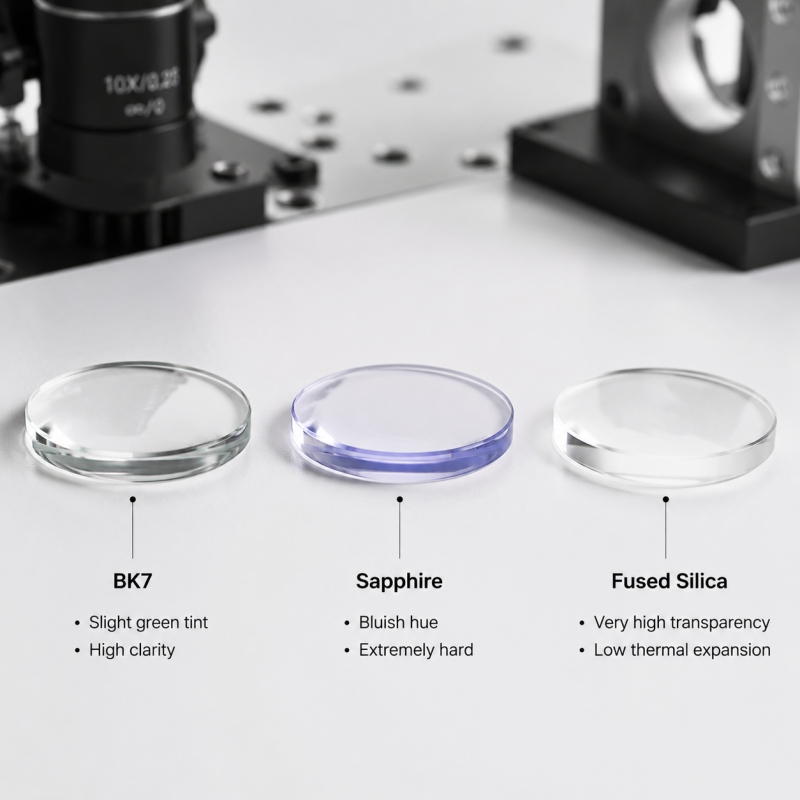
Sapphire, or single-crystal alumina (Al₂O₃), is a high-performance material with high hardness, strength, heat resistance, optical transmittance, and chemical resistance. Sapphire is a high-purity, dense single-crystal material with no ‘polycrystal’ boundaries and a dense pore-free microstructure, except for the excess oxygen sites on the single-crystal surface. Sapphire is extremely resistant due to its high strength, with a hardness of 9° on the Mohs scale, and can resist scratches, abrasions, and other damage.
Sapphire passes UV light with a wavelength ranging from 0.17 μm to 0.25 μm and continues up to a wavelength of 5–5.5 μm and longer for Optical Windows within UV, visible, and infrared regions. Sapphire has a high melting temperature of 2030–2040 °C with excellent heat conductivity and heat resistance, with excellent chemical and mechanical compatibility. Sapphire is already a common term used for most applications in areas involving Optical Windows, Laser Windows, Substrates for Semiconductors, scratch-resistant Protective Covers, Scientific Instruments for Research, and Industrial Applications, among other applications involving key technologies.
Crystal Structure and Classifications
Sapphire is a single crystal of α-type corundum, with a chemical composition of Al₂O₃, and has a hexagonal crystal system with a 3m rhombohedral symmetry. Lattice constants vary according to a value of approximately ≈ 4.75–4.79 Å and c ≈ 12.9–13.0 Å; however, due to its dense packing, lack of porosity, and lack of grain boundaries, the resulting single crystal has outstanding strength, thermal conductivity, and optical homogeneity. Because it is a single crystal, sapphire is much different from other alumina ceramics because of improved strength, clarity, and homogeneity of strength and heat conductivity.
For instance, C-tangent is used for preventing birefringence, commonly used in precise optical windows; A tangential cut for improved strength and abrasion resistance, commonly used in demanding applications where strength is a priority; and for cost-effective uses, Random-cutting angles are used. The arrangement of atoms inside a single crystal is hexagonal, with the aluminum oxide alumina plane being occupied by an aluminum ion, providing an outstanding strength and high-quality optical properties for a single crystal of corundum.
Growth and Processing
High-quality sapphires can be produced by employing modern crystal growth techniques according to optical requirements and other industry standards. The Kyropoulos process and SAPMAC process can be used for the precise growth of crystals. The Kyropoulos process is used for the growth of large-sized sapphire crystals with a low density of defects by slowly lifting the seeds in molten Al₂O₃ and by controlling the temperature gradient and growth rates precisely. The SAPMAC process is an improvement over the Kyropoulos process with better control over the number of lifting segments and temperature control, resulting in stable growth with high-quality crystals.
The grown sapphire crystal is devoid of grain boundaries and multiple grains, ensuring the excellent mechanical, thermal, and optical properties of the grown crystal. During the processing stage, the direction of the crystal cut needs to be chosen based on the requirements, ensuring the performance of the optical window/mechanical parts with polishing and cleaning treatment. The standard processing techniques include precision mechanical polishing, single-point diamond cutting, glass molding, and other techniques that match the requirements of different sizes and qualities.
Mechanical Properties
It has outstanding mechanical strength. Its compressive strength is up to 2–25 GPa, Young’s modulus is 330–380 GPa, about twice the value for steel. Its hardness is high (Mohs 9), only next to diamond, so it is very resistant to scratches and abrasions. Its mechanical strength is greatly affected by its purity and direction of its crystals, with higher purity translating to consistent mechanical strength; its strength and hardness differ depending on the direction. Even at a temperature of about 1200 °C, it has a certain strength and mechanical properties.
Thermal Performance
The thermal conductivity of a sapphire is remarkably good, with an average value of 25–35 W/m·K, and the coefficient of thermal expansion is approximately 5–6 × 10⁻⁶/K, impacted by the purity level and crystal orientation. Its high melting temperature and stable values for the coefficient of thermal expansion make it ideal for use in high-temperature applications with good optical and mechanical strength. The specific heat value is in the range of 700–800 J/kg·K, ensuring efficient spreading of heat energy. The internal crystal stresses reduce at higher temperatures or temperature gradients, making it less prone to fracturing and curvature.
Optical Performance
Sapphire has a broad optical transmittance range from approximately 0.17 μm in the UV region up to 5–5.5 μm in the mid-infrared region. For an optical-grade sapphire window, a light transmittance of 80–90% or better (coated or uncoated) is common, although UV sensitivity is a function of the energy gap region with low transmittance in the region 140–240 nm; IR transmittance is generally more consistent. It has a refractive index given by No ≈ 1.75 and Ne ≈ 1.74 with a wavelength of 1 μm, with a slight birefringence effect and a C-cut which reduces birefringence effects to a negligible value.
Application Examples
Sapphire is used in a variety of demanding optical, industrial, and scientific applications, including the following:
- High-precision optical window, laser window, observation window for scientific instruments
- Watch surface and protective cover
- Semiconductor substrates and electronic devices
- Laser processing, aerospace, and defense equipment
- Industrial parts and wear-resistant components
Its special properties make it a valuable asset in high-temperature, high-pressure, corrosion-resistant, and wear-resistant applications.
Conclusion
Sapphire (Al₂O₃) is an excellent candidate for use in sophisticated optical and industrial applications because of its high hardness, strength, and good thermal and optical properties. With the advent of sophisticated Kyropoulos and SAPMAC growth techniques, along with sophisticated cutting and processing, the capabilities of sapphire crystals can be fully harnessed. Matching the specific crystal direction with a specific processing technique can use a combination of mechanics, optics, and heat for producing high-reliability and long-lasting components, regardless of whether these components need to be used in the form of optical windows, semiconductor wafers, or high-wear parts.