A lens is one of the most versatile and indispensable elements in optics, underpinning technologies from everyday eyeglasses to advanced scientific instruments. By precisely bending and redirecting light rays, a lens enables image formation, focusing of light, and shaping of a beam. In this article, we explore what a lens is, how it works, its various classifications, materials, and real-world applications.
Definition and Basic Functions
Definition:
A lens is an optical element, typically made of transparent glass or plastic, bounded by two refracting surfaces, at least one of which is curved. Its curvature causes incident light to change direction as it passes through the material.
Basic Functions:
- Converging (Focusing): A convex lens gathers parallel rays toward a focal point, forming real or virtual images.
- Diverging (Spreading): A concave lens causes parallel rays to spread outward, appearing to originate from a virtual focal point.
- Image Formation: By controlling where light rays cross, lenses create magnified, reduced, inverted, or erect images on sensors, film, or the retina.
Lenses serve as the backbone of cameras, microscopes, telescopes, and corrective eyewear—each relying on the same fundamental ability to manipulate light.

Working Principles
1. Refraction of Light
Whenever light travels between media of different refractive indices—such as air and glass—it bends at the interface. Snell’s law governs this change in angle, dictating how much a ray will deviate.
2. Converging Action of Convex Lenses
A convex (positive) lens is thicker at its center than at its edges. Parallel rays entering the lens refract toward the optical axis and converge at the focal point (F). The distance from the lens center to F is the focal length (f).
3. Diverging Action of Concave Lenses
A concave (negative) lens is thinner at the center and thicker at the edges. Parallel rays refract away from the optical axis, appearing to diverge from a virtual focal point on the object side. This virtual focus enables corrective lenses for myopia and beam expanders.
Types of Lenses
A. By Function
Convex (Converging) Lenses
- Applications: Magnifiers, camera objective lenses, telescope objectives.
- Image Formation: Can produce a real, inverted image (when the object is beyond 2f) or a virtual, upright, magnified image (when the object is between f and 2f).
Concave (Diverging) Lenses
- Applications: Eyeglass lenses for nearsightedness, peephole viewers, and angle attachments.
- Image Formation: Always produces a virtual, upright, reduced image regardless of object distance.
B. By Shape
- Both surfaces are sections of spheres.
- Variants: Double convex, double concave, plano convex, plano concave, convex concave.
- One or both surfaces follow a non-spherical profile (e.g., parabolic or hyperbolic).
- Advantage: Minimize spherical aberration and improve edge-to-edge sharpness in high-performance systems.
Lens Geometry and Parameters
- Curvature Radius (R): The radius of the sphere from which a spherical surface is derived; steeper curvature (smaller R) yields a shorter focal length.
- Thickness (t): Central thickness affects lens power and aberrations.
- Aperture Diameter (D): Determines light gathering ability and depth of field.
Lens Materials
Material | Refractive Index | Dispersion (Abbe Number) | Strengths | Limitations |
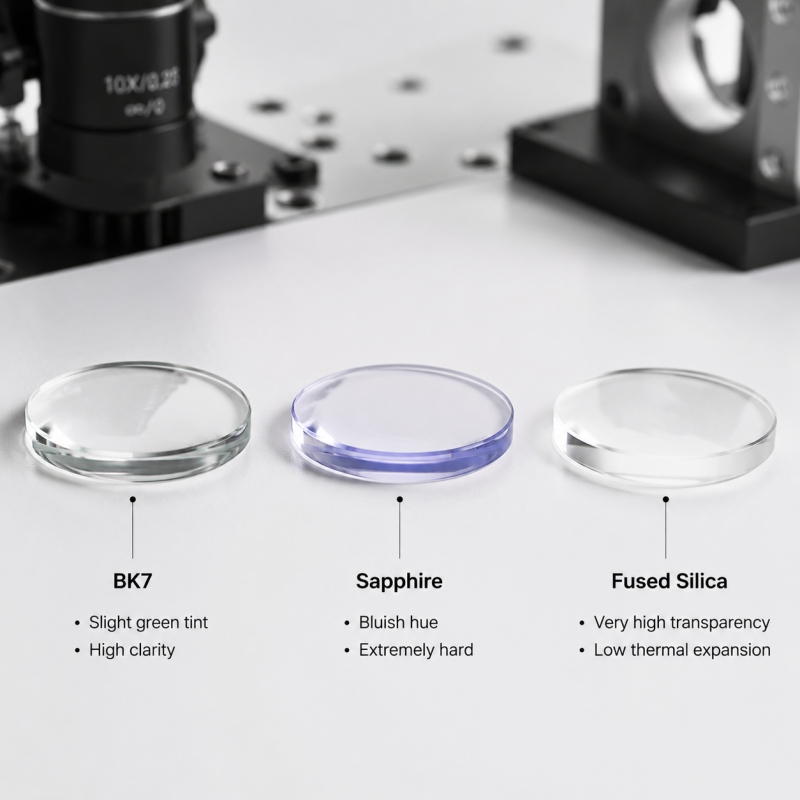
Optical Glass (e.g., BK7) | ~1.517 | ~64 | High transparency, mechanical durability | Heavier, costlier than plastics |
Optical Plastic (PMMA, PC) | ~1.49–1.59 | ~30–50 | Lightweight, low-cost, easy molding | Lower scratch resistance, aging effects |
Fused Silica (SiO₂) | ~1.458 | ~67 | Excellent UV transmission, low thermal expansion | Hard to shape, higher cost |
Sapphire | ~1.76 | ~72 | Exceptional hardness, scratch resistance | Very brittle, expensive |
Crystal (e.g., LaSFN9) | ~1.85 | ~25 | High refractive index for compact optics | Expensive, sensitive to moisture |
Application Scenarios
Imaging Systems
- Cameras & Smartphones: Multi-element lenses form sharp images on digital sensors.
- Projection: Lenses focus light from a lamp or LED onto screens for presentation or cinema.
Vision Correction
- Eyeglasses & Contacts: Customized convex or concave lens shapes correct refractive errors, guiding light to focus precisely on the retina.
Magnification & Inspection
- Microscopes: Objective and eyepiece lenses deliver high magnification and resolution for biological and materials research.
- Telescopes: Long focal length lenses bring distant objects like stars and planets into view.
Scientific Instruments
- Spectrometers: Collimating and focusing lenses ensure accurate wavelength separation and detection.
- Laser Systems: Beam shaping lenses control spot size and divergence for cutting, welding, and medical treatments.
Frequently Asked Questions (FAQ)
1· What Is Focal Length and How Is It Measured?
The focal length is the distance between a lens’s principal plane and its focal point for collimated light. It can be measured by focusing sunlight onto a screen and measuring the distance where the spot is sharpest.
2. How Do I Choose the Right Lens Material?
Balance optical performance (refractive index, dispersion), mechanical properties, cost, and weight. For precision optics, glass or fused silica is preferred. For lightweight, low-cost applications, optical plastics work well.
3. What Are Optical Aberrations and How Are They Corrected?
Aberrations—such as spherical aberration, chromatic aberration, and astigmatism—stem from deviations of real rays from ideal paths. Correction strategies include using aspheric surfaces, achromatic doublets, and multi-element designs.
Conclusion
Throughout this exploration of what a lens is, Hobbite covered its fundamental definition, the physics of refraction, the spectrum of lens types, key geometrical parameters, material choices, and diverse applications. From everyday glasses to high-tech scientific instruments, lenses continue to help us understand the world by capturing and focusing light. Next time you peer through a magnifier or snap a photo, you’ll appreciate the intricate optical design that makes perfect imaging possible.