In the early days of optics, most lenses were spherical. Spherical shapes were widely used not because they were optically ideal, but because they were relatively simple to manufacture. Traditional grinding and polishing processes were naturally suited to creating spherical surfaces. For a long time, almost all optical applications, such as telescopes and microscopes, relied on combinations of spherical lenses to achieve high image quality.
However, when light passes through a spherical lens, rays from different areas of the lens do not focus at the same point. Rays hitting the edge of the lens typically focus earlier than those passing through the center. This phenomenon is called spherical aberration. When an optical system requires higher resolution, a larger aperture, or a more compact structure, this aberration becomes very noticeable. The traditional solution was often to increase the number of lenses, using multiple spherical elements together to compensate for the aberration. But this approach created new problems, such as increased size and weight from more lenses, greater light loss, and higher assembly complexity.
It was within this engineering context that optical designers began to explore a new idea: What if a lens surface was no longer limited to a simple sphere, but instead used a precisely designed change in curvature so that light rays from different positions could converge at the same point? Could this improve image quality while reducing the number of lenses needed? This idea gradually evolved into what we now call aspheric lens design.

What Aspheric Lens Design Actually Means in Optical Engineering
When many people first hear “aspheric lens design,” they often focus on the word “aspheric,” thinking it just refers to a lens with a different shape. But in actual optical engineering, aspheric lens design isn’t simply about changing a lens’s shape. It’s a design method that optimizes the path of light by controlling the distribution of curvature across the lens surface.
Unlike a spherical lens, the curvature of an aspheric lens is not constant. Every point on a spherical lens has the same radius of curvature. However, the curvature of an aspheric lens changes gradually depending on the distance from the optical axis. Through this variation, designers can make light rays that would otherwise focus at different points come together at a single focal point, significantly reducing aberrations.
In modern optical design, this change in curvature is usually described using mathematical models. Design software uses aspheric equations to define the lens surface shape and evaluates the system’s imaging quality through extensive ray tracing calculations. Designers can continuously adjust these parameters to find the best balance for the system in terms of resolution, distortion, field of view, and light efficiency. Therefore, from an engineering perspective, aspheric lens design is more like an optical optimization strategy than just a single type of lens.
How Aspheric Surfaces Improve Optical Performance
Aspheric design is becoming increasingly common in modern optical systems because it can improve multiple aspects of optical performance simultaneously, not just reduce one type of aberration.
First is the control of spherical aberration. Because an aspheric surface can change its curvature profile across different zones, the edge rays and center rays can be redirected to meet at the same focal point. This is crucial for high-resolution imaging systems. Especially in large-aperture systems, aberrations tend to increase rapidly if traditional spherical lenses are used. Aspheric design helps maintain good image quality while keeping a large aperture.
Second is the improvement of off-axis aberrations, such as coma and astigmatism. When light enters an optical system from the edge of the field of view, spherical lenses often cause noticeable image distortion. An aspheric surface, with its specific curvature distribution, can help reduce this problem, leading to more uniform image quality across the entire field of view.
Another important advantage is system simplification. In many cases, a single aspheric lens can replace a combination of several spherical lenses. This means the optical system can become more compact, while also reducing reflection losses between lenses. This is especially important for products that need to be miniaturized, such as mobile devices or sensor systems.
The Design Process Behind Modern Aspheric Lenses
In practical engineering, aspheric lens design is rarely done by manual calculation anymore. Modern optical design relies almost entirely on professional software for simulation and optimization, such as Zemax OpticStudio and CODE V.
The design process typically starts with a basic optical structure. The designer first determines the key parameters of the system, such as focal length, field of view, sensor size, and target resolution. Based on these, an initial optical model is built. Then, ray tracing algorithms are used to analyze the path of every light ray through the system.
Once aspheric surfaces are introduced into the design, the software automatically adjusts the surface parameters based on the set optimization goals. For example, goals might be set to minimize spherical aberration, reduce distortion, or improve the MTF (Modulation Transfer Function). The optimization algorithm continuously adjusts the curvature coefficients, gradually bringing the system’s performance closer to the design requirements.
However, a theoretical design is not the same as the final product. Designers must also consider manufacturability, such as the aspheric slope, surface error tolerances, and assembly sensitivity. If a design has extremely high theoretical performance but is too difficult or expensive to manufacture, it is often not practical for real-world engineering.

Manufacturing Technologies That Enable Aspheric Lens Design
The rapid spread of aspheric design in recent decades is largely due to advancements in manufacturing technology. Decades ago, even if a designer could calculate the ideal aspheric shape, it was very difficult to manufacture it precisely.
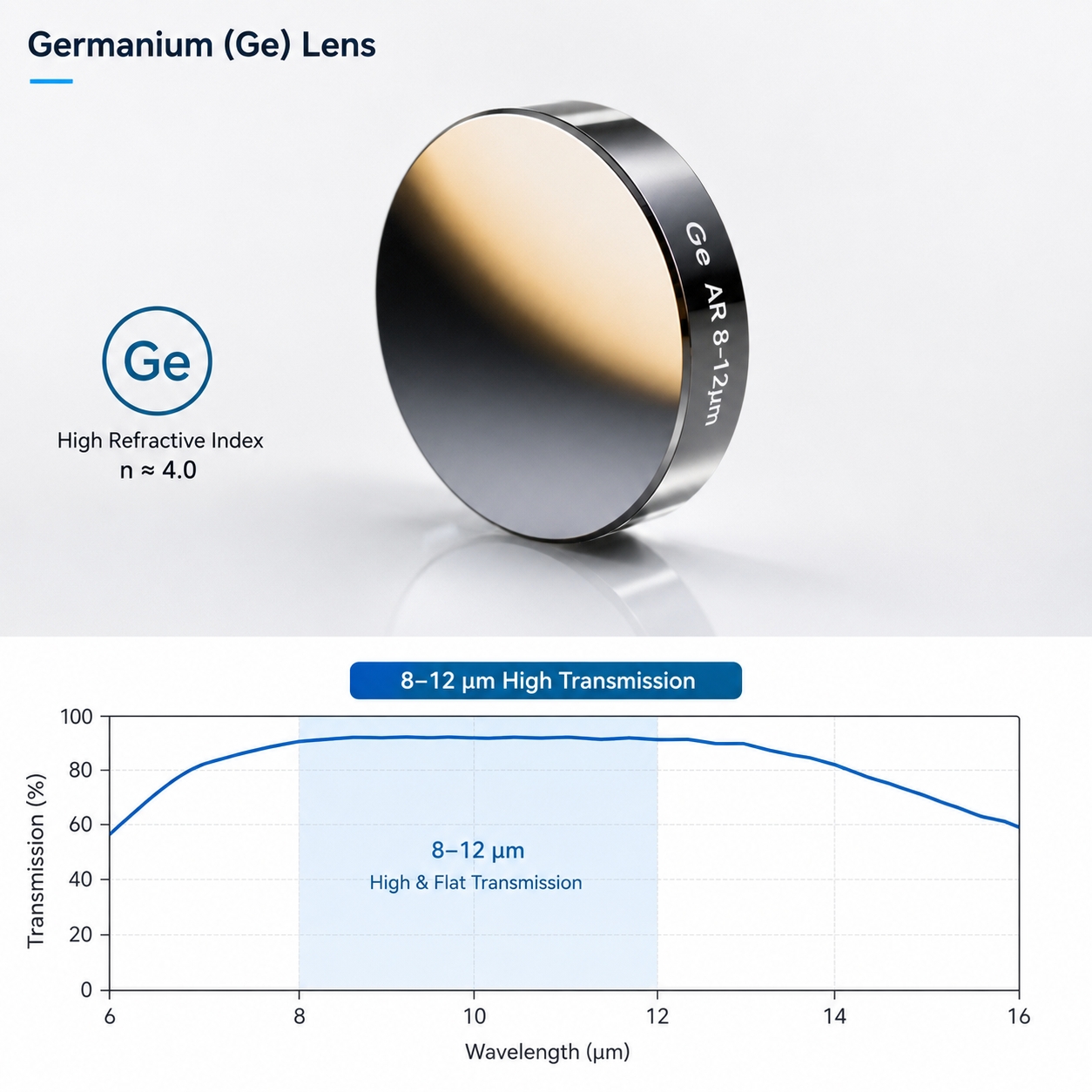
Common methods for manufacturing aspheric lenses today include precision glass molding, single-point diamond turning, and high-precision CNC polishing. Different processes are suitable for different materials and applications. For example, infrared optical systems often use diamond turning, while high-volume consumer electronics more frequently use molding techniques.
The development of these manufacturing technologies means aspheric lenses are no longer limited to high-end scientific research equipment. They are now gradually entering large-scale industrial applications, such as consumer electronics and automated sensor systems.
Where Aspheric Lens Design Is Used Today
As optical systems demand better performance and smaller sizes, aspheric design has become a key component of many modern devices. In consumer electronics, almost all smartphone cameras rely on aspheric lenses to achieve high-resolution imaging while keeping the module size extremely small.
In immersive display devices, such as virtual reality and augmented reality systems, aspheric lenses are used to widen the field of view and reduce image distortion, providing a more natural visual experience.
In the industrial and automation fields, many laser systems and sensor devices also depend on aspheric optical elements for higher precision in beam control. For example, in laser collimation, scanning systems, and autonomous driving sensors, aspheric design can effectively improve beam quality and increase system efficiency.
The Limitations and Trade-Offs of Aspheric Lens Design
Although aspheric lenses have clear advantages, they are not always the best choice for every optical system. In some applications, traditional spherical lenses still have irreplaceable benefits.
The first issue is manufacturing cost. Aspheric lenses typically require more complex processing equipment and stricter inspection procedures. Therefore, in small production runs, their cost can be significantly higher than that of spherical lenses.
The second issue is assembly sensitivity. Because an aspheric lens often performs more optical functions, it is more sensitive to positional and tilt errors during assembly. If the assembly precision is insufficient, the system’s performance can noticeably decrease.
Therefore, in practical design, many optical systems do not rely entirely on aspheric lenses. Instead, they use a combination of spherical and aspheric elements to achieve a balance between performance, cost, and manufacturing difficulty.
FAQ
Are aspheric lenses always better than spherical lenses?
No. Aspheric lenses have advantages in reducing aberrations and shrinking system size, but they are usually more expensive and complex to manufacture. Therefore, many systems still use a hybrid design with both spherical and aspheric lenses.
Why are aspheric lenses commonly used in modern cameras?
Modern camera systems need to achieve high-resolution imaging in a very small space. Aspheric lenses help control aberrations while reducing the number of lenses needed, making them an important part of camera module design.
Can a single aspheric lens replace multiple spherical lenses?
In some cases, yes. A well-optimized aspheric lens can compensate for several types of aberrations simultaneously. This means it can potentially replace a combination of multiple spherical lenses, thereby simplifying the optical system structure.