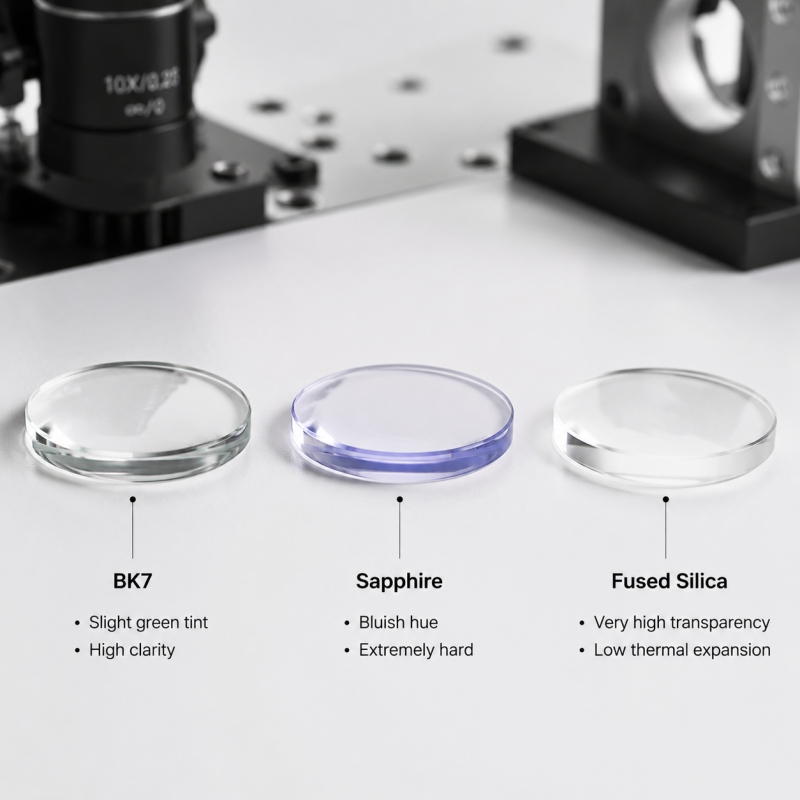
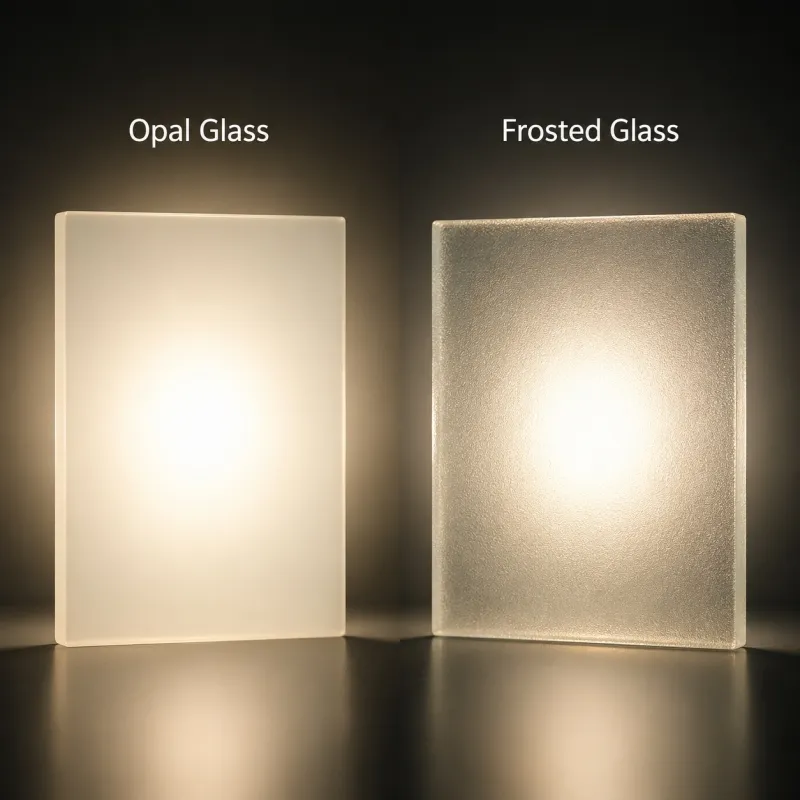
In the world of optical materials, the most familiar ones are often optical glass, quartz, or plastic lenses, as these are widely used in cameras, microscopes, and everyday optical devices. However, when optical systems venture into the infrared spectrum, the choice of materials suddenly becomes very limited. Many materials that perform well in visible light strongly absorb infrared energy, making them almost completely opaque. Therefore, infrared optical systems require materials with special optical properties, and germanium is one of the most important among them.
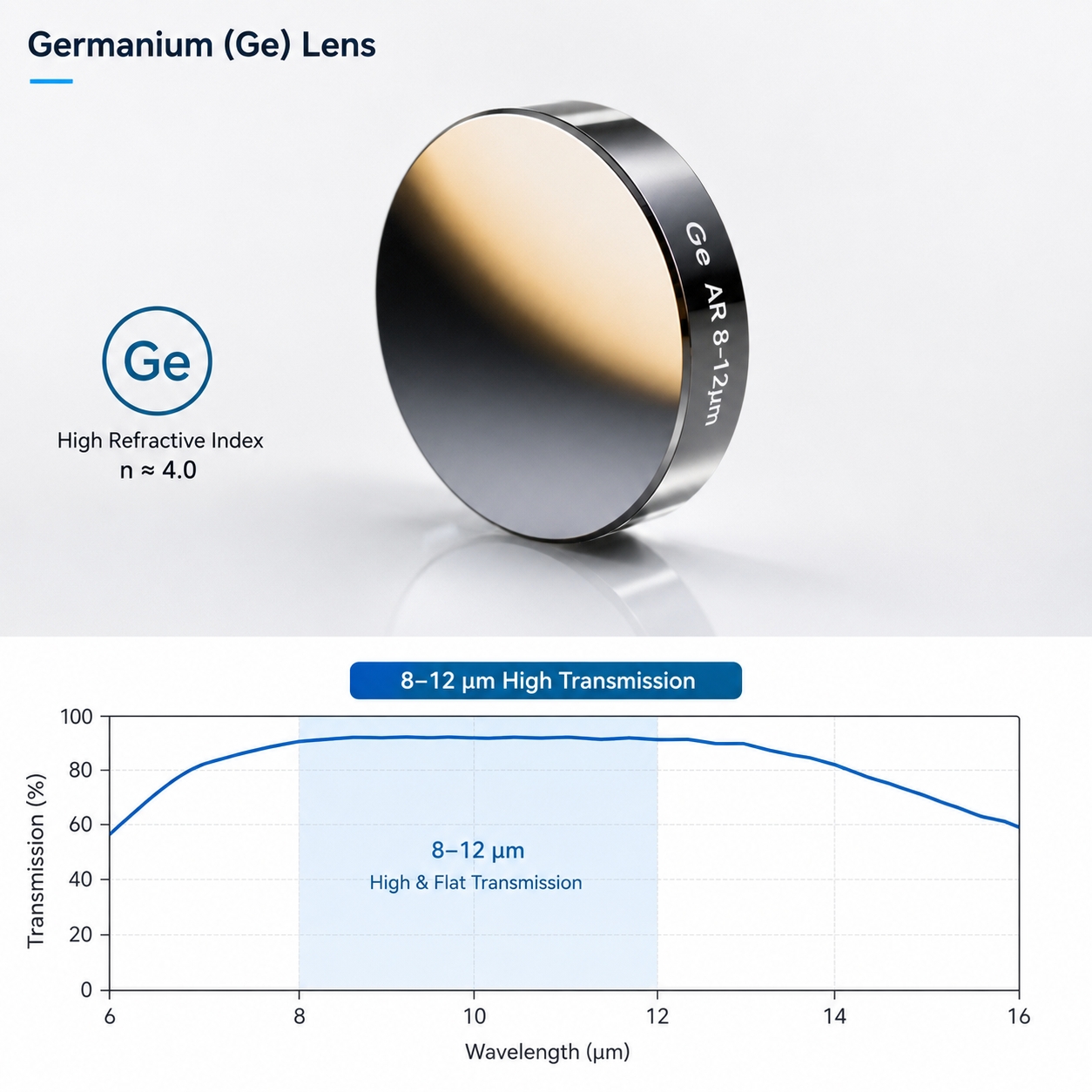
In many infrared imaging devices, the lens surface you see isn’t transparent glass, but rather a material with a grayish-black, metallic luster. This is very likely a germanium lens. Although it appears almost opaque to the naked eye, it transmits infrared light very efficiently. Because of this unique optical behavior, germanium has become an indispensable material in infrared optical systems.

What Kind of Optical Material is Germanium?
From a material science perspective, germanium is a semiconductor element belonging to Group IV of the periodic table, with a crystal structure similar to silicon. It was first widely used in semiconductor electronic devices, playing an important role in early transistors and infrared detectors. Later, with the development of infrared technology, it was discovered that germanium possesses very stable optical performance in the infrared range, leading to its extensive use in manufacturing infrared optical components.
Germanium crystals typically appear grayish-black or dark gray with a metallic sheen. Unlike ordinary optical glass, germanium used in optics is usually a single-crystal material, meaning its internal atomic arrangement is highly regular. This allows for very stable optical performance during processing. Through cutting, grinding, and polishing, germanium can be fabricated into various infrared optical elements, such as infrared lenses, windows, and protective domes.
In many infrared devices, germanium components are often positioned at the very front of the system to receive infrared radiation from the environment and transmit it to the detector or imaging system.
Germanium’s Transmission Characteristics in the Infrared
One of germanium’s most important optical features is its excellent transmittance in the infrared spectrum. While many common optical materials exhibit strong absorption in the infrared, germanium maintains a stable transmittance over a broad infrared range.
Generally, germanium’s effective transmission band is approximately from 2 µm to 14 µm. This range conveniently covers the most commonly used bands in infrared technology, such as:
- 3–5 µm (Mid-Wave Infrared, MWIR)
- 8–12 µm (Long-Wave Infrared, LWIR)
These two bands are precisely the operating ranges for many thermal imaging cameras and infrared sensors. Consequently, germanium lenses are often the core optical components in a vast number of infrared lenses.
From a practical standpoint, if a material cannot transmit light effectively in these infrared bands, it is virtually unusable for infrared imaging systems. The reason germanium has long held a prominent position as an infrared optical material is largely due to its stable and reliable transmission performance across these critical wavelengths.
Optical Advantages of a High Refractive Index
Besides its good infrared transmittance, germanium has another outstanding optical property: a very high refractive index. In the long-wave infrared region, germanium’s refractive index reaches approximately n ≈ 4, a value significantly higher than that of common optical glasses.
A high refractive index means that light rays can be bent more strongly as they propagate through the material. For optical design, this has significant practical implications. Because when a material has a high refractive index, designers can achieve the same optical effect with fewer lenses or gentler curves, allowing the entire optical system to be more compact.
This is crucial for many infrared devices. For example, in drones, vehicle night vision systems, or handheld thermal imagers, the device size is often strictly limited. Using ordinary materials might result in a very long lens assembly, whereas high-index germanium helps shorten the optical path length, making the device lighter and more portable.
Of course, a high refractive index also introduces challenges, most notably a significant increase in surface reflection. Without an anti-reflective coating, a germanium surface would reflect a substantial portion of the light, reducing the overall transmission efficiency of the system. Therefore, in practical applications, germanium lenses are almost always coated with specialized infrared anti-reflective coatings to minimize reflection losses.
Dispersion Characteristics and Imaging Stability
In optical systems, light rays of different wavelengths refract to slightly different degrees when passing through a material. This phenomenon is called dispersion. If a material has high dispersion, different wavelengths will focus at different points, causing chromatic aberration and degrading image quality.
Germanium has relatively low dispersion in the infrared bands. This means that different infrared wavelengths don’t experience excessively different focal shifts when passing through a lens. For infrared imaging systems, this characteristic helps maintain image sharpness and reduces the need for complex compensatory elements in the optical design.
Although infrared imaging doesn’t rely on color information in the same way visible-light photography does, wavelength differences still affect the focal point. If dispersion is not well-controlled, image clarity suffers. Therefore, germanium’s low dispersion often helps simplify lens design in infrared optics.
The Impact of Temperature on Germanium’s Optical Performance
Another frequently mentioned characteristic of germanium is its sensitivity to temperature changes. When the ambient temperature varies, both the refractive index and the physical dimensions of germanium change to some extent. This phenomenon is known in optical engineering as the thermo-optic effect.
Under normal conditions, this change might be negligible, but in high-precision infrared systems, it can affect the focal length or image position. Consequently, engineers often consider temperature compensation in many infrared lens designs. This can involve using combinations of materials with opposite thermal responses, special mechanical structures, or software-based corrections to mitigate the effects of temperature fluctuations.
In some high-end infrared devices, this approach is called “athermalization design,” and its goal is to ensure the optical system maintains stable imaging quality across a range of operating temperatures.
Manufacturing Process of Germanium Optical Components
Unlike ordinary glass lenses, the fabrication of germanium lenses typically starts with single-crystal material. First, high-purity germanium crystals are grown using specialized crystal growth techniques. This is followed by several processing steps.
In production, manufacturing germanium optical components generally involves these key stages:
- Crystal Slicing: The large crystal is cut into blanks of appropriate size and shape.
- Precision Grinding: The basic curved surfaces are generated using precision grinding, often with diamond tools due to the material’s hardness.
- Polishing: The surfaces are polished to achieve optical-grade smoothness and accuracy.
- Coating: Finally, infrared anti-reflective coatings are applied to enhance transmittance and reduce reflection losses.
Because germanium is relatively hard and dense, the processing often requires diamond tooling for precision machining. This is one of the reasons why the manufacturing cost of germanium optics is generally higher than that of standard glass lenses.
Limitations of Germanium as an Optical Material
Despite its many advantages in infrared optics, germanium is not without drawbacks. Firstly, its density is relatively high, around 5.3 g/cm³. This means that for larger lenses, the overall weight can become significant.
Secondly, the cost of germanium material is relatively high. The process of producing high-purity single-crystal germanium is complex, and when combined with precision fabrication and coating, the price of germanium optical components typically exceeds that of common optical materials.
Furthermore, germanium is almost completely opaque in the visible spectrum. Therefore, it cannot be used in visible-light systems like standard cameras or microscopes. Its application is almost entirely confined to the infrared field.
These factors mean that while germanium is critically important, it is generally used only in infrared systems and does not serve as a replacement for other common optical materials in other applications.
Practical Applications of Germanium in Infrared Systems
Thanks to its stable infrared transmission and high refractive index, germanium has become a key material in numerous infrared devices. In practical applications, germanium optics are commonly found in various infrared imaging and detection equipment, such as:
Thermal imaging cameras
- Industrial infrared inspection equipment
- Night vision systems
Vehicle infrared driver-assistance systems
In many infrared lens designs, engineers combine multiple germanium lenses to achieve better imaging quality and higher light utilization efficiency. For systems requiring long-range detection or high sensitivity, germanium lenses are often an indispensable component.
With the continuous advancement of infrared technology in fields like security surveillance, industrial inspection, and autonomous driving, the demand for germanium optical materials continues to grow. While new infrared materials are constantly being researched, germanium is expected to remain a fundamental and very important material in infrared optical systems for the foreseeable future.