When companies invest in optical components, the choice of optical materials can make a huge difference in both performance and cost. The choice of different materials may lead to various issues, such as different product prices, project time, etc. In this guide, we explore five of the most cost-effective optical materials, analyzing their advantages, limitations, and ideal applications to help businesses make smarter procurement decisions.
Key Factors in Material Selection for Companies
Before evaluating specific materials, it’s important to consider the factors that influence their cost-effectiveness in a business context:
- Material Cost and Availability– The price of raw materials and how easily they can be sourced in bulk.
- Fabrication Complexity– Some materials are harder to cut, polish, or coat, increasing manufacturing costs.
- Durability and Stability– Materials that resist heat, chemical exposure, or environmental stress reduce long-term replacement costs.
- Performance Fit– Choosing a material with just the right optical performance avoids over-engineering and unnecessary expense.
Top 5 Cost-Effective Optical Materials
1. Optical Glass
Advantages:
- High transparency and wide refractive index range.
- Mature processing technology ensures consistent quality.
Limitations:
- Moderate resistance to thermal shock compared to fused silica.
- Heavier than polymer alternatives.
Why It’s Cost-Effective: Balances performance with moderate cost, suitable for bulk manufacturing.
Ideal Applications: Industrial lenses, mirrors, prisms for lighting and imaging systems.
Not Recommended For: Extreme UV or high-temperature laser systems where thermal stability is critical.
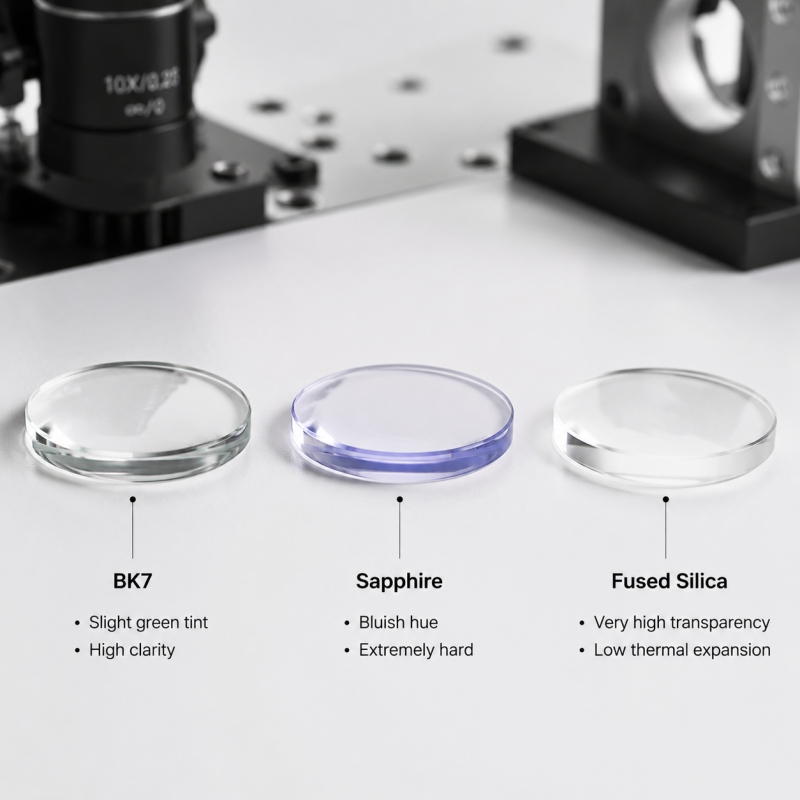
2. Fused Silica
Advantages:
- Extremely low thermal expansion and excellent UV transmission.
- Very stable over long-term usage, reducing maintenance costs.
Limitations:
- Higher raw material and processing costs than common optical glass.
- More challenging to fabricate in complex shapes.
Why It’s Cost-Effective: Despite a higher upfront cost, its durability and performance reduce long-term replacement expenses.
Ideal Applications: Laser systems, precision optics, scientific instrumentation.
Not Recommended For: Standard consumer optics where performance requirements are modest and cost sensitivity is high.

3. Borosilicate Glass
Advantages:
- Low thermal expansion and good chemical resistance.
- Easier and cheaper to fabricate than fused silica.
Limitations:
- Slightly lower optical quality compared to high-grade optical glass.
- Less suitable for high-precision laser optics.
Why It’s Cost-Effective: Provides sufficient performance for industrial and lab applications at a lower cost than fused silica.
Ideal Applications: Laboratory equipment, optical windows, industrial sensors.
Not Recommended For: High-end imaging systems where superior optical clarity is critical.
4. Acrylic / PMMA
Advantages:
- Lightweight and easy to fabricate.
- Very low cost per unit compared to glass alternatives.
Limitations:
- Scratches easily, poor heat resistance.
- Not suitable for high-power laser or outdoor UV exposure.
Why It’s Cost-Effective: For non-critical or short-life applications, it dramatically reduces material and labor costs.
Ideal Applications: Display covers, protective optical elements, low-precision lenses.
Not Recommended For: Harsh industrial environments or applications requiring high optical accuracy.
5. K9 Glass (Crown Glass)
Advantages:
- Good optical clarity and moderate refractive index.
- Very affordable and widely available.
Limitations:
- Limited thermal and chemical resistance compared to borosilicate or fused silica.
- Not suitable for high-precision optical instruments.
Why It’s Cost-Effective: Provides adequate performance at low cost, ideal for bulk production and educational purposes.
Ideal Applications: Teaching optics, low-cost lenses, and demonstration kits.
Not Recommended For: High-precision imaging or laser applications.
Conclusion
For companies, selecting the right optical materials isn’t just about performance—it’s about balancing cost, durability, and suitability for the intended application. Optical glass, fused silica, borosilicate glass, acrylic/PMMA, and K9 glass represent five of the most cost-effective options, each with specific advantages, limitations, and ideal scenarios.
By understanding the strengths and weaknesses of each material, you can make informed decisions that minimize waste, reduce production costs, and ensure its optical components perform reliably in the field.