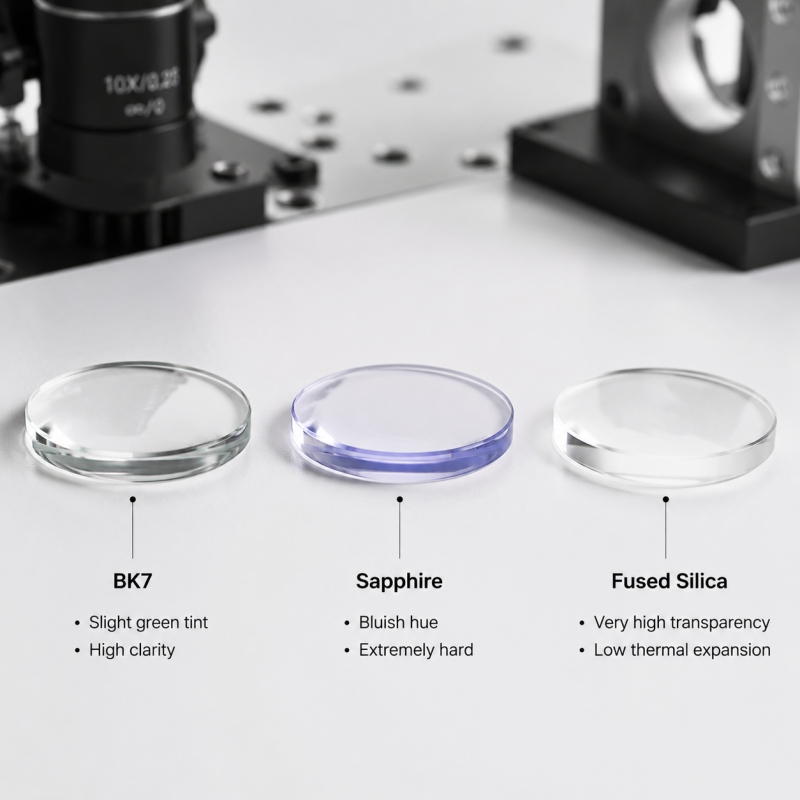
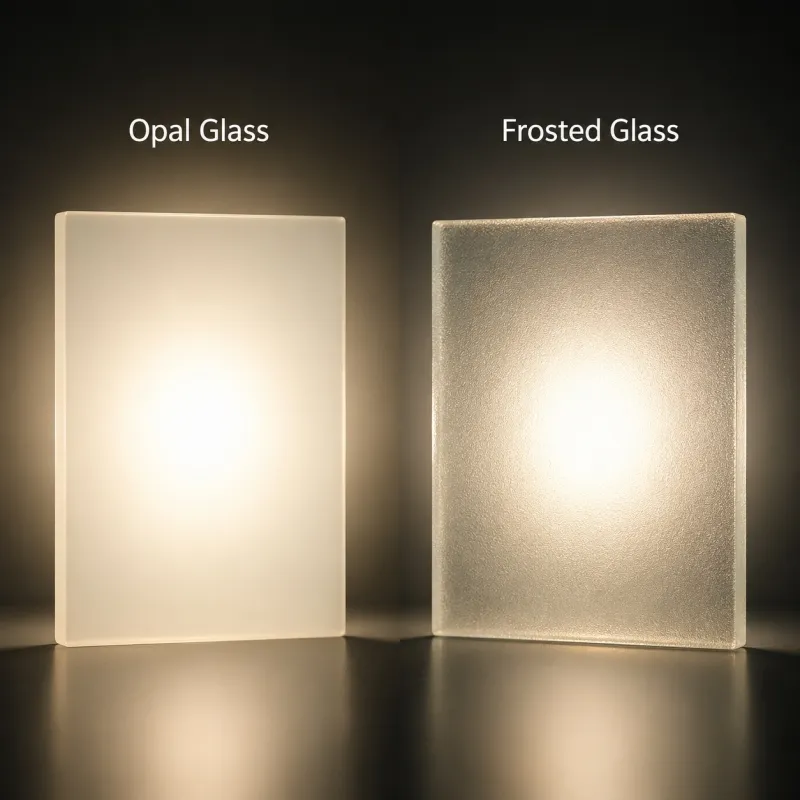
The special feature of aspherical lenses is their aspherical surface structure, which effectively reduces spherical aberration and coma, greatly improving image quality. Apart from the precision in design geometry, performance is decided by the material selection. Refractive index, dispersion coefficient, thermal expansion properties, mechanical stability, surface processability, and cost factors all directly affect the final optical system effect.
In actual optical engineering, the selection of the material should be based not only on its physical properties but also on a comprehensive consideration of the processing method and performance trade-offs. This article systematically analyzes the types of materials commonly used in aspherical lenses, including their optical properties, manufacturing methods, typical applications, and design points.
Overview of Aspherical Lens Materials
Aspherical lenses are primarily made up of three types of materials at present: optical glass, engineering plastics, and crystals and specialty materials.
Material Type | Refractive Index | Abbe Number | Transmission Range | Thermal Expansion | Typical Applications |
Optical Glass | 1.5–2.0 | 50–90 | 350–2200 nm | Low | Imaging, Laser Systems |
Engineering Plastics | 1.49–1.62 | 30–55 | 400–1100 nm | Medium | Consumer Electronics, AR/VR |
Crystals & Specialty Materials | 1.4–2.7 | N/A | UV–IR | Low to Medium | IR & High-Power Optics |
These various comparison tables allow the engineer to have a quick look during the phase of material selection about the suitability of different materials for a particular optical system.
Aspheric Glass Lenses
Optical Properties
Optical glass dominates precision imaging because of its high refractive index and low dispersion. Its high refractive index allows for stronger bending of light with a thinner structure, while very low dispersion ensures sharp, color-accurate imaging over the wide spectral range. It also provides great thermal stability and adaptability against environmental changes, which ensures consistency in performance over time.
Manufacturing Techniques
In manufacturing, the aspherical lenses made of glass usually adopt high-precision grinding and polishing and cooperate with CCOS (Computer-Controlled Optical Surfacing) to achieve repeatable manufacturing of complex surfaces. Further polishing and coating will improve its transmittance and durability. With long production cycles and high expenses, its excellent optical quality makes it the first choice for scientific research, laser measurement, and high-end imaging equipment.
Typical Applications
Scientific research instruments, high-end photographic lenses, astronomical telescopes, laser ranging, and optical metrology systems, etc.
In cases where high precision and long-term stability are pursued, glass is undoubtedly the ideal material.

Plastic Aspherical Lenses
Optical Properties
Plastic materials (e.g., PMMA, PC, COP) are used in many consumer and portable optical systems. Compared to traditional glass materials, plastics have the advantages of light weight, high plasticity, and low cost. Designers can modify the refractive index and dispersion parameters of materials through material compounding or modification to optimize the system’s imaging quality to a certain degree.
Manufacturing Techniques
Regarding the fabrication process, plastic aspherical lenses mainly adopt injection molding, which is suitable for mass production; die casting molding for small and medium-sized batch high-precision manufacturing; and diamond turning for rapid prototyping of samples or custom optics. Although plastics are not as thermally stable and scratch-resistant as glass, their lightweight and affordability make them highly competitive in AR/VR devices, automotive vision, and smart terminals.
Typical Applications
Smartphone and flat-panel camera modules, wearable display systems, projection and autonomous driving imaging modules, and more.

Crystal and Special Material Aspheric Lenses
Optical Properties
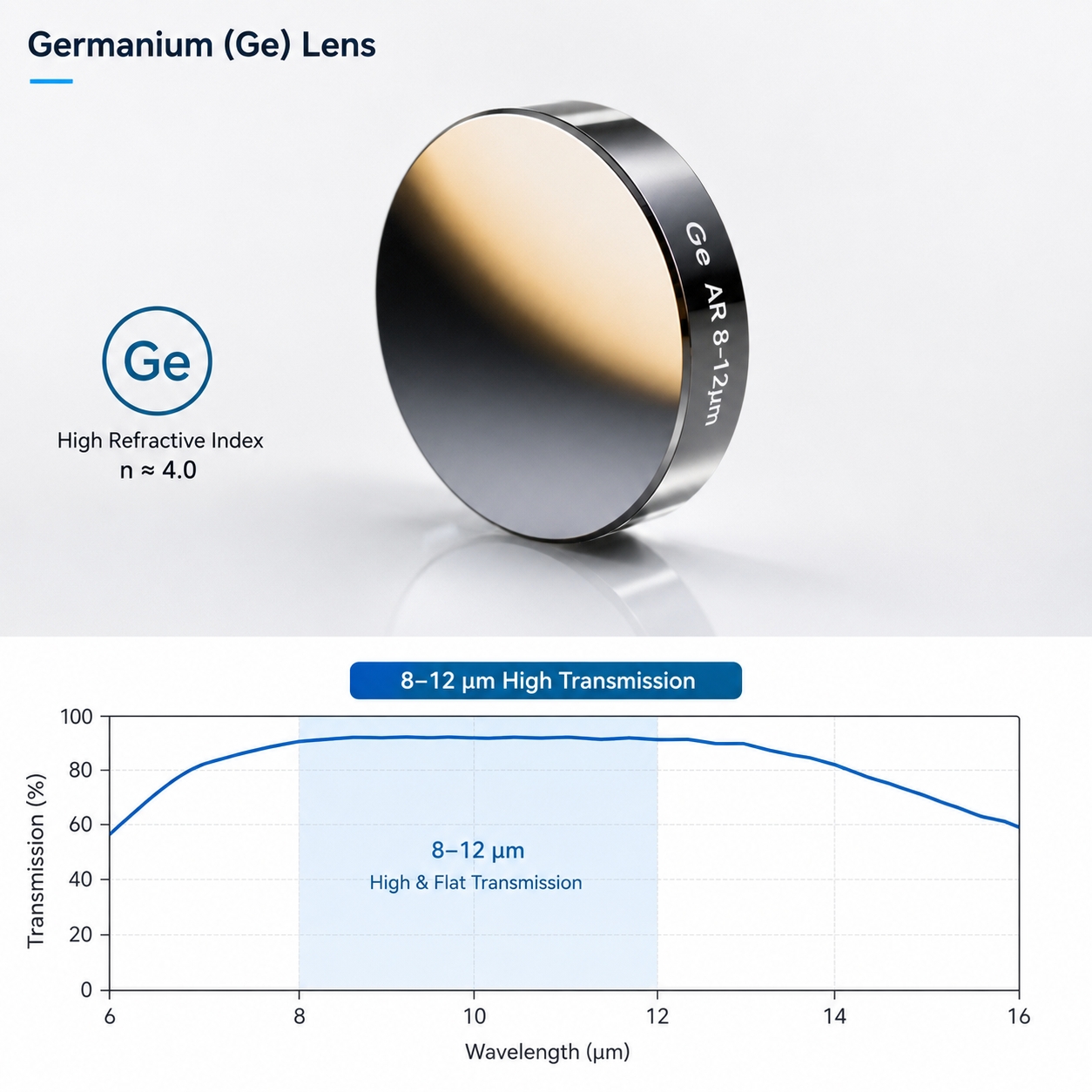
Crystals and specialty materials address systems that require UV, IR, or high-power optical performance that cannot be replaced by glass or plastic. Common materials include ZnSe, CaF₂, and Si. They offer a higher refractive index, broader spectral transmission ranges from UV to IR, and extremely high laser energy densities.
Manufacturing Techniques
Processing these materials requires a high level of precision, which is achieved with special equipment. In general, ultra-precision grinding and polishing are used, and some infrared crystals must be processed at low temperatures or in inert environments. Besides this, different types of crystals should be matched with corresponding anti-reflective or protective coating technologies to maintain the best transmission performance and durability.
Typical Applications
Infrared imaging and detection systems, high-power laser cutting equipment, space optical instruments, precision scientific research equipment, etc. In applications requiring high-energy load-bearing and special wavelength transmission, these materials represent the core choice for advanced optical systems.

Material Selection – Engineering Considerations
In aspherical lens material selection, designers often have to make trade-offs among the following factors:
- Optical Properties: Refractive index, dispersion, and transmission range.
- Mechanical and Thermal Stability: Controlling deformation of materials subjected to temperature fluctuations or mechanical load.
- Manufacturing Process: Whether the material supports injection molding, fine polishing, or ultra-precision machining.
- Cost and Batch: Unit price, molding cycle, and mass production feasibility.
A Common Selection Process:
Determine system requirements → Screen candidate materials → Evaluate machinability → Analyze cost-effectiveness → Make the final decision. This process ensures optical performance that will balance manufacturing and budget.
Conclusion
The choice of material for aspherical lenses plays a deciding role in the design of optical systems. Glass materials represent precision and stability; plastics bring lightweight and high production capacity; crystals and specialty materials extend the limits of optical systems in the field of ultraviolet, infrared, and high power.
The design freedom and performance potential of aspherical optics continue to increase with the evolution of high-index plastics and composites. Reasonable material selection affects not only imaging quality and mechanical reliability but also is the starting point for innovation in the optical system.