Lenses are the heart of optical systems, directing and shaping light for applications like imaging, communications, and lasers. Among the many lens designs available, cylindrical lenses and traditional (spherical) lenses are two widely used types, each serving unique purposes. Understanding the differences between them can help ensure optimal performance when designing or customizing an optical system.
What is a Cylindrical Lens?
A cylindrical lens features curvature along only one axis, unlike spherical lenses, which curve in two directions. This unique geometry allows the lens to manipulate light in a single dimension: it can converge incoming parallel rays into a line or diverge them into a linear spread, depending on whether the lens surface is convex or concave along that axis.
Because the lens does not focus light in the perpendicular direction, the resulting image is line-shaped rather than point-shaped. This one-dimensional control of light is particularly useful in applications such as laser line generation, optical scanning, beam shaping, and coupling light into optical fibers, where controlling the distribution of light along a single axis is critical.

Common Types of Cylindrical Lenses
Cylindrical lenses can be broadly categorized based on their surface geometry and optical function:
Positive Cylindrical Lens
- Description: A lens with a convex curvature along one axis and flat along the perpendicular axis. It focuses light into a line.
- Applications: Laser line generation, barcode scanning, optical measurement, beam shaping in industrial and scientific systems.
Variants:
- Plano-Convex Positive: Flat on one side, convex on the other; common for standard line focusing.
- Bi-Convex Positive: Both sides are convex along the same axis; stronger focusing for high-precision applications.
Negative Cylindrical Lens
- Description: A lens with a concave curvature along one axis and flat along the perpendicular axis. It spreads light into a linear distribution.
- Applications: Beam expansion, line illumination, laser homogenization, and optical testing setups.
Variants:
- Plano-Concave Negative: Flat on one side, concave on the other; commonly used to diverge a laser line.
- Bi-Concave Negative: Both sides are concave along the same axis; produces stronger divergence for specialized beam shaping.
Achromatic Cylindrical Lens (Positive or Negative)
- Description: Made from two different types of glass to reduce chromatic aberration, suitable for polychromatic light.
- Applications: Spectroscopy, multi-wavelength laser systems, precision optical instrumentation.
Concave-Convex Cylindrical Lens (Meniscus, Positive or Negative)
- Description: One side concave, one side convex along the same axis; can slightly focus or diverge light depending on the curvature combination.
- Applications: Beam shaping in compact optical systems, optical correction.
Because of these variations, cylindrical lenses are essential in applications such as laser beam shaping, barcode scanning, light sheet microscopy, and optical fiber coupling, where one-dimensional control of light is critical.

What is a Conventional Lens?
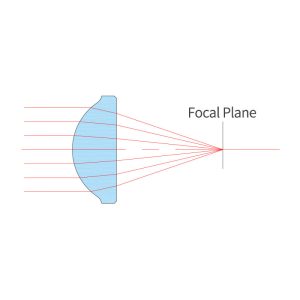
When people refer to a “normal” lens, they usually mean a spherical lens. Unlike cylindrical lenses, a conventional lens has curvature in two directions, which allows it to focus or diverge light in both axes simultaneously. This results in a point focus, suitable for imaging or projection tasks.
Common examples include:
- Convex (converging) lenses: bring parallel rays to a focus point.
- Concave (diverging) lenses: spread light rays outward.
These lenses are widely used in cameras, microscopes, telescopes, eyeglasses, and projectors where accurate point focusing and image formation are required.
Key Differences Between Cylindrical and Conventional Lenses
To better illustrate the distinction, here is a detailed comparison across several optical dimensions:
Aspect | Cylindrical Lens | Conventional (Spherical) Lens |
Focusing | Focuses or diverges light in one axis only, creating a line focus | Focuses or diverges light in both axes, creating a point focus |
Optical Surface | Curvature along one direction (single axis), flat in the other | Curvature along two directions (dual axis), usually spherical |
Imaging Result | Produces a line image | Produces a point image |
Applications | Laser beam shaping, barcode scanning, optical fiber coupling, light sheet microscopy | Photography, microscopes, telescopes, projectors, eyeglasses |
Energy Distribution | Modifies energy distribution in one axis, forming line or strip-shaped beams | Modifies energy distribution in two axes, forming circular or point beams |
Typical Types | Positive cylindrical lens (converging), negative cylindrical lens (diverging) | Convex lens (converging), concave lens (diverging) |
Design Complexity | Requires precise single-axis grinding and alignment | More common and easier to manufacture with mature processes |
Limitations | Not suitable for full 2D imaging, but irreplaceable in linear light applications | Excellent for imaging, but cannot shape light into a line |
Application Scenarios
Cylindrical Lenses:
- Laser line projection in industrial measurement
- Barcode scanner optics
- Light shaping in biomedical instruments
- Optical fiber coupling in telecom systems
Conventional Lenses:
- Camera lenses for photography
- Eyeglasses for vision correction
- Microscope and telescope objectives
- Projection systems in education and entertainment
How to Choose the Right Lens?
The decision between cylindrical and conventional lenses depends on the desired optical effect:
- If your system requires line focusing or one-dimensional beam shaping, a cylindrical lens is the right choice.
- If your system needs imaging, projection, or point focusing, a conventional spherical lens is more suitable.
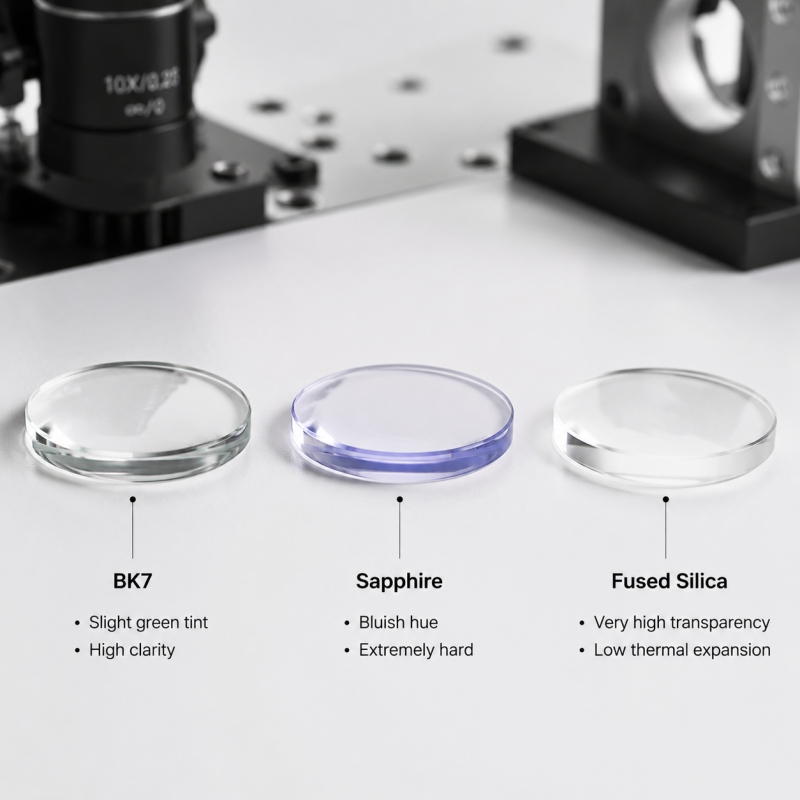
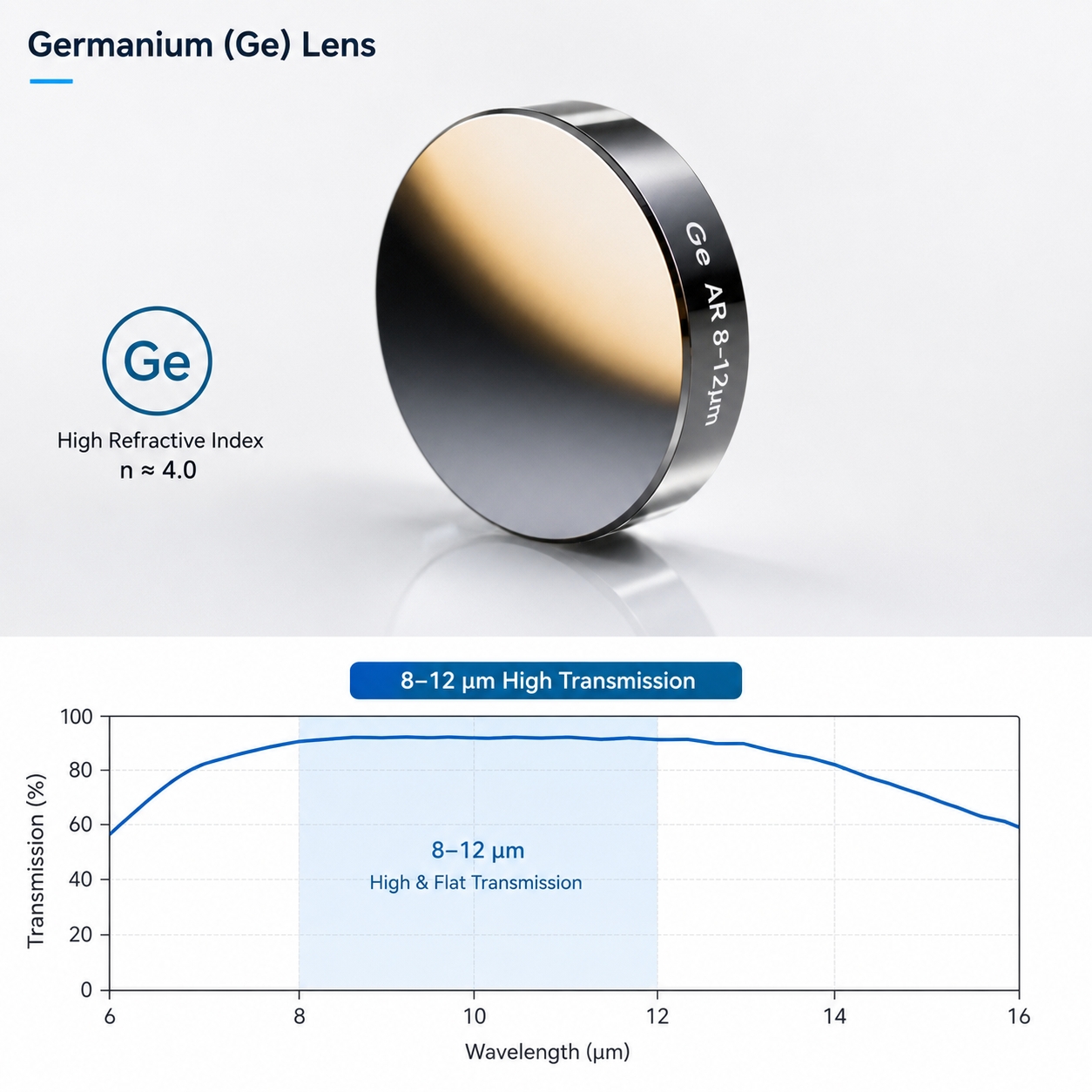
- Additional factors such as material (optical glass, fused silica, sapphire), tolerances, and wavelength range should also be considered for high-precision applications.
How to Choose the Right Cylindrical Lens for Your Application
Cylindrical lenses are essential in laser processing, optical fiber coupling, measurement systems, and scientific research. Choosing the right lens goes beyond optical performance—it also involves balancing cost, manufacturing capabilities, and delivery timelines.
Factors to Consider When Choosing a Cylindrical Lens
Application Scenario
- Identify the specific optical function: line generation, beam shaping, divergence control, or precision measurement.
- The application determines the required focal properties, beam distribution, and optical tolerances.
Cost and Value
- Standard lenses generally offer high cost-efficiency for common applications.
- High-precision or specialty lenses may have higher upfront costs but are necessary for critical optical performance.
Manufacturing Capabilities
- Consider whether the supplier can provide the required surface quality, dimensional tolerances, and coatings.
- Complex designs, such as non-spherical or diffractive lenses, require advanced fabrication techniques.
Delivery Time
- Standard lenses are usually available quickly.
- Customized lenses require longer lead times for design, fabrication, and testing, which should be factored into project planning.
System Integration and Performance
- Evaluate how the lens interacts with other optical components in your system.
- Optimizing alignment, material selection, and coating options ensures maximum efficiency and stability.
Conclusion
While both cylindrical and conventional lenses manipulate light, their focusing geometry and application fields are fundamentally different. Cylindrical lenses are indispensable for beam shaping and linear light distribution, whereas conventional lenses remain the foundation of imaging systems.
For industries ranging from laser processing and optical communication to medical imaging and scientific research, choosing the right lens ensures accuracy, efficiency, and performance.
At Hobbite, we offer comprehensive optical design and customization services, providing both cylindrical lenses and spherical lenses tailored to your specific industrial or research applications.
By combining simulation, prototyping, and precision fabrication, our team ensures lenses meet exact specifications for precision imaging, beam shaping, or specialized optical setups. Whether you require standard components or high-precision custom solutions, Hobbite delivers high-quality optics that balance performance, manufacturability, and cost-effectiveness.