In the fields of fiber optic communication and sensing, efficient transmission and precise manipulation of optical signals are critical. Hobbite provides high-performance fiber collimators, regarded as “beam-shaping experts.” They convert divergent light emitted from fibers into collimated beams or focus parallel beams into fiber cores, ensuring stable and high-quality signal transmission.
What is a Fiber Collimator?
A fiber collimator is a fiber assembly designed to collimate or focus light at the fiber end. It typically consists of:
- Optical fiber section– single-mode fiber (SMF) is most common, but polarization-maintaining (PMF) or multimode fiber (MMF) can also be used.
- Miniature lens– such as a C-lens, aspheric lens, or GRIN lens.
- Precision alignment– sub-micron assembly ensures efficient beam shaping.
Hobbite’s fiber collimators transform divergent beams into parallel light or focus collimated beams into fiber cores, making them reliable optical interfaces in advanced systems.

Working Principle of a Fiber Collimator
The principle is based on refraction and focusing:
- Light emitted from the fiber end typically diverges.
- A lens refracts and reshapes the beam. The lens curvature, refractive index, and distance from the fiber determine beam propagation.
- Proper design allows divergent beams to become collimated, or collimated light to be focused precisely at a target.
Essentially, the fiber collimator acts as a miniaturized optical interface that reduces insertion loss and ensures stable propagation in complex systems.
Main Types of Fiber Collimators
According to lens design and function, fiber collimators can be classified into:
C-Lens Collimator
- Uses spherical lenses.
- Simple design, cost-effective, highly customizable.
- Widely used in PON, ONU, and mass communication devices.
Aspheric Lens Collimator
- Corrects spherical aberration.
- Provides higher collimation accuracy and beam quality.
- Suitable for precision sensing and laser applications.
GRIN Lens Collimator
- Uses a graded-index lens.
- Offers lower aberration and higher coupling efficiency.
- Ideal for miniaturized and integrated systems.
Focusing Fiber Collimator
- Performs both collimation and focusing.
- Applied in fiber coupling, laser processing, and precision measurement.
Key Performance Parameters
When selecting a fiber collimator, customers often focus on:
- Operating wavelength range(e.g., 1260–1650nm for communication systems)
- Insertion loss(typically ≤ 0.5 dB)
- Return loss(RL ≥ 55 dB, with APC options for lower reflection)
- Beam spot size and MFD matching
- Collimation accuracy and divergence angle
- High-power handling capability
- Dimensions and packaging
Hobbite ensures strict control over these parameters through advanced assembly processes and comprehensive testing.
Applications of Fiber Collimators
Fiber Communication
- Low-loss coupling between fibers or between fibers and devices.
- Improves transmission efficiency and signal stability.
- Hobbite fiber collimators are widely deployed in PON ONU series products, serving as integrated optical components for leading industry clients.
Fiber Sensing
- Applied in fiber interferometers and fiber lasers.
- Enables high-precision and high-sensitivity measurements.
Laser Technology
- Used for beam collimation, focusing, and shaping.
- Common in laser processing, medical aesthetics, and R&D systems.
Other Applications
- Optical testing and metrology instruments.
- Aerospace and defense optical interconnects.
- Photonic integrated circuit packaging.
Manufacturing and Customization Capabilities
Hobbite offers both standardized and fully customized fiber collimators, ensuring compatibility with diverse applications:
Precision Manufacturing
- Sub-micron alignment for high coupling efficiency and low insertion loss.
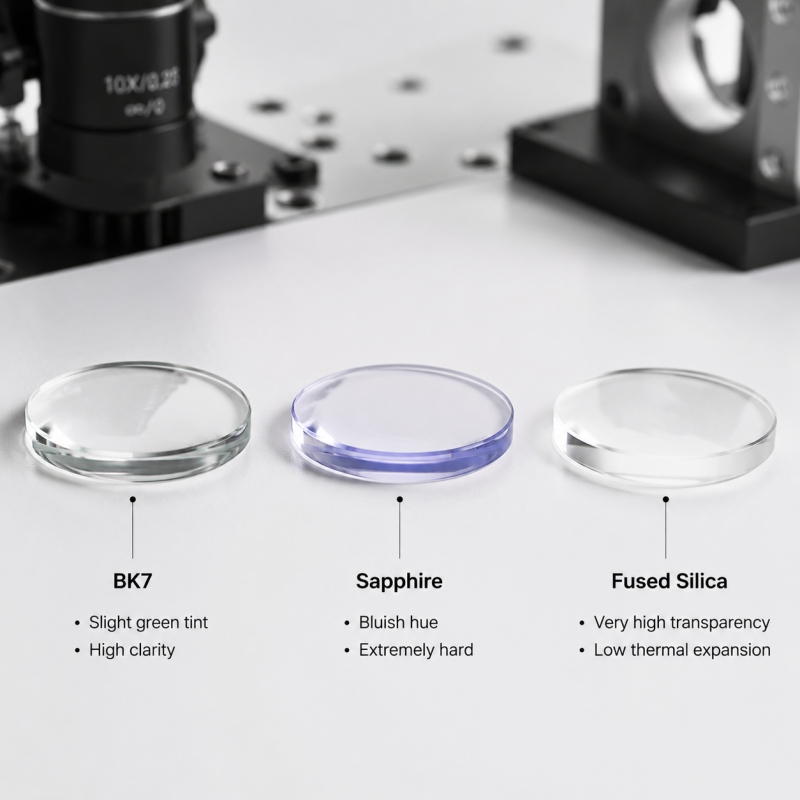
- High-purity optical materials (optical glass, fused silica, sapphire) for excellent durability and transmission.
Parameter Customization
- Supports multiple wavelength ranges (850nm, 1310nm, 1550nm, or custom).
- Available with SMF, PMF, or MMF fibers.
- Multiple lens structures (C-lens, aspheric, GRIN) for different use cases.
Reliability Assurance
- Comprehensive testing for insertion loss, return loss, thermal cycling, and humidity.
- Compliance with Telcordia GR-468 and RoHS standards.
Flexible Delivery
- Supports prototypes, small-batch, and large-scale production.
- Fast turnaround to support research institutes and fast-developing industries.
Conclusion
Fiber collimators are critical optical components in fiber communication, sensing, and laser systems. Their performance directly impacts overall system stability and efficiency.
With extensive expertise in optical design, manufacturing, and assembly, Hobbite provides high-performance, customizable fiber collimators to support global clients in advancing next-generation optical applications.