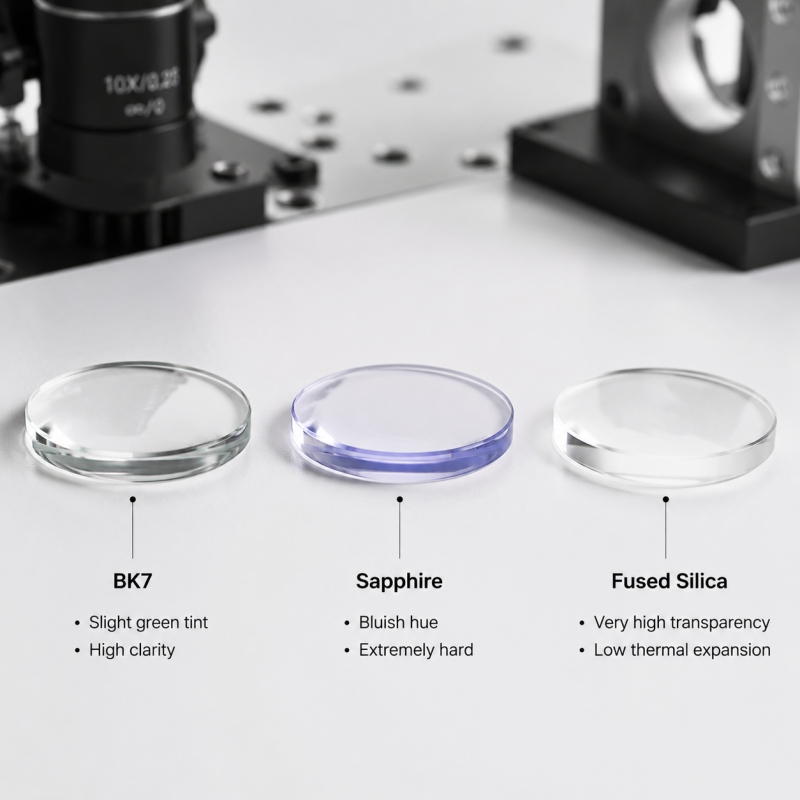
Optical materials are crucial for modern optical systems, ranging from consumer electronics to industrial and scientific instruments. Among them, Sapphire Glass and BK7 (K9 Glass) are widely used due to their unique properties. However, they serve very different purposes in optics and protective applications. Understanding their characteristics, advantages, and limitations is essential for engineers and designers when selecting materials for lenses, windows, or protective covers.

1. Material Composition
Sapphire Glass
Sapphire Glass is made from single-crystal aluminum oxide (Al₂O₃), grown through methods like the Kyropoulos or Czochralski process. Its crystalline structure gives it exceptional hardness, chemical stability, and thermal resistance.
BK7 (K9 Glass)
BK7, also known as K9 Glass, is a borosilicate crown glass. It contains silica (SiO₂) as the primary component, with added potassium oxide (K₂O) and lead oxide (PbO) to improve optical clarity and machinability. BK7 is an amorphous material, meaning it lacks a crystalline structure.
Summary: Sapphire Glass is crystalline, while BK7 (K9 Glass) is amorphous.
2. Hardness and Scratch Resistance
Sapphire Glass
- Mohs hardness: ~9 (second only to diamond)
- Extremely scratch-resistant, suitable for smartphone screens, watch crystals, and laser windows.
- Limitation: Brittle, prone to cracking under strong impacts.
BK7 (K9 Glass)
- Mohs hardness: ~5.5–6.0
- Less resistant to scratches; regular handling can cause minor surface damage.
- Advantage: Softer and slightly more impact-tolerant than Sapphire Glass.
Summary: Sapphire Glass excels in scratch resistance; BK7 is easier to handle but more prone to surface wear.
3. Optical Properties
Property | Sapphire Glass | BK7 (K9 Glass) |
Transparency | 200–5500 nm (UV to near-IR) | 350–2200 nm (visible to near-IR) |
Refractive Index | ~1.76 | ~1.517 |
Abbe Number | ~72 (low dispersion for some orientations) | ~64 |
Birefringence | Can be low if properly oriented | Negligible |
Surface Polishing | Difficult, requires diamond tools | Easy, can be polished with conventional optical abrasives |
Explanation:
Sapphire Glass offers wider wavelength transmission and a higher refractive index, suitable for laser windows and scientific optics.
BK7 Glass is ideal for precision lenses and prisms due to ease of shaping and low internal stress.
4. Mechanical and Thermal Properties
Sapphire Glass
- High melting point (~2030°C)
- Excellent thermal stability and chemical resistance
- Very hard but brittle; prone to catastrophic fracture under point loads
BK7 (K9 Glass)
- Lower melting point (~1200°C)
- Moderate thermal resistance
- Softer, less brittle, easier to machine into complex shapes
Summary: Sapphire Glass can withstand extreme conditions but is harder to process; BK7 is more forgiving during manufacturing.
5. Manufacturing and Cost
Sapphire Glass
- Expensive due to complex crystal growth and machining processes
- Shaping requires CNC diamond grinding, laser cutting, or polishing
- Suitable for high-value applications where durability is critical
BK7 (K9 Glass)
- Low cost and widely available
- Easy to mold, cut, and polish into lenses, prisms, and optical components
- Suitable for mass production and laboratory optics
Summary: Sapphire Glass is premium and high-cost; BK7 is economical and versatile.
6. Applications
Material | Typical Applications |
Sapphire Glass | Watch crystals, smartphone screens, laser windows, scientific instruments, scratch-resistant protective covers |
BK7 (K9 Glass) | Camera lenses, prisms, optical teaching equipment, laboratory optics, decorative optical elements |
Observation: Sapphire Glass is chosen for durability and scratch resistance; BK7 is chosen for precision optics and cost-effectiveness.
7. Advantages and Limitations
Sapphire Glass Advantages:
- Extremely hard and scratch-resistant
- Excellent thermal and chemical stability
- Wide wavelength transparency
Sapphire Glass Limitations:
- Expensive
- Difficult to shape and polish
- Brittle under high impact
BK7 (K9 Glass) Advantages:
- High optical clarity
- Low dispersion suitable for lens design
- Easy and low-cost machining
BK7 (K9 Glass) Limitations:
- Scratches easily
- Lower thermal and chemical resistance
- Not suitable for extreme environments
8. Conclusion
Sapphire Glass and BK7 (K9 Glass) are both essential optical materials, but they cater to different requirements:
- Sapphire Glass is ideal for applications where durability, scratch resistance, and extreme environmental performance are critical.
- BK7(K9 Glass) is ideal for precision optics, lenses, prisms, and laboratory instruments, where optical clarity and ease of shaping are more important than hardness.
Selecting between Sapphire Glass and BK7 (K9 Glass) requires careful consideration of durability, optical properties, production costs, and the demands of the target application.
In our optical component production, the glass materials we use are sourced from high-quality suppliers such as SCHOTT and Corning, ensuring consistent optical performance, low dispersion, and high thermal stability.