Spherical Aberration is one of the most common optical aberrations. It occurs when light rays pass through a lens or reflect off a spherical mirror, where rays striking different radial zones fail to converge at a single, precise focal point. This phenomenon typically causes image blurring or prevents the focal spot from concentrating efficiently, thereby degrading overall image quality.
The root cause of this issue lies in the geometric structure of the lens or mirror surface itself. Due to the physical nature of a spherical profile, marginal rays traveling near the edges of the optic follow a different propagation path than paraxial rays passing near the center, preventing them from focusing at the exact same spatial position.
In fact, spherical aberration was discovered as early as the 17th century. Scientists at the time already recognized that simple spherical lenses struggled to form completely sharp, crisp images. Although various optimization methodologies have been engineered since then, spherical components remain widely utilized today because they are relatively simple to manufacture and highly cost-effective, ensuring that spherical aberration continues to be a core factor that must be carefully managed in optical design.
How Does Spherical Aberration Occur?
The occurrence of spherical aberration is, at its root, intrinsically linked to the geometric characteristics of the spherical structure itself. Whether inside a spherical lens or across a spherical mirror, light rays striking different spatial positions follow propagation paths that are not perfectly identical, which is the absolute origin of the issue.
Under idealized design conditions, we expect all light rays to converge precisely at a single, shared focal point. However, within a real-world spherical system, incoming rays can be broadly categorized into two groups: “paraxial rays” traveling near the central optical axis, and “marginal rays” passing near the outer edges. These two groups of light rays exhibit entirely different behaviors when interacting with an optical surface.
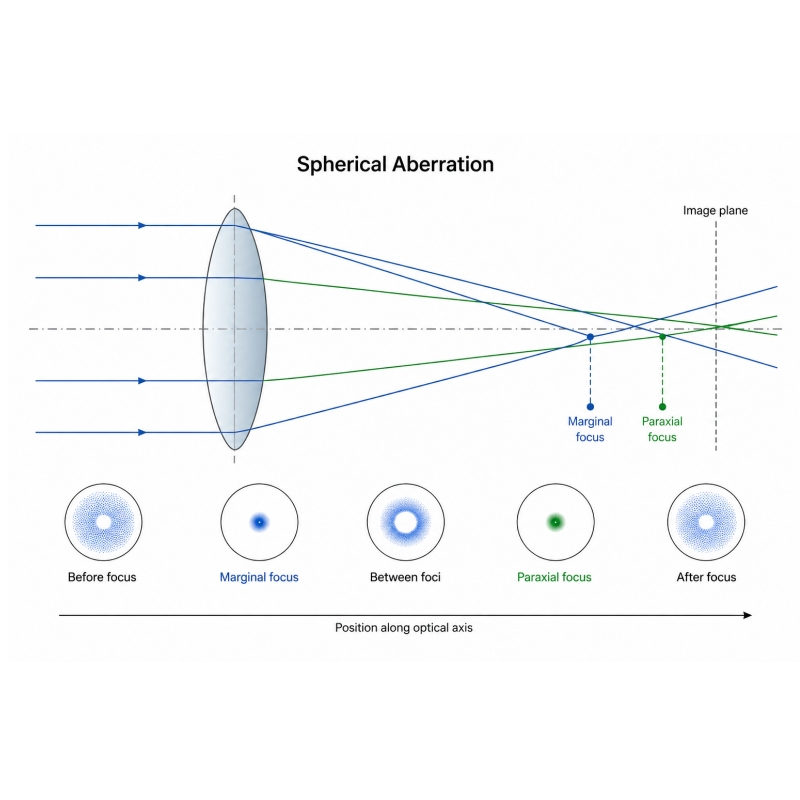
In the case of a spherical lens, light rays entering at different incident angles experience varying degrees of angular deflection during refraction. Marginal rays near the edges undergo a significantly stronger refractive bending, causing them to arrive at their focus earlier or later than the paraxial rays. This spatial mismatch in focal positioning creates a “blurred focal zone” instead of a single, infinitesimal point of crisp focus.
The phenomenon is fundamentally similar within spherical mirror systems, though the driving mechanism is surface reflection rather than material refraction. Because marginal rays encounter a steeper angle of incidence, their reflected trajectories deviate from the idealized focus, preventing them from intersecting at the exact same spatial point as the paraxial rays. This geometric discrepancy scales aggressively as the radial distance from the optical axis increases, ultimately forcing the light to form a blurry halo rather than a focused spot.
This is precisely why spherical aberration becomes far more pronounced in large-aperture systems or hyper-precision applications: the more marginal rays the system utilizes, the greater the overall wavefront deviation becomes.
What Are the Effects of Spherical Aberration?
The presence of spherical aberration prevents light rays from converging precisely into a single point. This “inability to achieve perfect focus” triggers a cascade of compounding performance issues across different types of optical systems.
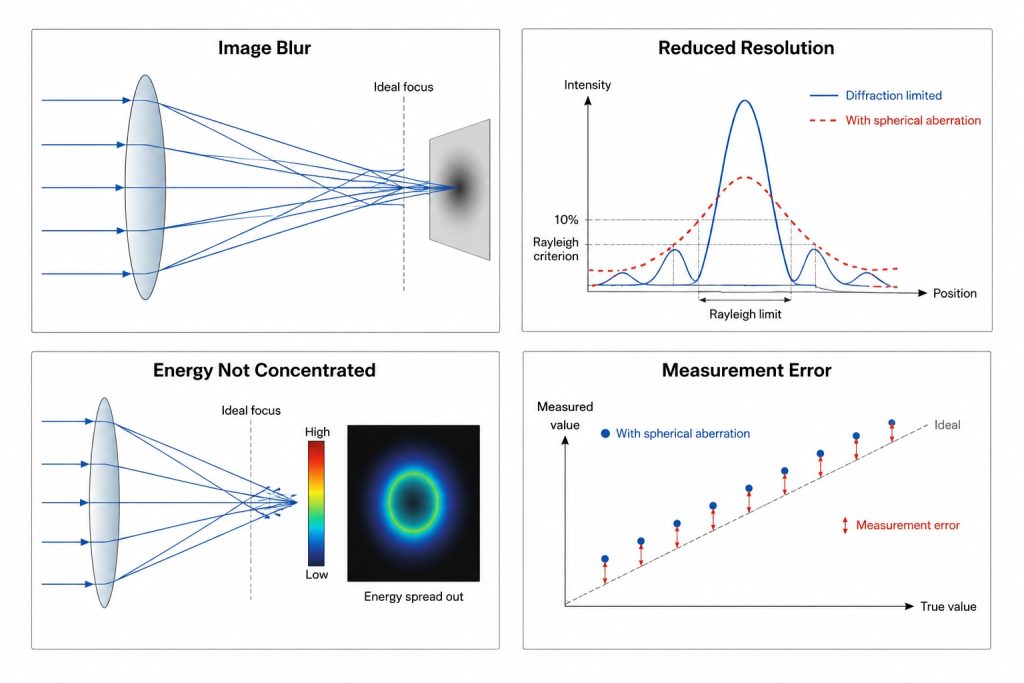
- Image Blurring: Because the light rays spread across a spatial zone rather than concentrating into a sharp focal spot, fine details become smeared and structural edges lose their crispness. This is precisely why images appear hazy, soft, and lack sharpness in lower-quality optical systems.
- Loss of Resolution: When light rays originating from multiple closely spaced micro-structures overlap with one another, the optical system loses its ability to distinguish separate fine details. This is especially critical for instruments like microscopes, telescopes, or cameras, as it directly compromises their observation and recognition capabilities.
- Inability to Efficiently Concentrate Energy: Energy that should theoretically be focused into a highly concentrated, microscopic spot becomes spatially dispersed. This not only dramatically lowers the peak energy density but also severely impairs processing precision or signal detection efficiency, thereby undermining overall system performance.
- Measurement Errors: When the position of the focal spot or the resulting image shifts away from the nominal baseline, it introduces corresponding deviations into the measurement data. This is a critical issue that cannot be overlooked in high-precision metrology and inspection applications.
Ultimately, all of these adverse effects stem from a single root cause: light rays fail to converge at a shared point and instead form a blurred zone of dispersion. Understanding this mechanism allows engineering teams to implement more targeted optimization strategies to mitigate the impact of spherical aberration in real-world applications.
How to Mitigate or Correct Spherical Aberration?
The root issue of spherical aberration is that light rays passing through different radial zones fail to converge at a single spatial point. Consequently, all optimization methodologies are inherently centered around one objective: forcing all light rays to focus as closely as possible onto a shared point.
Among these strategies, the most direct and thorough solution is the utilization of aspherical components. Unlike spherical profiles, an aspheric surface can be precisely contoured based on the target light paths, forcing marginal rays and paraxial rays to converge at the exact same spatial position, thereby eliminating spherical aberration at its physical source.
Beyond altering the surface geometry of a single element, structural systemic design can also be deployed for aberration compensation. A prime example is the multi-element lens assembly, where elements of varying curvatures work in tandem to progressively correct wavefront deviations as light propagates through the optical train, thus lowering total system aberration. This approach is ubiquitous in photographic lenses and complex optical systems. On a more refined level, modern optical engineering heavily leverages optical design optimization, utilizing simulation software to iteratively adjust lens shapes, thicknesses, and air spaces to achieve peak system performance under specific operational conditions.
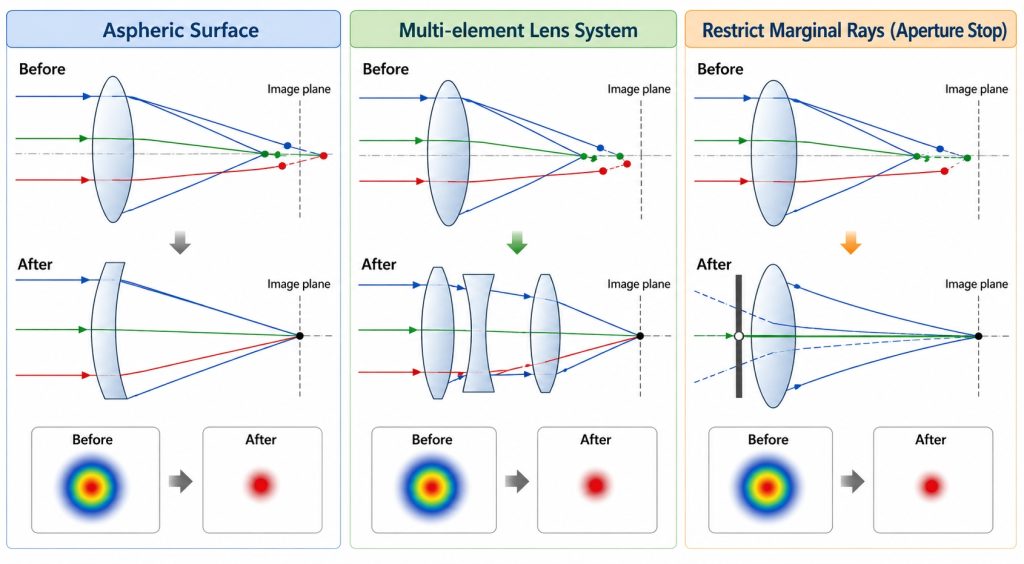
Another more straightforward approach is to restrict the participation of marginal rays. By incorporating an aperture stop or iris control, the system only allows paraxial rays traveling near the optical axis to pass through, effectively reducing the impact of spherical aberration. Although this technique reduces total optical throughput, it serves as a highly effective and cost-efficient trade-off in many application scenarios.
Despite the continuous advancement of aspheric technology, spherical components remain widely utilized throughout the industry. The reasoning is straightforward: spherical elements are significantly easier to fabricate, entail much lower production costs, and offer excellent structural stability. In numerous applications where precision requirements are not extremely stringent, a well-engineered spherical system can still deliver strong, reliable performance.
Spherical Aberration vs. Other Aberrations: What Are the Differences?
In real-world optical systems, spherical aberration is by no means the only issue that compromises image quality. To fully comprehend its specific characteristics, it is essential to contrast it with other common aberrations. Different types of aberrations exhibit distinct differences in both their root causes and visual manifestations, and these variations dictate exactly how they impact overall system performance.
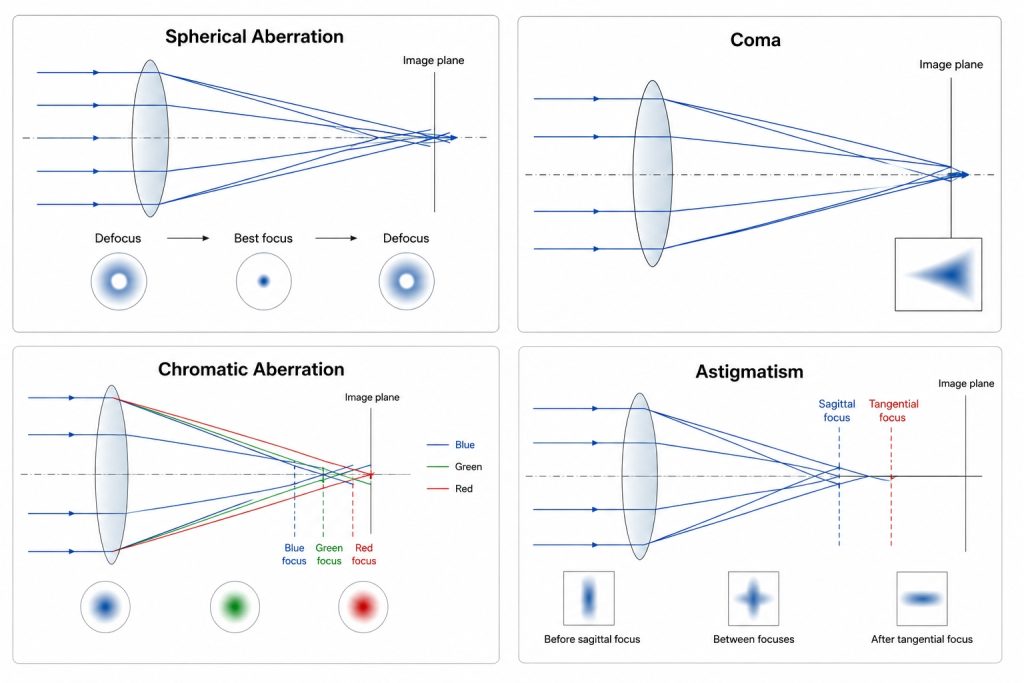
- Spherical Aberration vs. Chromatic Aberration: Spherical aberration is a classic monochromatic geometric aberration derived strictly from the spherical structure itself; it occurs even under single-wavelength monochromatic illumination. Chromatic aberration, on the other hand, is completely different, as it is driven by the material dispersion properties of the optical substrate. Because different wavelengths of light encounter different refractive indices within the same medium, they fail to focus at a shared spatial position. Consequently, spherical aberration is independent of wavelength, whereas chromatic aberration is inherently a color-dependent phenomenon.
- Spherical Aberration vs. Coma: Spherical aberration is natively present right along the central optical axis, meaning image blurring occurs even when the object is perfectly centered within the field of view. Coma, by contrast, manifests primarily as an off-axis aberration. When light rays originate from an object point that deviates from the optical axis, the resulting spot geometry warps into an asymmetric flare resembling a comet’s tail. Therefore, coma predominantly degrades image quality at the periphery of the field of view.
- Spherical Aberration vs. Astigmatism: The defining hallmark of astigmatism is the optical system’s inability to simultaneously focus light rays propagating through different cross-sectional planes. For instance, the system forms separate tangential and sagittal focal lines at differing longitudinal positions, making a crisp, point-like image impossible to achieve. In contrast, spherical aberration is not a direction-dependent or plane-dependent issue; instead, it manifests as a uniform axial scattering of all rays along the direction of the optical axis, creating an elongated, continuous focal zone.
Viewed holistically, although these varied aberrations all lead to a degradation in image quality, their physical root causes are entirely distinct. Spherical aberration originates from surface geometry, chromatic aberration stems from material dispersion, coma is tied to off-axis propagation angles, and astigmatism relates to the directional properties of the incoming wavefront. Understanding these fundamental differences is crucial for isolating and diagnosing separate aberration types and their systemic impacts.
Conclusion
Spherical aberration occurs because spherical surfaces cannot bring all incident light rays to a single focal point. This phenomenon has been recognized for centuries and continues to influence both classical and modern optical systems. Although aspherical lenses and advanced correction techniques can mitigate their effects, spherical lenses remain widely used due to their simplicity, cost-effectiveness, and ease of manufacturing.
A clear understanding of how spherical aberration forms, the problems it causes, and the methods available to correct it is essential for designing precise, high-performance optical instruments.