In everyday life and high-tech fields, optical lenses are ubiquitous. From smartphone cameras and microscopes to laser processing equipment and aerospace imaging systems, lenses determine the clarity, optical efficiency, and system volume of imaging. Yet, different types of lenses differ significantly in performance and applications.
Spherical lenses have a spherical surface, and their curvature remains consistent across the entire surface. It is simple in design, easy to produce, and less expensive, making it suitable for most general-purpose optical systems. However, the refraction of off-axis light is different from that at the center of the optical axis. There are inherent spherical aberrations that affect the clarity in imaging.
In contrast, the radial surface curvature of an aspherical lens can be optimized to suit the requirements of an individual optical system. An aspherical lens corrects spherical aberration effectively and demonstrates improved performance in high-resolution, large-numerical-aperture applications, reduces the number of lenses involved, reduces size and weight, and allows the realization of miniaturized yet high-performance optical systems.
By learning about the optical performance, the mathematical foundation, the manufacturing process, as well as material and environmental factors of the two, a better selection of the most suitable lens solution and an optimal balance between performance and cost can be reached.
Optical Performance
 Spherical lenses are simple due to their constant surface curvature. However, off-axis light refraction differs from the center of the optical axis, and spherical aberration occurs, leading to a shift in focus and a loss in imaging sharpness. Particularly in large-aperture or high-resolution applications, the sharpness of the edges decreases in an image.
In the case of chromatic aberration, the light rays of different wavelengths are usually refracted in spherical lenses, rendering them susceptible to multichromatic light bias. At the same time, spherical lenses may produce distortion at the edges of imagery so that the geometric nature of an image is not completely in agreement with the original object.
 Aspherical lenses effectively eliminate spherical aberration by refocusing off-axis light with a radial curvature. They demonstrate advantages in the correction of chromatic aberration and edge distortion, which allow images to maintain consistent clarity throughout the field of view.
High numerical aperture aspherical lenses reduce the number of lenses and thus diminish system weight, reduce light loss, and increase luminous flux. Aspherical lenses not only improve imaging accuracy but also optimize system design, enabling miniaturized, high-performance optical systems.
Mathematics Fundamentals and Geometry
Type | Expression | Parameter Description | Function |
Conic | z = A·x² + B·x·y + C·y² + D·x + E·y + F | A–F: coefficients adjust surface shape | Correct spherical aberration and edge focus |
Polynomial | z = C·(1+k)·(r/R)² + A·r⁴ + B·r⁶ + C·r⁸ + … | r: radial distance, C: conic constant, k: cone coefficient, A, B, C: polynomial coefficients | Optimize spherical aberration, chromatic aberration, and astigmatism |
These factors, when varied, serve to optimize lens curvature for different optical systems and enhance imaging performance.
Manufacturing Process
Aspherical Lenses
- Precision Glass Molding: The glass is heated to a malleable state, formed by a mold, and then cooled. It is a small-sized, high-volume production method.
- Precision Polishing (including magnetofluid polishing): Suitable for large-sized lens or sample production. The surface accuracy is high.
- Single-Point Diamond Turning (SPDT): Applicable to plastics, metals, and crystalline materials; lenses and molds can be directly machined.
- Polymer Molding: Aspherical surfaces are molded on spherical surfaces or achromatic lenses to realize double correction of spherical aberration and chromatic aberration.
- Plastic Injection Molding: Low cost and lightweight; normally applied for requirements of moderate optical performance, poor thermal stability, and low pressure tolerance.
Spherical Lenses
- Mechanical Polishing: Traditional mature process, suitable for glass or plastic lenses.
- Molded Mass Production: Small-diameter lenses can be produced rapidly, efficiently, and at low cost.
- Combined Correction: It is obtained by the combination of multiple spherical lenses.
Materials and Environmental Factors
Glass Material: High refractive index, low absorption, good thermal stability; for high precision imaging systems.
Plastic Materials: Light, low cost, but with poor thermal stability for low to moderate optical performance systems.
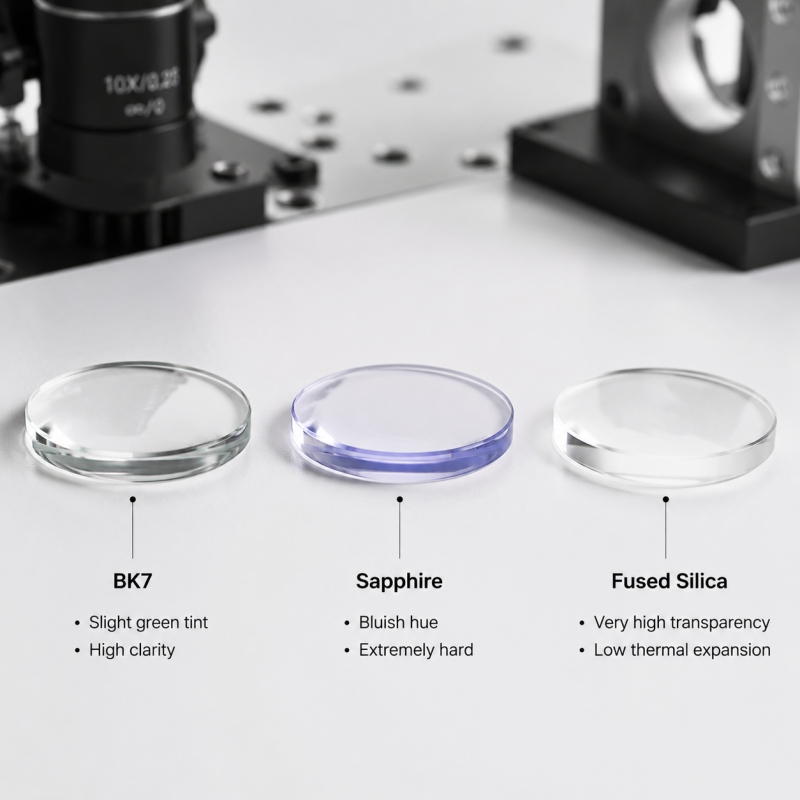
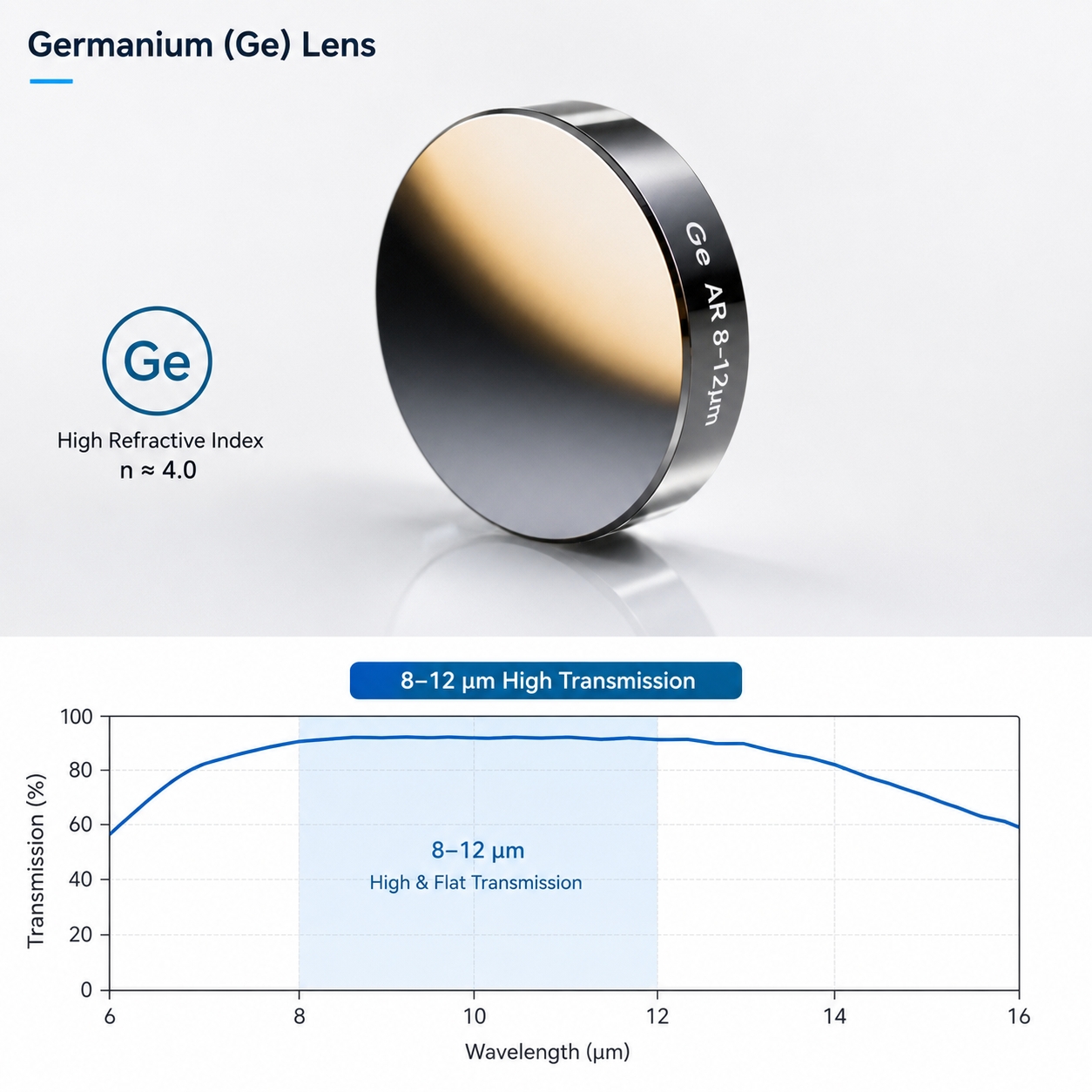
Crystals or Composites: Used in infrared, laser, or special optical systems; high performance yet very costly.
Environmental factors may affect the performance of the lenses:
- High temperatures can alter the refractive index in the material and affect the position of the focal point.
- Vibration or mechanical stress may cause lens microshift or cracking, especially for aspherical lenses requiring higher mounting accuracy.
- Light intensity and humidity can affect how long plastic lenses last, while glass and crystalline materials are more stable.
Considering material properties and environmental conditions helps select the most suitable lens that will ensure long-term system stability and imaging quality.
Comparison of Overall Benefits
Advantage Category | Aspherical Lenses | Spherical Lenses |
Aberration Correction | Accurate correction of spherical aberrations, chromatic aberrations, and distortions for improved image quality | Aberration correction can be achieved through a multi-lens combination at the cost of more optical components |
Resolution and Luminous Flux | High numerical aperture and high resolution while reducing light loss | Limited to individual lens performance; requires reducing the numerical aperture or increasing the optical elements |
System Miniaturization and Weight | Can reduce the number of lenses, and thus the system volume and weight | Systems are usually heavy and require multiple lenses to achieve the function |
Manufacturing Flexibility | Curvature can be customized to support complex optical functions | Simple and mature manufacturing for high-volume production |
Cost | Individual lenses are expensive, but the system cost may be reduced by decreasing the overall component count | Individual lenses are low-cost, appropriate for low-cost applications |
Adaptability to the Environment | High demand for installation accuracy and sensitive to vibration and thermal expansion | Flexible requirements on tolerance and installation, with good thermal stability and mechanical adaptability |
Application Scenarios | High-end imaging, aerospace, projectors, microscopes | Industrial inspection, educational equipment, and low-cost optical systems |
Evaluation Summary
When choosing a lens, consider the following:
- Performance vs. Cost: Aspherical lenses reduce the number of components and system weight, but are complex and expensive to manufacture. Spherical lenses, on the other hand, are well-established and low-cost, but may require more lens combinations to correct aberrations.
- System Impact: Reduced component count, reduced mechanical tolerances and coating requirements, improved overall reliability.
- Selection Criteria: Full range of lens options, imaging accuracy, volume, weight, environment, and throughput.
- Application Examples: High-end imaging systems (microscopes, aerospace, projectors) → aspherical lenses preferred. Spherical lenses are the first choice for industrial inspections, education, and low-cost equipment.
Conclusion
Both spherical and aspherical lenses have their respective merits. Spherical lenses can be used for general-purpose systems because of their low cost and ease of manufacturing, while aspherical lenses excel in high resolution, miniaturization, and optimization of optical efficiency. By evaluating a combination of materials, environmental factors, and manufacturing processes, the most suitable lens solution can be selected to achieve the best balance of performance and cost.