In modern optics, the Wedge Prism is a simple yet effective tool for light management. While resembling a simple transparent element with two non-parallel surfaces, it enables very accurate manipulation of light beams due to its specific geometry. It serves a range of applications, from laser alignment to advanced optical research across many fields.
What Is a Wedge Prism?
A Wedge Prism is a kind of optical prism where the two surfaces are inclined in relation to one another, taking on wedge-shaped geometry. Unlike standard dispersive prisms that separate light into their spectral components, the Wedge Prism does not primarily produce color dispersion, but rather serves to deflect or shift the path of the light beam. This property makes it extremely useful for applications that require beam steering or fine optical adjustments.

Working Principle of a Wedge Prism
When a light ray passes through a Wedge Prism, it undergoes refraction at both surfaces. Since the surfaces are not parallel, the exiting ray is deviated by a predictable angle. The degree of deviation depends on:
- The wedge angleof the prism
- The refractive indexof the material
- The incident angleof the incoming light
The wedge angle and material can be specifically designed so that the manufacturer provides prisms with highly accurate deflection. If two Wedge Prisms are combined (often called a Risley Prism pair), they offer variable beam steering simply by relative rotation.
This makes them very versatile in applications where continuous adjustment is required.
How to Use a Wedge Prism
1. Single Prism Usage
Upon rotation of a single Wedge Prism, one can slightly change the propagation direction of a light beam. This is especially useful during laser alignment work.
2. Paired Usage (Risley Prisms)
When two Wedge Prisms are mounted together, rotation of one or both allows the deflection angle to be precisely controlled. This configuration is commonly utilized in scanning systems and optical test setups.
3. Installation Tips
Wedge Prisms are often cemented into adjustable holders to provide fine rotation.
In laser systems, they must be carefully aligned to minimize optical loss and ensure proper system alignment.

Wedge Prism Optical Path Diagram
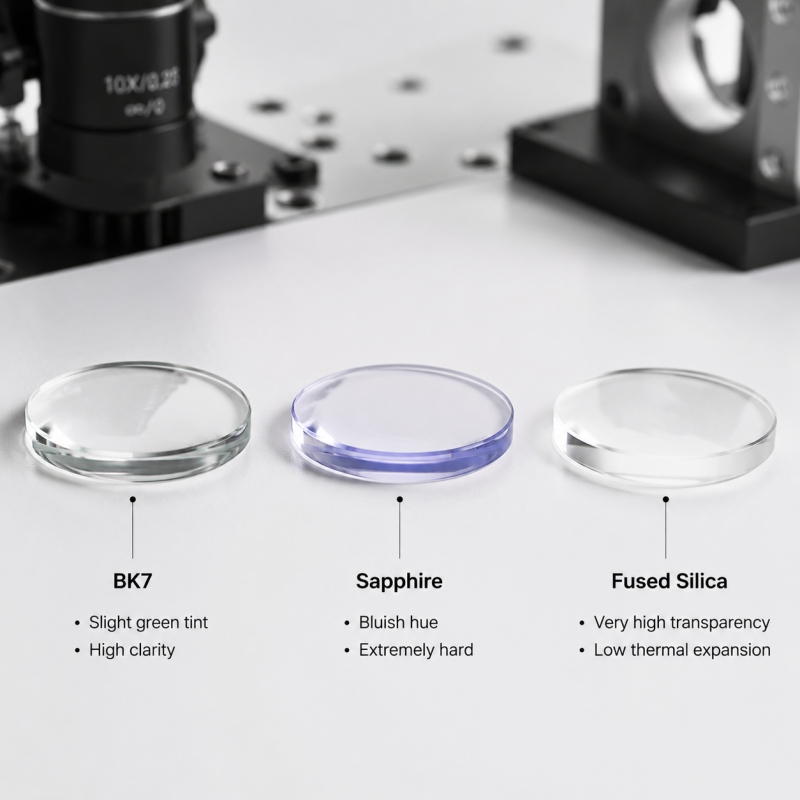
Users also need to make a choice on the material — typically BK7 or fused silica, depending on the operating wavelength. Materials with excellent thermal resistance are recommended for high-power laser applications.
Applications of Wedge Prisms
The Wedge Prism is valued both in scientific and industrial fields, with a good balance of flexibility and precision. Usual applications include:
- Beam Steering: Changing the direction of light without moving the source itself.
- Laser Alignment: Fine adjustment of laser beam directions in optical experiments or industrial systems.
- Optical Instruments: Used in microscopy, telescopes, and imaging devices for light path correction or modulation.
- Interferometry: Paired Wedge Prisms can create interference effects and help align optical paths for accurate measurements.
With their capability for varied usage, Wedge Prisms can also be found in medical imaging, communication, and defense technologies.
Advantages of Using Wedge Prisms
- High precision in beam control
- Simple geometry and cost-effective design
- Easy integration into optical setups
- Suitable for a wide range of wavelengths and materials
- Can be used alone or in pairs for more complex functionality
Advantages and Disadvantages of the Wedge Prism
Advantages
- Provides the exact deviation of light angularly
- Compact and easy to operate in optical systems
- Flexible design allows single or paired usage
- Reliable across scientific, medical, and industrial fields
Disadvantages
- Limited angular deviation when used alone
- May introduce minor aberrations if not aligned properly
- Some optical power loss due to surface reflections
- High-power lasers may require specialized materials to avoid damage
Conclusion
The Wedge Prism is a simple yet versatile optical component that has received continued applications in modern technology. Its ability to deflect beams with precision makes it of much value in laser systems, interferometers, and optical instruments across several industries.
While limitations exist, its simplicity, adaptability, and precision make the Wedge Prism a very important component in optics. Whether used for research, industrial alignment, or advanced imaging, the Wedge Prism shows that even the simplest optical designs can have a remarkable impact in science and engineering.