Written by Ava, Senior Optical Engineering Consultant at Hobbite
Last updated: July 31, 2026
Update details: This update was prepared to reflect current content requirements, informed by consultations with photonics researchers and Hobbite’s in-house expertise in optical component design, and has been reviewed and approved by Hobbite’s engineering team.
In the world of modern optics, three terms often appear repeatedly: collimation, coupling, and focusing. These concepts describe how light is managed in different stages of an optical system, from its emission to its final application. Understanding them is not only important for researchers and engineers who design advanced optical devices, but also for anyone trying to evaluate optical components or technologies.

Collimation
Collimation is the process of aligning divergent light into parallel rays, minimizing beam spread as it travels through space. This is typically achieved using optical elements such as convex lenses, mirrors, or collimating fibers, and it forms the foundation for controlling how light behaves in an optical system.
Principle and Implementation
When light propagates through free space, it naturally diverges and spreads out over distance. Collimation is the process of redirecting this divergent light into parallel rays, minimizing the beam’s spread. This is achieved using optical elements such as convex lenses, mirrors, or collimating fibers. Depending on the type of light source and the intended application, different collimation methods can be chosen to ensure stable and well-defined beams.
Functions and Uses
The primary role of collimation is to reduce beam divergence and improve transmission efficiency. It creates uniform and stable beams that can be used as the foundation for subsequent optical operations. In laser processing, collimation ensures even energy distribution across the beam. In optical communication, collimated light is easier to guide into fibers for long-distance transmission. In scientific experiments, well-collimated light is crucial for interference, imaging, and precise measurements.

Coupling
Principle and Implementation
Whenever light passes from one medium to another, part of it is reflected or lost. Coupling addresses this problem by ensuring efficient energy transfer from one optical system to another through mode matching and refractive index control. In practice, engineers use lens coupling, fiber end-face coupling, or waveguide coupling to optimize light transfer. Fine adjustments to alignment and positioning are critical for achieving high coupling efficiency.
Functions and Uses
Coupling reduces energy loss and ensures stable signal transmission. In fiber-optic communication, efficient coupling between a laser source and an optical fiber enables high-speed, long-distance data transfer. In optical sensors, the coupling of light between the source and detector directly affects detection accuracy and sensitivity. In photonic chips, the connection between external fibers and waveguides determines overall system performance.
Focusing
Principle and Implementation
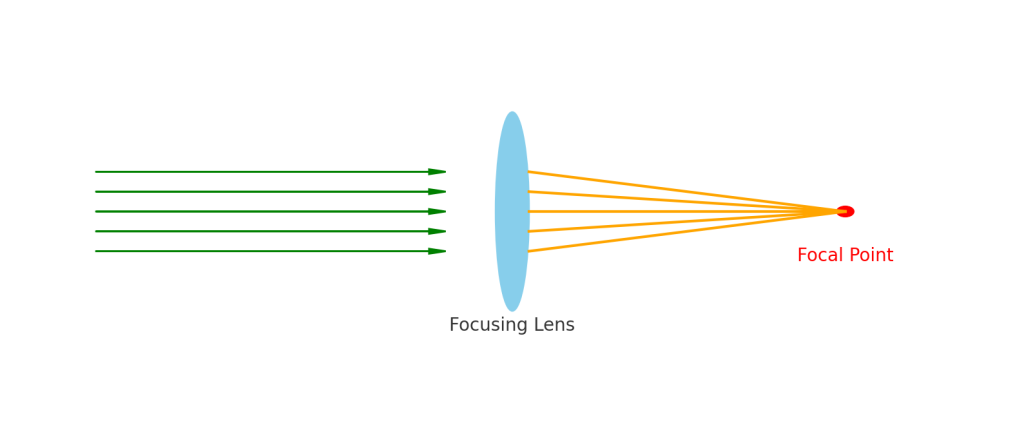
Focusing is based on the principle of bending or redirecting light rays through refraction or reflection so that they converge at a single focal point. The design of optical components, such as convex lenses, parabolic mirrors, and focusing objectives, determines where and how strongly the light converges. Factors like focal length, lens diameter, and beam diameter are carefully adjusted to create the desired focal spot.
Functions and Uses
Focusing enhances light intensity and improves resolution, allowing optical systems to perform with higher precision. In microscopes and cameras, focusing ensures sharp, clear images. In laser cutting and engraving, focusing concentrates light energy into a tiny spot, enabling accurate and efficient material processing. In medical devices, focused beams are applied in laser surgery and diagnostic imaging, where accuracy and safety are equally important.
The Relationship Between Collimation Coupling and Focusing
The three processes are closely connected and often occur sequentially in a single optical system:
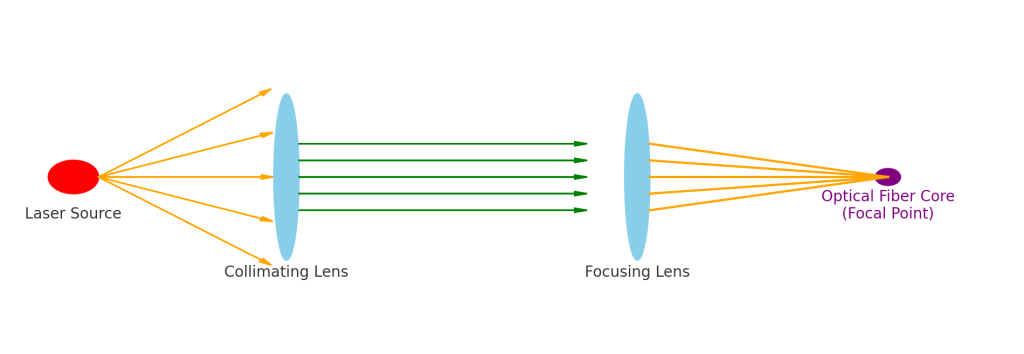
- Collimation: Divergent light from a source is first aligned into parallel rays.
- Coupling: The collimated light is then transferred efficiently into a fiber, waveguide, or another system.
- Focusing: Finally, the transmitted light is concentrated at the target point for imaging, processing, or detection.
Together, these steps form the backbone of how light is controlled and utilized across modern optical technologies.
Development
Historically, collimation and focusing were achieved with simple convex lenses and mirrors. As manufacturing techniques advanced, freeform lenses and micro-nano optical structures were introduced, dramatically improving precision and efficiency. Coupling technologies also evolved, moving from conventional lens-based methods to integrated low-loss couplers that support today’s high-capacity optical communication systems. Looking ahead, future trends include dynamic focusing, adaptive coupling, and ultra-precise collimation powered by intelligent optical components and AI-driven design tools. These innovations are expected to push the boundaries of what is possible in scientific research, medical treatment, and industrial applications.
FAQPage
1. What is collimation in optics?
Collimation is the process of aligning divergent light into parallel rays, minimizing beam spread as it travels through space.
2. What is optical coupling?
Optical coupling is the process of transferring light efficiently from one optical system to another, such as from a laser source into a fiber, through mode matching and alignment.
3. What does focusing mean in optics?
Focusing is the process of redirecting light rays so they converge at a single focal point, enhancing intensity and image resolution.
4. What does collimated mean in optics?
A beam of light is described as “collimated” when its rays remain parallel, and the beam diameter stays nearly constant over distance, rather than spreading out. It’s the opposite of a divergent beam. See “What is collimation in optics?” above for how this parallel state is achieved. Collimated light is essential in laser cutting, LIDAR, and long-distance optical communication, where beam stability over distance directly affects performance.
Conclusion
Collimation, coupling, and focusing represent three fundamental processes in optical engineering. Each plays a unique role—ensuring beams are parallel, enabling efficient energy transfer, and concentrating light at precise locations. Together, they form the essential workflow of modern optical systems. As technology evolves, their continued development will shape the next generation of high-performance applications in communication, healthcare, and beyond.