Picking the right material is a big deal when designing high-performance optical systems. Optical lens glass and crystal materials are both widely used, but they serve very different purposes. Knowing their differences helps engineers, researchers, and designers make smarter choices for cameras, microscopes, lasers, or other optical devices. Let’s take a closer look at what sets them apart and where they’re heading in the future.
What Makes Optical Lens Glass Stand Out?
You might think of optical lens glass as just another type of glass, but it’s carefully engineered to manage light precisely. It’s produced through controlled melting, molding, and polishing, resulting in lenses that have consistent clarity and refractive properties.
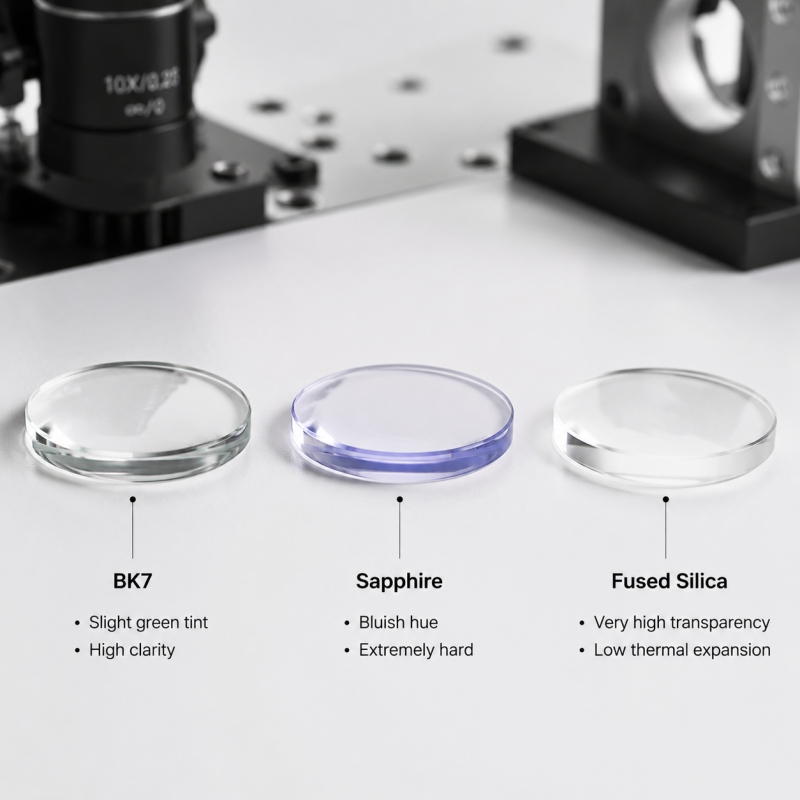
Common types like BK7, Fused Silica, and optical crown or flint glass are appreciated for:
- Consistent optical clarity across the visible spectrum
- Cost-effectiveness for larger-scale production
- Flexibility across imaging, measurement, and consumer applications
Thanks to these properties, optical lens glass remains a reliable choice for many optical components, balancing performance with affordability.

What Makes Crystals Different?
Crystals such as sapphire (Al2O3), calcium fluoride (CaF2), and lithium niobate (LiNbO3) have highly ordered atomic structures that give them unique optical and mechanical properties.
- They are incredibly hard and scratch-resistant.
- They offer thermal stability and low absorption in specific wavelength ranges.
- Some crystals exhibit specialized behaviors, like birefringence or UV/IR transmission.
Crystals are typically reserved for applications requiring extreme precision or durability, like high-power lasers, aerospace optics, and demanding scientific instruments.
How Glass and Crystals Really Compare
Optical Performance
- Optical lens glass provides smooth, uniform transmission and predictable refractive indices—ideal for most imaging systems.
- Crystals offer specialized properties for high-power or wavelength-specific applications.
Durability and Handling
- Glass is easier to shape and polish, but is softer and more prone to scratches.
- Crystals are extremely durable, but processing them requires specialized equipment.
Production and Cost
- Glass can be produced in bulk with consistent quality.
- Crystals require careful growth and precise cutting, which increases cost.
Best Use Cases
- Glass: cameras, microscopes, telescopes, general imaging
- Crystals: lasers, aerospace, defense, high-precision scientific instruments
Ever wonder why most consumer devices stick with glass while crystals are reserved for specialized tools? It all comes down to the balance between cost, manufacturability, and performance requirements.
The Future of Optical Lens Glass
Smarter Glass Formulations
The next generation of optical lens glass is being designed to reduce chromatic aberration and improve light transmission across wider wavelength ranges. Innovations in low-dispersion and hybrid glass aim to enhance performance in compact devices.
Hybrid Optical Systems
We’re seeing more systems that combine glass and crystal components. Glass handles the standard imaging path, while crystals provide precision in specialized channels, creating versatile, high-performance optical modules.
Miniaturization and Precision Manufacturing
As devices get smaller, polishing, molding, and coating techniques allow optical lens glass to maintain high accuracy even at micro scales. This supports wearable devices, AR/VR optics, and portable scientific instruments.
Sustainable and Cost-Effective Production
New manufacturing methods aim to reduce material waste and energy use. Optical lens glass production is evolving to be more sustainable while keeping costs reasonable for mass production.
Conclusion
The choice between optical lens glass and crystal materials isn’t about which is better—it’s about matching the material to the application. Glass dominates imaging and general-purpose lenses, while crystals shine in extreme or high-precision roles.
At Hobbite, we specialize in custom optical solutions, including high-quality optical lens glass components and advanced crystal optics. With cutting-edge manufacturing and rigorous quality control, we help engineers and designers develop optical systems ready for tomorrow’s technology.