In laser-based optical systems, generating a consistent and well-defined laser line is a fundamental requirement across many technical fields, from industrial metrology to medical diagnostics. However, many conventional lens types—particularly cylindrical lenses—fail to deliver a uniformly illuminated line when used with Gaussian laser beams. This limitation often results in central brightness and dim edges, compromising the precision of imaging, alignment, and detection systems.
The Powell lens was originally designed to solve this major problem.. By reshaping the beam’s energy distribution, it creates a laser line with constant intensity, free from the irregularities caused by Gaussian profiles. This article explores what a Powell lens is, how it works, and why it is essential in systems that demand optical uniformity. We’ll also compare its performance with other beam-shaping methods to fully understand its technical advantages.
What Is a Powell Lens?
The Powell lens is a precision aspheric optical element that is specifically used to convert a collimated laser beam into a straight, uniformly illuminated light. Unlike cylindrical or spherical optics, which manipulate light symmetrically and often exacerbate intensity inconsistencies, the Powell lenses have an aspherical profile, where a unique geometry redistributes light evenly from the center to the edges of the projected line.
This design allows it to counteract the non-uniform intensity of laser sources—especially those exhibiting a Gaussian distribution—producing a flat-top illumination pattern that maintains its brightness across the entire length of the beam.

What Kind of Light Needs a Powell Lens?
Understanding Gaussian Beams
The vast majority of diode and solid-state lasers available on the market emit a beam with a Gaussian intensity distribution. This means that the center of the beam is significantly brighter than the edges, with intensity decreasing exponentially from the core outward. When passed through a standard cylindrical lens to form a line, the center becomes overly bright, while the ends fade out, creating an unusable brightness gradient.
Where Powell Lenses Excel
This is exactly where the Powell lens comes into play. It accepts a Gaussian beam and redistributes the central intensity laterally, creating a line with nearly flat-top uniformity. The resulting output is a sharply defined, evenly illuminated laser line suitable for high-precision environments.
Whether used with 405 nm, 532 nm, or 808 nm lasers, the Powell lens corrects the non-uniformity and ensures consistent energy delivery along the entire line—something traditional optics struggle to accomplish.
How Does a Powell Lens Work?
The optical function of a Powell lens is rooted in its aspheric curvature, which is carefully engineered to introduce specific angular deviations across the beam profile. This enables the transformation of Gaussian energy into a line of constant brightness.
1. Controlled Redistribution of Intensity
The lens captures a collimated Gaussian beam and bends rays entering at different radial positions by different amounts. Rays entering near the beam center are directed toward the ends of the output line, while edge rays remain near the center. This controlled redistribution reduces peak intensity and fills in the dimmer regions.
By contrast, a cylindrical lens merely stretches the beam in one direction without altering its internal energy profile—leading to a bright center and poorly illuminated edges.
2. Fan Angle and Output Customization
The Powell lens comes in a range of fan angles, usually from 5° to 90°, which define how wide the resulting line appears on the target surface. A larger fan angle spreads the beam over a greater distance, useful for wide-field scanning or large object inspection.
The fan angle is determined by the lens’s surface shape and focal length, which must be chosen based on system geometry and projection distance. The flexibility of the Powell lens’s fan angle customization makes it highly versatile.
3. Angular Refraction vs. Uniform Output
Unlike lenses that refract light symmetrically (such as spherical or cylindrical types), the Powell lens imparts non-linear angular deviation depending on radial input. This is crucial for correcting beam non-uniformity and achieving linear edge-to-edge brightness.
The combination of optical precision and aspheric complexity gives the Powell lens its unique ability to equalize intensity over long distances—making it invaluable in systems where accuracy is paramount.
4. Aberration Control and Thermal Stability
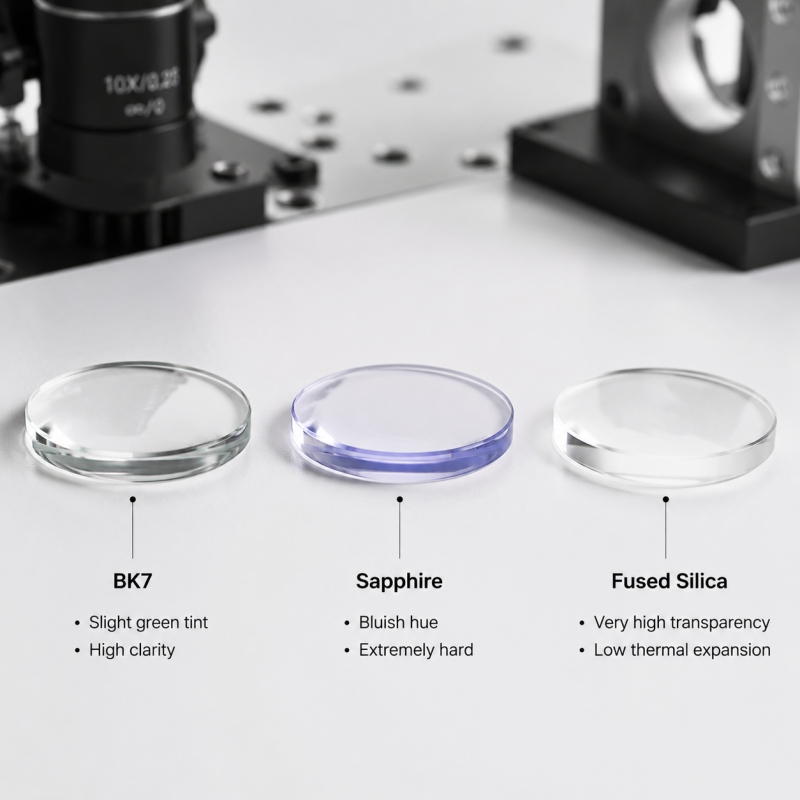
High-performance Powell lenses are often made from low-expansion materials like fused silica or BK7 glass, and are coated with anti-reflective films to minimize transmission loss. This ensures high damage thresholds, low thermal drift, and minimal spherical aberration, even under demanding environmental conditions.
Such characteristics allow the Powell lens to deliver repeatable results over time and temperature, which is particularly beneficial in field-deployed or high-speed scanning applications.
Comparison with Other Beam-Shaping Optics
To fully appreciate the capabilities of the Powell lens, it’s important to compare it with other common beam-shaping solutions:
Optical Component | Uniformity | Complexity | Ideal for Gaussian Beams? | Typical Use Case |
Poor | Low | × | Basic beam stretching | |
Spherical Lens | Very Poor | Low | × | Focusing or diverging beams |
DOE (Diffractive) | High | High | √ | Custom beam profiles are expensive |
Powell Lens | Excellent | Medium | √ | Uniform laser lines, general purpose |
As shown above, while diffractive optics can also deliver beam uniformity, they tend to be costly and highly application-specific. The Powell lens offers an effective middle ground, providing excellent performance with Gaussian beams, a moderate cost, and ease of integration.
How to Choose the Right Powell Lens
Selecting the right Powell lens involves matching the lens specifications to your system’s beam characteristics:
- Laser Wavelength: Confirm the lens material and coating match the laser’s operating wavelength (e.g., 405 nm, 532 nm, 650 nm, 808 nm, 1064 nm).
- Input Beam Diameter: Choose a lens optimized for your laser’s beam diameter (e.g., 0.8 mm, 1.0 mm, 2.0 mm).
- Fan Angle: Determine line length and working distance; wide fan angles produce longer lines at short distances.
- Material Selection: BK7 for standard conditions, fused silica for high-power or UV applications.
- Power Threshold: Ensure the lens can handle the input laser’s energy without degradation or thermal distortion.
Customization is often available for mounting constraints, special coatings, or integration into compact modules.
Conclusion
The Powell lens is an indispensable tool in modern optical systems that demand precise, evenly illuminated laser lines. By transforming a Gaussian beam into a uniformly bright projection, it addresses one of the key limitations of standard cylindrical and spherical lenses.
Its unique aspheric geometry, ability to control fan angles, and compatibility with various wavelengths make it the go-to solution for engineers and designers who need accuracy, repeatability, and beam quality. While other options like diffractive optics may offer similar performance, few match the Powell lens in terms of reliability, cost-effectiveness, and integration flexibility.
Whether you are building machine vision platforms, calibration tools, or scientific imaging systems, incorporating a Powell lens will enhance the uniformity and performance of your optical solution.