The wavelength of light not only determines the color of light but also directly affects the material selection, structural design, and coating scheme of optical components. In engineering, the choice of each wavelength is associated with optical performance, integration cost, and environmental suitability. For different application fields, optical component design must optimize the optical path structure, material absorption, and transmittance according to wavelength characteristics to ensure optical accuracy, stability, and efficiency. This article will analyze the design points of optical components at different wavelengths in detail from the five major fields of laser, optical communication, imaging, medical optics, and LiDAR.
The relationship between wavelength and optical performance
The wavelength of light is the core reference parameter for optical component design. In the design of optical components, it is necessary to select materials with high refractive index and controllable dispersion, and optimize surface polishing and coating to ensure imaging accuracy and color reproduction. Long wavelength light (such as near-infrared and far-infrared) has strong penetration and weak scattering, but the thermal effect is obvious, which puts forward higher requirements for the heat resistance, absorption loss and thermal expansion control of the material.
Optical component design in different industries uses wavelength characteristics to achieve different goals:
- Laser optics: Have Lenses, prisms, and beam splitters that need to match the laser wavelength to achieve high focusing accuracy, energy transfer efficiency, and dispersion control while avoiding thermal distortion.
- Optical communication components: Collimators, lenses, couplers, and filters need to achieve low loss and high stability in the target communication bands (such as 850 nm, 1310 nm, 1550 nm).
- Imaging Elements: Lenses, prisms, and filters affect resolution, contrast, and color reproduction in the visible or near-infrared bands.
- Medical optics: At specific wavelengths (e.g., 532 nm, 808 nm, 1064 nm), components need to ensure that penetration depth and absorption characteristics match, while coatings need to take into account biosafety and optical transmission efficiency.
- LiDAR / Radar Optics: The wavelength matching of windows, lenses, and filters determines the detection distance and signal strength, while considering high power resistance, environmental adaptability, and anti-interference capabilities.
Laser optical components
The material matches the wavelength of the coating
Wavelength | Typical Components | Design Significance | Precautions |
355 nm | UV lens, prism | High energy density, suitable for microfabrication | Materials need to be resistant to UV damage, coating is resistant to UV absorption |
532 nm | Green light lens, beam splitter | Material has good absorption, high focusing accuracy | Coating needs to take into account both transmittance and dispersion compensation |
808 / 940 nm | Infrared lens, collimator | Low thermal effect, low transmission loss | Low absorption of material, anti-thermal expansion design |
1064 nm | Nd: YAG lens, beam splitter | High power, stable metal absorption | The coating needs to withstand high power |
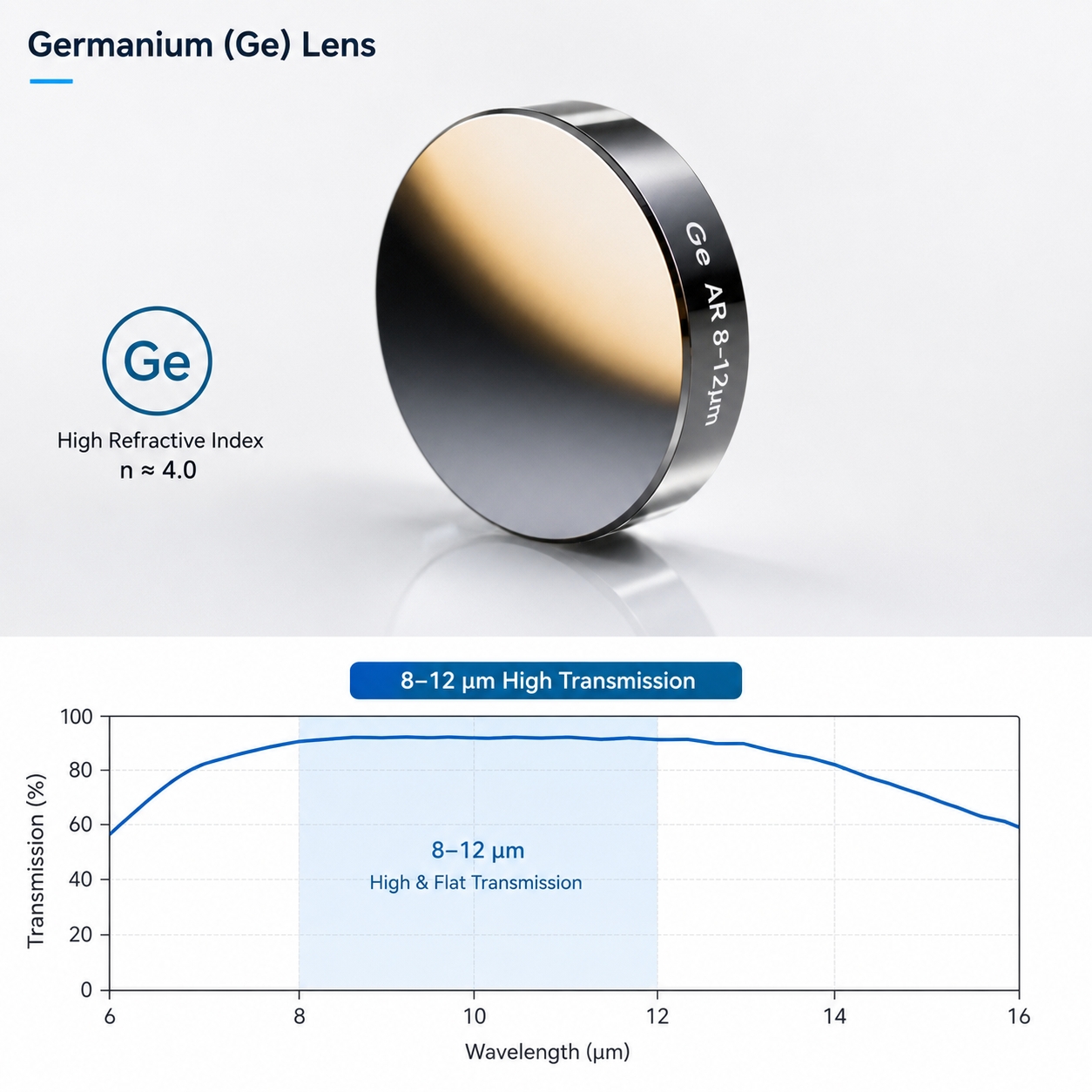
10.6 μm | CO₂ optical window and lens | Suitable for processing non-metallic materials | High temperature resistance and thermal expansion need to be controlled |

Optical communication optical components
low-loss bands and structural optimization
Wavelength | Typical Components | Technical Significance | Design Points |
850 nm | VCSEL collimating lens, multimode lens | Short-range, low-cost communication | Coating needs to optimize multimode fiber coupling |
1310 nm | Single-mode lens, coupler | Mid-range, low dispersion | Optical components need to ensure low loss and high stability |
1550 nm | DWDM filter, collimator | Low loss over long range, EDFA gain compatible | Coatings and materials need to ensure high transmittance and fiber matching |
1625 nm | System monitoring filter | Optical network monitoring prevents conflicts with service wavelengths | — |

Imaging and detection optical components
Wavelength affects resolution and contrast
Wavelength | Typical Components | Design Features | Precautions |
405 nm | Microscope lens, illumination filter | High resolution, shallow depth of field | The coating needs to resist violet light damage |
532 nm | Industrial detection lens, splitting prism | Color is natural, sensitive to the human eye | The coating needs to ensure transmittance and dispersion compensation |
650 nm | Barcode lens, marking detection lens | Good stability, low cost | Optical path design needs to be anti-glare |
850 / 940 nm | Infrared lens, fiber optic collimator | Invisible detection, low environmental interference | Coating needs to be low absorption, material temperature resistant |
1550 nm | Safety monitoring window, lens | Eye safety, high power available | Materials and coatings need to withstand high power |

Medical optical components
Tissue penetration and absorption matching
Wavelength | Typical Components | Mechanism of Action | Design Points |
193 / 248 nm | Corneal surgery lens | High-precision cutting | Material needs to be resistant to UV damage; coating resistant to high-energy |
532 nm | Skin beauty lens, filter | Hemoglobin absorption strong | The coating needs to ensure transmittance and control light dispersion |
650 nm | PDT lens | Activates photosensitizer | Material transparency and coating with low absorption |
808 / 980 nm | Laser therapy lenses | Deep penetration, heating | The coating needs to be heat-resistant and resist thermal expansion |
1064 nm | Vascular closure lens | Deep absorption, safe and stable | Material resistant to high power; coating with high transmittance |

LiDAR/radar optics:
Detection range and environmental adaptability
Wavelength | Typical Components | Technical Significance | Design Points |
905 nm | Window, lens | Short-range detection, high efficiency | Material needs to be resistant to ambient temperature changes |
1550 nm | High-power window, lens | Long-distance detection, eye-safe | Material with low absorption; coating resistant to high power |
10 μm | Infrared window, lens | Thermal imaging and remote monitoring | Material resistant to high temperature; stable coating |

Comparison table of comprehensive wavelength and optical components
Industry | Common Wavelengths | Core Reasons | Typical Optical Components | Design Focus |
Laser processing | 355 / 532 / 1064 / 10.6 μm | High material absorption efficiency | Lens, prism, beam splitter | Material matching, coating resistance to high power, and focus accuracy |
Optical Communication | 850 / 1310 / 1550 nm | Fiber low-loss zone | Collimators, lenses, filters | Optical path stabilization, coating transmittance, fiber coupling |
Imaging Inspection | 405 / 532 / 650 / 850 nm | Resolution & contrast balance | Lenses, prisms, filters | Material refractive index, coating dispersion, scattering control |
Medical Optics | 193 / 248 / 532 / 808 / 1064 nm | Tissue absorption & penetration control | Lenses, windows, filters | Material heat resistance, coating transmittance, and safety |
LiDAR / Radar | 905 / 1550 / 10 μm | Detection distance, signal strength, and environmental adaptability | Windows, lenses, filters | Materials with low absorption, coating power resistance, and environmental stability |
FAQ: Optical component wavelength selection
What are the main considerations for optical component wavelength selection?
→ Material absorption, refractive index, thermal expansion, coating transmittance, and resolution or penetration requirements of the target application.
Why is the performance of the same optical component so different at different wavelengths?
→ Because the refractive index of the material varies with wavelength, the coating design is optimized for specific wavelengths, and the optical path scattering and dispersion also change with wavelength.
Can an optical system use multiple wavelengths at the same time?
→ Yes, but wavelength separation and optical path matching are performed by splitting prisms, multi-layer coatings, or multi-lens combinations.
What are the requirements for component coating at optical communication wavelengths?
→ Coatings need to ensure low loss and high transmission in the communication band, while being resistant to high power and environmental changes.
How do LiDAR optics ensure environmental adaptability?
→ Choose low-absorption, high-power resistant materials, while coating protection and moisture-resistant environment design are key.