In the design of optical products, you often get confused about light guide rods (especially tapered light guides) and end caps. The reason for the confusion is simple: because they look similar, are similar in size, and overlap in some applications, which can lead to errors or performance deviations based on drawings alone. In this blog, we will take you to re-understand the differences between the two in terms of structural design, optical function, and applicable scenarios.
Product features
Light guide rod (including tapered light guide rod)
A light guide rod is a transparent optical component used to control the direction of light propagation and spot morphology. Straight rod rods are often used for beam transmission and collimation, while tapered or tapered rods are different, mainly used in beam divergence, shaping, or optical coupling. The light guide rod can be matched with a tapered light guide or fiber optic coupling fittings to further improve the optical path efficiency or achieve a more specific spot distribution. Typical application scenarios include: laser module beam guidance, fiber coupling, and optical path shaping of projection devices.

End cap
The end cap is a component installed on the internal end of the optics to protect and shape the element, which not only protects the end face of the optical component but also stabilizes the beam exit or improves the beam shape. Unlike light guide rods, end caps are usually not used for long-distance light guidance, but focus more on local beam shaping and mechanical protection. Therefore, end caps are usually used in various optical modules such as laser diode packaging and fiber end-face protection.

Technical comparison table
Item | Light Guide Rod | End Cap |
Primary Function | Directing, diverging, and shaping light beams | Shaping light at the exit and protecting the end |
Optical Structure Role | Controls light propagation path and adjusts beam profile | The shape of the beam at the end protects optical elements |
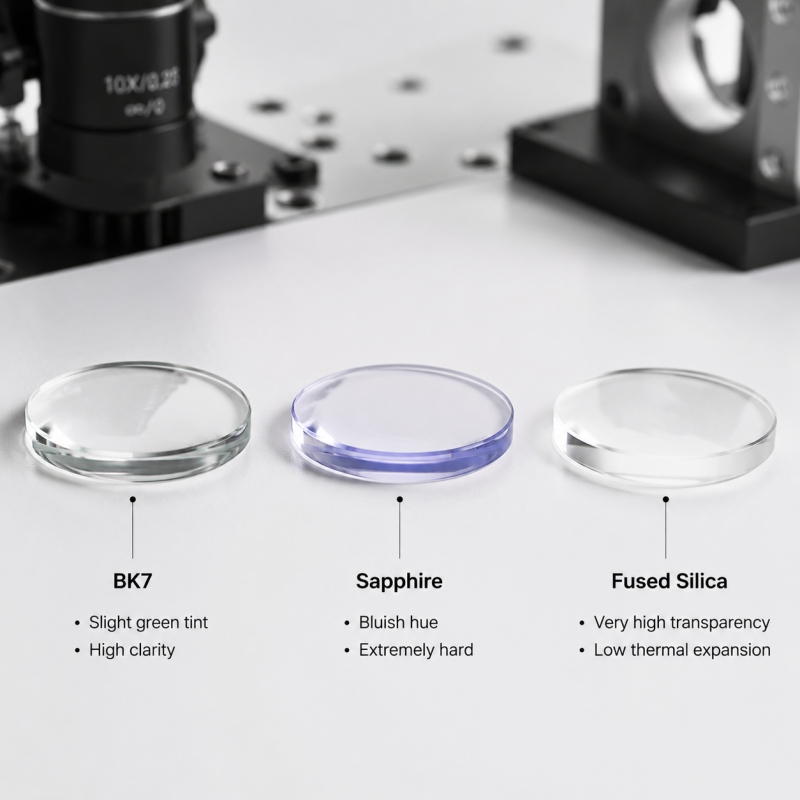
Material Options | Optical glass, quartz, sapphire, calcium fluoride | Optical glass, quartz, plastic, or hybrid materials |
Applicable Wavelength | Visible to infrared (depends on material) | Visible to infrared (depends on material) |
Installation Position | Mid-path of the optical system or before the light source exit | End of optical path, on optical element surface |
Environmental Adaptation | Heat-resistant, moisture-resistant, chemically resistant | End protection, impact-resistant, environment-resistant |
Beam Control Capability | High (can shape, diverge, or collimate) | Medium to low (minor beam adjustment at the end) |
Typical Applications | Laser modules, fiber coupling, projection devices | Laser diode packaging, fiber end protection, and optical module ends |
Accessories | Tapered light guides, fiber coupling components | Mounting fixtures, sealing components |
Technical comparison and suggestions
At the technical level, the light guide rod focuses on light transmittance, beam divergence angle, and wavefront control, while the end cap mainly focuses on beam outlet shaping and protection, and the regulation of the optical path itself is relatively limited.
In terms of environmental adaptation, the light guide rod needs to consider the characteristics of installation space, temperature resistance, moisture resistance, and chemical corrosion resistance. End caps pay more attention to end protection, mounting fastening, and application adaptability.
Although the two can complement each other in optical structure, they do not solve the same problem: the light guide rod is used for effective guidance and spot adjustment, while the end cap is used for end protection and local shaping. There are clear differences between the two, but they can also be combined to achieve better optical performance and structural protection if required.
Selection guidance
If you are in doubt about your choice, Hobbite recommends that you focus on the parameter information, coupling efficiency, and application suitability of the optical components. Secondly, it is necessary to balance cost, supply chain feasibility, and product compatibility with oneself. If you have testing needs, please contact us for a sample application.
Common misunderstandings
· Myth 1: The light guide rod and the end cap are directly interchangeable
Although the two are similar in appearance, they do not mean that they are functionally the same, and direct replacement can lead to serious consequences, such as spot distortion or reduced output power.
- Solution: The core requirements need to be clarified – beam guidance and shaping (light guide rod) or end protection and outlet shaping (end caps), and the spot quality needs to be verified in combination with optical path simulation.
· Myth 2: Only focus on the appearance size and ignore the optical parameters
Many users only look at size matching and ignore key indicators such as material refractive index, light transmittance, and beam divergence angle.
- Solution: Please select the material and size according to the wavelength band and optical requirements, and verify the light transmission efficiency and spot uniformity through simulation or testing if possible.
· Myth 3: Ignoring environmental adaptation
Note: High temperatures, humidity, or chemical environments can affect the stability and storage of optical products.
- Solution: Choose the right material and coating according to the working environment, such as sapphire or quartz at high temperature, hydrophobic coating, or corrosion-resistant material for moisture.
· Myth 4: Blindly pursue high-precision or high-cost products
Note: High-precision products are not necessarily suitable for common applications, which can increase costs and have no significant performance gains.
- Solution: According to the actual scene to match the accuracy level, ordinary optical modules can choose low accuracy, and high-precision optical experiments or laser ranging should only choose precision products.
· Myth 5: Ignore the advantages of the combination
Note: Thinking that light guide rods and end caps should only be used separately may miss the opportunity to optimize overall performance.
- Solution: The overall optical structure layout is comprehensively considered in the design, and the light guide rod is used for beam shaping and guidance, and the end cap is used for end protection and local spot adjustment.
Application
As passive optical structural components, light guide rods and end caps have the advantages of no power supply, strong environmental adaptability, and controllable manufacturing costs. Their applications have expanded from traditional laser optical paths and fiber optic coupling to emerging fields such as AR/VR optical waveguides, laser sensing, and beam shaping. With the development of new materials, precision machining, and coating technologies, light guide rods and end caps will play a wider role in higher wavelengths, more complex optical paths, and intelligent optical structures in the future.
Summary
Light guide rods and end caps may be similar in appearance, but there are obvious differences in function, technical parameters, and application scenarios. The light guide rod focuses on beam guidance, divergence, and shaping, while the end cap focuses on optical end protection and outlet shaping. Scientific selection should integrate optical, mechanical, and environmental factors to avoid blind replacement to ensure optical structure performance and equipment reliability.