In optical structure design, a prism is one of the most representative basic optical components. Whether it involves reflections, deflections, or image rotation, it is almost inseparable from its participation.
In this article, we will provide an in-depth analysis of the five most commonly used optical prisms – equilateral prisms, wedge prisms, right-angle prisms, roof prisms, and Dwayne prisms- and help you to understand why they are widely used in terms of optical principles, optical path characteristics, and design ideas.
Why are these types of prisms most commonly used?
In optical design, “commonly used” means not only stable performance, but also can meet the diverse needs of different structures for optical paths. These five prisms usually have the following commonalities:
- Clear optical characteristics: it can realize functions such as refraction, reflection, or image reversal;
- Mature structural design: easy to manufacture, install, and integrate universally;
- Stable and reliable performance: it can maintain accurate accuracy in different wavelengths and light sources;
- Perfect processing technology: Requirements such as angle control and surface accuracy can be achieved in mass production.
Equilateral prism
Principle and function
The three sides of the equilateral prism are all 60°, and the refraction and dispersion effects of light can be used to deflect light at a fixed angle and separate different wavelengths. It is commonly found in spectrometers, colorimetric testers, and spectroscopic equipment.
- Features: fixed light deflection angle, symmetrical structure; stable spectral separation results; It is sensitive to the refractive index of the material and needs to be accurately matched during design.

Structural analysis
After the incident light is refracted twice, the difference in the deflection angle of red, green, and blue light is caused by different wavelengths. Improper matching of angles or refractive indices can lead to spectral overlap or dispersion that is too wide, so the prism angle tolerance needs to be tightly controlled.
Wedge Prism
Principle and function
The wedge prism deflects light at a small angle through the angle formed by two slightly inclined planes. The optical axis can be corrected when used alone, and the double wedge combination can be scanned or angle adjusted.
- Features: The deflection angle can be controlled linearly, and the flexibility is high; It can realize dynamic optical path adjustment; Small size and easy integration into small optical modules.

Structural analysis
The deflection angle of light is directly proportional to the wedge angle and refractive index. The design needs to weigh the deflection accuracy and wavefront distortion. A common misconception is that “the larger the angle, the more obvious the deflection”, but too large a wedge angle can introduce aberrations and beam distortion. The solution is to keep the system balanced on the optical axis by using a double wedge reverse fit.
Right Angle Prism
Principle and function
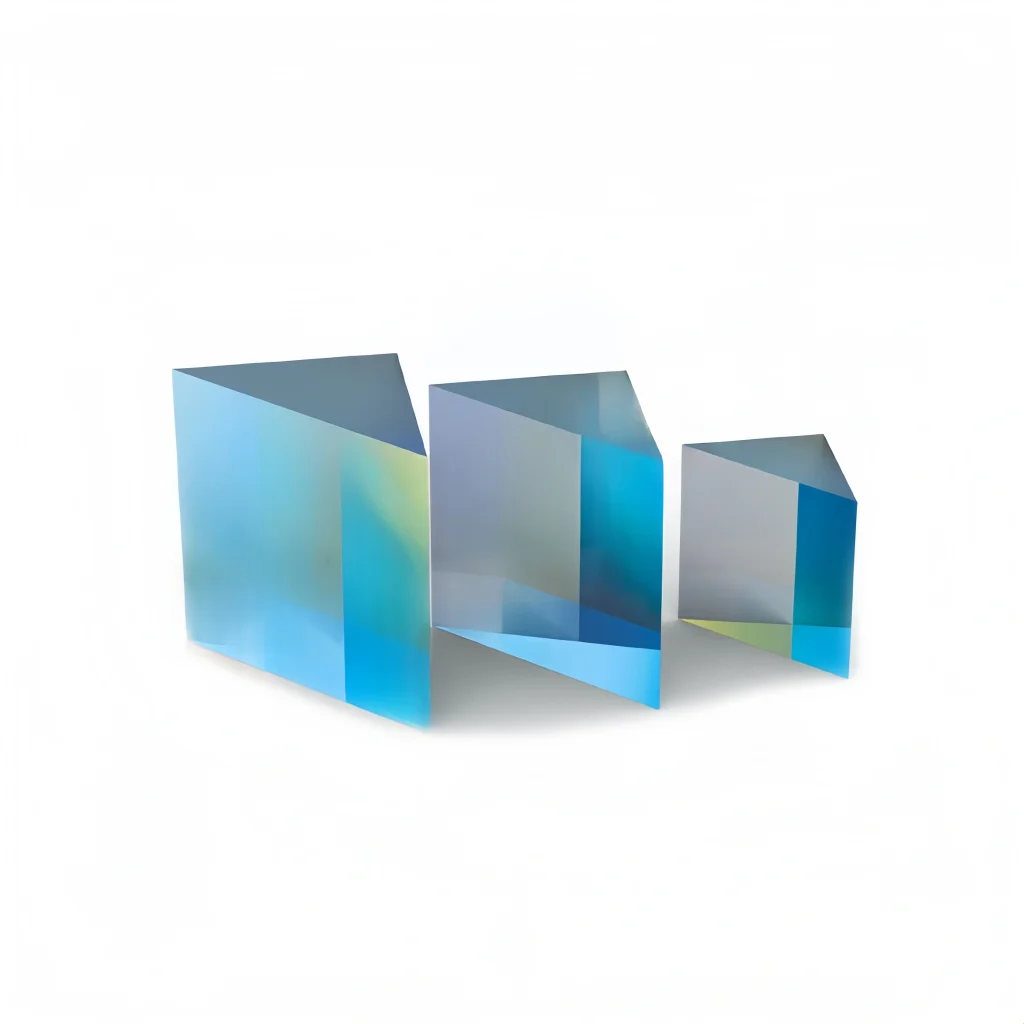
Right-angle prisms use the principle of total reflection to deflect light by 90° or fold back 180°, which is the most commonly used type of reflective prism.
- Features: accurate reflection angle, strong predictability of the optical path; It has excellent optical stability; High reflectivity can be obtained without coating under total reflection conditions.
Structural analysis
The light enters from the short side and satisfies the total reflection condition at the bevel. If the angle of incidence is close to the critical angle, the reflectivity can be enhanced by the dielectric reflective film. Due to its simple structure and easy use, right-angle prisms are widely used in rangefinders, interferometers, and image retraction modules.
Roof Prism
Principle and function
The Roof Prism is composed of two reflective surfaces perpendicular to each other, which can reflect light 180° and invert the image left and right. It is an extremely important reflective structure in telescopes, ranging systems, and imaging equipment.
- Features: Realize optical path reversal and image flipping; small structure and short optical path; It can replace multiple mirror combinations to improve the stability of the optical structure.

Structural analysis
The angle between the two sides of the roof prism is 90°, and the light returns to the direction of incidence after two total reflections, but the image is reversed horizontally. If the angle error of the reflective surface exceeds a few arcseconds, the output image will appear with double shadows. Therefore, the machining of ridge prisms focuses on controlling the “ridge angle” and surface flatness. In laser ranging and telescope systems, reflective surfaces are often coated to improve reflectivity and fouling resistance.
Dove Prism
Principle and function
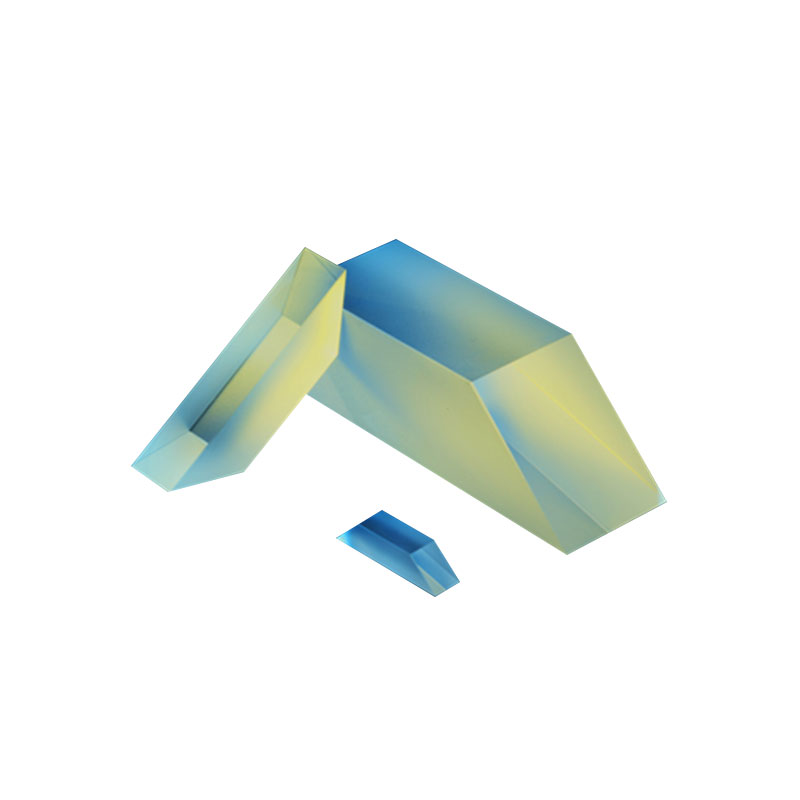
The Daway prism is a unique rotating prism. As light travels along its main axis, the image rotates twice as much along the axis while the beam direction remains the same.
- Features: It can realize image rotation or reversal; The optical path is stable and does not affect the direction of beam propagation; It is commonly used in interferometers, image stabilization systems, etc.
Structural analysis
The Dawey prism is also based on the total reflection principle. Any angle of incidence or axis of rotation deviation can cause image rotation errors. The factory design should strictly ensure that the rotation axis and the optical axis are concentric, and the ratio of prism length to spot diameter should be optimized to reduce edge reflection loss.
Technical structure analysis: comparison of five prism optical paths
Prism Type | Main Function | Optical Path Characteristics | Advantages | Disadvantages |
Equilateral Prism | Spectral separation | Fixed deflection angle | Mature design, low cost | Dispersion is difficult to control, and angular flexibility is low |
Wedge Prism | Beam deflection (fine-tuning) | Adjustable and combinable deflection angles | Flexible alignment, suitable for beam steering systems | Prone to eccentricity, high installation and adjustment precision required |
Right Angle Prism | Optical path retraction | Total internal reflection structure | Stable reflection, high accuracy, allows compact designs | Limited by internal reflection angle range |
Roof Prism | Image flipping | Double reflection structure | Short optical path, high structural stability | Sensitive to roof angle errors, high processing difficulty |
Dawey Prism | Image rotation | Parallel reflection light path | High accuracy, controllable rotation | Alignment error significantly affects optical performance |
Why are they preferred?
From the perspective of stable optical performance, these prisms can highly meet the needs of multi-industry scenarios from visible light to infrared bands, and due to the maturity of current manufacturing technology, they can ensure that both angle and surface accuracy can be controlled in batches. In terms of structural compatibility, it can be seamlessly integrated with lens groups, laser modules, etc., and most of the suppliers on the market generally have high manufacturing reliability, wide tolerance in installation, and repeated positioning accuracy in line with the requirements.
How to choose the right prism?
When choosing a prism, we first need to consider the optical structure and performance requirements:
- Optical path purpose: if used for beam deflection, choose a wedge-shaped prism; For reflective rebound, choose a right-angle or ridge prism.
- Space constraints: Small laser systems prioritize ridge or wedge structures.
- Image requirements: If the image needs to be rotated or reversed, choose Dauway or Roof Prism.
- Processing Level: High-precision imaging applications should focus on the angular tolerance and surface quality level of the process.
- Cost and performance: Equilateral and right-angle prisms are the most cost-effective in terms of price and performance.
Although the five prisms have different structures, they together form the basis for today’s optical applications. From beam correction to image inversion, from precision measurement to laser scanning, the development of prisms is an important part of today’s optical design.