Solving the Challenge of Uneven Light
One of the most common frustrations in optical design is uneven illumination. Laser beams often show hotspots, projectors may lose brightness at the edges, and imaging devices can struggle with inconsistent contrast. These issues don’t just lower performance—they can lead to wasted energy, poor results, and higher system costs.
Over the past decade, many engineers have turned to rod optics as a reliable way to solve this challenge. Compact, durable, and highly efficient, they reshape light into stable and uniform beams, making them a preferred choice in lasers, medical devices, and inspection tools.
What Are Rod Optics?
In simple terms, rod optics are cylindrical glass or crystal components designed to even out light distribution. Instead of bending rays like a standard lens, they use controlled internal reflections along the rod to spread intensity evenly across the beam.
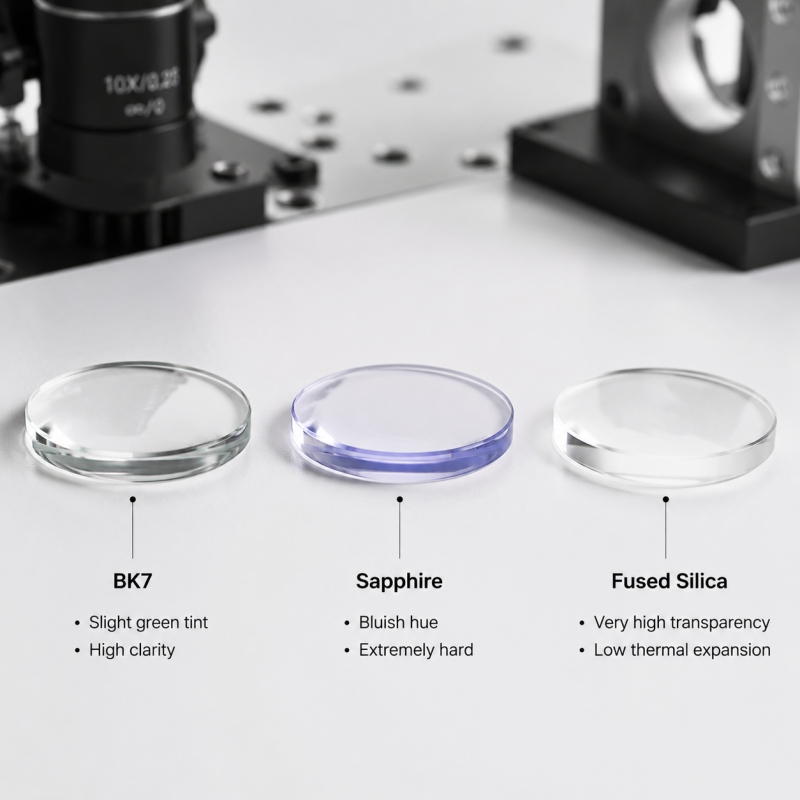
Because of their geometry, they excel in applications where stability and uniformity are critical. They are typically manufactured from optical materials such as BK7, fused silica, or sapphire, and can be tailored in length, diameter, and coatings to fit very specific requirements.

How Do Rod Optics Work?
Imagine a laser beam entering a polished cylinder. As the light bounces repeatedly inside, intensity peaks are smoothed out until the output looks uniform across its profile. This makes rod optics especially useful when you need a flat-top beam instead of a sharp Gaussian profile.
Compared with fibers or diffuser plates, rod optics offer:
- Higher thermal resistance for high-power lasers
- Lower transmission losses
- More consistent illumination across the entire field
This makes them an elegant solution for engineers looking for a balance between efficiency and performance.
Where Are Rod Optics Used?
Laser Processing
From welding to engraving, uniform beams are essential. Rod optics eliminate hotspots, extend equipment life, and improve processing precision.
Medical Devices
In endoscopes and surgical lasers, rod optics provide smooth illumination in tight spaces, helping doctors see more clearly during procedures.
Projection and Displays
They ensure even brightness across screens and sensors, creating better viewing quality for end users.
Inspection Systems
Automated quality checks rely on stable lighting. By removing intensity variations, rod optics reduce false errors and improve detection accuracy.
Scientific Research
Laboratories use them to maintain reproducible light conditions, which is essential for accurate experiments.
Selecting the Right Rod Optics
Choosing the right component depends on more than just size. Factors to consider include:
- Material – BK7 for general optics, fused silica for UV work, sapphire for maximum durability.
- Dimensions – Length and diameter matched to beam size.
- Coatings – Anti-reflective coatings to maximize transmission, or custom coatings for specialized wavelengths.
- Operating Conditions – Power levels, wavelength, and environmental stability all influence the design.
For demanding projects, custom rod optics are often the best choice, as they can be engineered precisely to meet the application’s specific requirements.
Advantages That Set Rod Optics Apart
Why do so many engineers and researchers adopt rod optics? The reasons are clear:
- Consistent illumination with minimal hotspots
- High tolerance to heat and power loads
- Strong durability and long service life
- Wide customization options for diverse applications
By directly addressing the pain points of light uniformity and energy loss, rod optics often outperform alternatives like diffusers or standard lenses.
The Future of Rod Optics
As optical systems evolve, the role of rod optics is expected to expand. High-power industrial lasers, miniaturized medical devices, and precision research instruments all demand stable illumination. At the same time, advancements in materials and coatings are opening up new possibilities for enhanced performance and durability.
For companies that rely on light control, integrating rod optics will increasingly become a standard choice rather than a specialized option.
A Practical Solution for Modern Optics
Uniform illumination may seem like a small detail, but it often determines whether an optical system performs reliably. By offering high stability, durability, and customization, rod optics solve problems that traditional optical elements cannot.
At Hobbite, we work closely with laser manufacturers, medical device developers, and research institutions to design and produce precision rod optics that meet demanding requirements. With advanced polishing, coating, and custom design capabilities, we ensure each component delivers consistent results in real-world use.
If your application requires stable light performance and long-term reliability, rod optics may be exactly the solution you’ve been searching for.